Types of RC Cars: Trucks, Buggies, Crawlers, Drifters and More
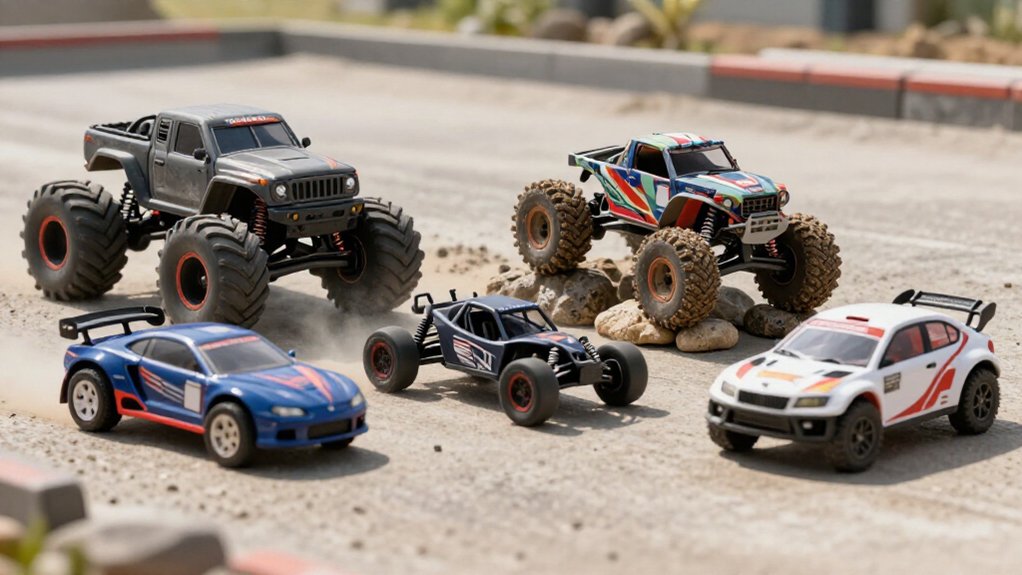
RC cars suit different terrain and driving styles. Choose a monster or stadium truck for rough ground, jumps, and agile handling; short-course trucks add body protection and tolerate contact. Buggies handle dirt tracks, while crawlers use four-wheel drive, low gearing, and flexible suspension to climb obstacles.
Drifters slide on smooth pavement; touring cars corner on asphalt or carpet. Match tires, scale, and drivetrain to your space and surface. Keep exploring, and you’ll find your fit.
Truck, Buggy, Crawler, Drifter
Which type of RC car suits your terrain? Choose by where you plan to drive and how you want the vehicle to respond.
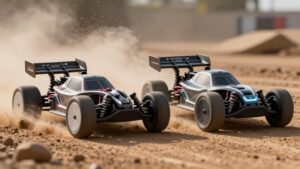
A monster truck uses large tires and high ground clearance to cross rough ground and absorb jumps. Stadium and short-course trucks suit dirt, with short-course models balancing speed and off-road control. For racing on dirt tracks, consider a buggy: its suspension handles jumps and uneven surfaces. Common 1/8- and 1/10-scale models give you racing options.
If you’re tackling rocks, logs, and obstacles at controlled speeds, choose a crawler. Low gearing, four-wheel drive, flexible suspension, and ground clearance support deliberate climbing. On smooth pavement, a drifter lets you slide through turns; rear-wheel drive, specialized steering, and popular 1/10-scale formats suit this style.
Tire Tread and Compound Choices
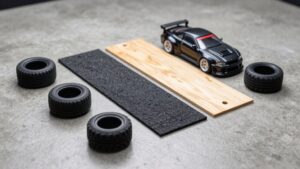
Choose tires by matching their tread and compound to the surface: deep, knobby treads grip dirt, grass, and gravel, while slick or low-tread tires suit smooth asphalt and carpet. For touring cars and on-road racers, a broad contact patch supports grip on smooth surfaces. Hard compounds reduce traction, helping you control slides with drift cars.
| Surface | Tread choice | Best fit |
|---|---|---|
| Dirt, grass, gravel | Deep knobby | Off-road cars |
| Asphalt, carpet | Slick, low tread | Touring cars |
| Smooth drift | Hard compound | Controlled slides |
| Rocks, obstacles | Grippy crawler tread | Uneven terrain |
For crawlers, choose obstacle-matching tread and rely on flexible suspension and ground clearance to keep tires planted on uneven terrain. Small models may struggle on grass or gravel; larger off-road vehicles handle these surfaces when tires match.
Short-Course vs. Stadium Trucks
When you compare short-course and stadium trucks, you’ll see enclosed, reinforced bodies and wheel arches on SCTs, versus stadium trucks’ open bodies, taller stance, wide suspension arms, and large tires. Both handle dirt and loose surfaces, but SCTs balance speed and control for track-style driving, while stadium trucks suit tricks and light off-road racing. Choose based on the track and terrain you’ll run; both offer more agility and track focus than traditional monster trucks.
Short-Course Truck Design
Short-course trucks (SCTs) pair enclosed wheel arches and wide bodies modeled on full-size racing trucks with reinforced chassis built to handle collisions. That shell shields the wheels and helps keep debris away from suspension components while giving you a scale-inspired profile. The broad body also makes the truck easy to identify on a crowded track.
Underneath the body, a reinforced chassis absorbs impacts from contact with barriers and other vehicles. This durable construction suits racing where close passes and occasional collisions are part of the action. If you want a first RC vehicle, many ready-to-run SCT models offer an accessible way to start, without requiring you to assemble the truck from individual components. Their balance lets you tackle dirt and loose surfaces confidently and routinely.
Stadium Truck Design
Stadium trucks sit higher than short-course trucks, with wide suspension arms and large tires that help them stay agile on dirt and loose surfaces.
Their geometry favors direction changes and control over rough ground. If you drive on dirt or enter light off-road races, this setup gives you a platform that can carry speed without feeling as bulky as a monster truck. Short-course trucks take a different approach: they balance handling with durability and tolerate collisions across mixed terrain.
Both designs combine off-road capability with speed, but you’ll notice the stadium truck prioritizes agility, while the short-course truck is built to stay composed through conditions and contact. Choose according to your track: loose dirt favors stadium agility; mixed surfaces and impacts favor short-course toughness.
Body and Wheel Differences
A short-course truck’s enclosed wheel arches and broad, full-size-inspired body contrast with a stadium truck’s open design and exposed wheels. Those shapes reflect priorities in scale and protection. You’ll see short-course shells modeled on full-size racing trucks, with coverage that shields the wheels and reinforces a collision-ready package.
Their bodies pair with reinforced chassis built for close racing and contact. Stadium trucks instead leave the wheels visible, making their suspension arms and large tires part of the silhouette. Their taller stance and wide arms accommodate dirt and loose surfaces, while the open layout keeps the vehicle’s components distinct.
Both designs deliver off-road capability, speed, and agility, but the stadium truck’s exposed hardware gives it a track-oriented appearance. Choose by the proportions and protection you prefer.
Handling and Driving Style
Although both handle uneven terrain, short-course and stadium trucks reward different driving styles. A short-course truck’s enclosed wheel arches and wide, full-size-racing-inspired body help it stay composed when you encounter bumps or contact. You get a stable balance of speed, control, and off-road capability, making it forgiving when your line gets crowded. Its design suits robust mixed-terrain driving and impacts.
A stadium truck’s open body, taller stance, wide suspension arms, and large tires let its suspension work through greater travel. You’ll notice quicker responses and a more nimble, track-oriented feel on dirt or loose surfaces. That agility also supports light off-road racing and tricks, but it’s less focused on absorbing collisions. Choose short-course for contact-tolerant versatility; choose stadium when you prefer precise, lively driving.
Best Track and Terrain
Which truck suits your track depends on how you want to drive it. Short-course trucks have enclosed wheel arches and wide bodies modeled after full-size racing trucks. Their shape helps contain spray and debris on dirt tracks and mixed off-road terrain. Reinforced chassis and collision-tolerant construction also handle close racing, where contact can occur frequently. That durability supports beginner-friendly RTR use without making rough courses their only setting.
Stadium trucks use an open layout, taller stance, wide suspension arms, and large tires suited to dirt and loose surfaces. Their suspension travel and agility support handling on light off-road courses, including jumps and tricks. Both types manage uneven terrain, but short-course trucks favor durable, track-style racing, while stadium trucks suit nimble driving across loose ground.
Choosing Your Truck
Choose between short-course and stadium trucks by matching their handling and durability to your driving conditions. SCTs use enclosed wheel arches and wide bodies modeled on short-course racers, while reinforced chassis help them withstand collisions. Their protected bodywork suits mixed-terrain driving and bump-prone racing.
Stadium trucks have open designs, taller stances, wide suspension arms, and large tires. This layout gives you nimble handling on dirt and loose surfaces, making these trucks responsive for tricks or light off-road racing. Both types deliver speed and off-road capability, but stadium models prioritize agility, while short-course models prioritize collision resistance.
Before buying, check scale, drivetrain, and replacement-part availability as well as body style. These factors determine whether the truck fits your terrain and how you’ll maintain it.
Small-Yard Model Picks
Small-Yard Model Picks
For a small yard, you’ll find 1/18- and 1/24-scale electric models easier to maneuver in tight spaces. Choose a slow, torque-focused crawler like the Axial SCX24 for rocks and roots, or a nimble buggy for dirt and small jumps; grass and gravel can challenge mini crawlers’ small tires. Before buying, check dimensions, battery and charger requirements, and parts availability.
Compact Scale Options
When yard space is limited, 1/18- and 1/24-scale RC cars are easier to maneuver, while 1/28 models suit especially tight areas. You can carry compact models easily, but scale doesn’t guarantee traction.
The 1/24-scale Axial SCX24 Ford Bronco uses 4WD and a brushed motor; its listed price is $149.99. The 1/18-scale Losi Mini LMT Zombie and Megalodon are 4WD brushed monster trucks, each priced at $249.99 with a battery and charger included. The 1/16-scale ARRMA MOJAVE GROM offers a compact option, with 4WD, a brushed motor, and a top speed above 20 mph.
Match tire size and ground clearance to your yard’s surface: very small rigs may struggle on grass or gravel. If those surfaces dominate, consider a larger scale with more clearance.
Tight-Turning Models
In a small yard, 1/18- and 1/24-scale RC cars are easier to maneuver through tight spaces than larger models. Their compact bodies need less room to turn, so you can navigate narrow paths and turn near fences or garden beds.
Choose a mini crawler such as the 1/24-scale Axial SCX24 when your yard includes obstacles indoors or outdoors. Its four-wheel drive helps maintain traction. For tighter, technical routes, the 1/18-scale Hobby Plus CR18P EVO 2 adds four-wheel drive, portal axles, and articulated suspension.
If you’ll run on smooth, confined pavement, consider an on-road model such as the 1/28-scale Kyosho MINI-Z. Its low-clearance chassis suits smooth surfaces, and its small footprint makes turning around easier. Match your model’s clearance and layout to the yard’s surface.
Low-Speed Crawlers
Low-speed crawlers suit small yards because 1/18- and 1/24-scale models maneuver more easily through tight spaces than larger rigs. At 1/24 scale, the Axial SCX24 Toyota 4Runner gives you four-wheel drive and a brushed motor for $159.99; its battery and charger come in the box. The SCX24 Ford Bronco offers the same scale, drivetrain and motor type for $149.99, also with battery and charger included.
For a larger mini option, consider the 1/18-scale Hobby Plus CR18P EVO 2 Convoy. Its portal axles improve clearance, while a two-speed transmission and articulated suspension help you adapt to changing terrain. When choosing any small crawler, prioritize 4WD, low gearing and articulated suspension. Those features help you maintain traction and guide the chassis over roots, stones and other yard obstacles without needing a wide running area. Check dimensions against your paths and turning space before you buy.
Quiet Electric Picks
For quiet small-yard runs, choose a 1/18- or 1/24-scale electric model; a 1/10-scale car may need more room. A compact brushed model keeps operating costs manageable and suits casual driving in confined space. If your yard has uneven ground or scattered obstacles, choose a mini crawler such as the Axial SCX24 Toyota 4Runner. Its 1/24-scale chassis and four-wheel drive help it negotiate tight routes and small backyard features.
For quicker laps, consider the 1/16-scale ARRMA MOJAVE GROM. This four-wheel-drive brushed truck is rated for speeds above 20 mph, so reserve enough clearance to turn and accelerate safely. Match its footprint and handling to your surface: crawlers favor obstacles and uneven terrain, while small trucks or buggies need more room to maneuver. Check limits first.
Turning Radius and Steering Feel
Turning radius and steering feel depend on a car’s scale, drivetrain, and intended terrain. If you run on grippy asphalt or carpet, a touring car’s low ride height and precise steering help you hold tight, consistent corners. A drift car uses steering kits and rear-wheel drive to start and control slides, so you need smooth, adjustable countersteering rather than optimizing lap times.
When you crawl over rocks, logs, and ledges, precise low-speed steering paired with controlled throttle lets you place each tyre. Four-wheel drive can steady steering on loose or uneven ground by improving traction; two-wheel drive weighs less but demands careful throttle input. Scale also sets turning demands: a compact 1/18-scale model fits tight spaces, while larger 1/8- and 1/5-scale vehicles need more room.
Parts Availability and Repair Costs
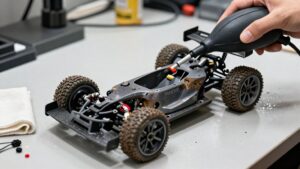
When choosing an RC car, check whether you can source parts for likely breakages, such as suspension arms, shocks, driveshafts, gears, wheels, and body components.
Hobby-grade vehicles use modular, replaceable components, so you can repair a damaged assembly instead of replacing the car. Before buying a truck, buggy, or crawler, verify that the manufacturer and retailers stock spares. Compare prices for damaged items; costs depend on durability and parts availability.
Robust bashers and monster trucks withstand impacts, yet repairs cost money. Toy-grade models often have sealed drivetrains and few upgrade options, making repairs impractical. Traxxas, Losi, Arrma, Axial, Redcat, and Team Associated support hobby-grade vehicles with parts. Check availability for your specific model, since support can vary across generations. Keeping spares on hand limits downtime.
Nitro vs. Electric Powertrains
Electric and nitro powertrains differ in how much setup, maintenance, and realism they bring to an RC car. With electric, you can drive with less preparation and upkeep, so it’s easier for beginners. Brushed motors cost less and offer performance; brushless motors deliver greater speed, power, efficiency, and acceleration. Performance electric cars often use LiPo packs, which need a compatible charger, careful handling, and proper storage.
Nitro models use combustion engines, giving you engine sound and exhaust smoke for a realistic, hands-on experience. You’ll need to refill fuel, tune the engine, and clean the car. Choose electric if you want quiet operation and low maintenance. Choose nitro if you enjoy managing an engine and value combustion realism. Involvement should guide your powertrain choice.
Top Picks for Wet Conditions
For wet dirt, grass, and gravel, a 4WD basher usually gives you better grip and control than a 2WD model. A durable chassis and robust suspension make this setup practical on puddle-prone, uneven ground, but check the manufacturer’s water-resistance rating before you drive.
- Choose a 4WD basher for faster runs across slick, mixed terrain; its driven wheels help maintain traction.
- Pick a crawler for slow, controlled progress on wet technical trails; flexible suspension and high-traction tires help it clear obstacles.
- Treat 1/18- and 1/24-scale models as portable options, not assured wet-terrain performers: compact size can hinder crossing grass and gravel.
- After each wet run, clean and thoroughly dry your RC car. Water-resistant electronics don’t make the whole vehicle submersible.
Dry bearings before storage.
Conclusion
Choose an RC car for the surfaces and space you actually have. Trucks and buggies suit speed, while crawlers handle obstacles and drifters reward precise control. Match tire tread and compound to traction needs, and consider turning radius, repair costs, and parts availability before buying.
Electric models simplify maintenance; nitro adds sound and tuning demands. For a small yard or wet conditions, prioritize manageable size and suitable tires. The right vehicle is the one you’ll enjoy driving and maintaining.
RC Car Gear Ratio & Top Speed Calculator
Work out final drive ratio, rollout, wheel rpm and theoretical no-load top speed from your motor KV, battery, gearing and tire size.
RC Truck Scale Size Converter
Convert a real truck's length, width and height to any RC scale from 1/6 to 1/24, or find the scale implied by a model's length.
Nitro Fuel Runtime & Cost Calculator
Enter your tank size, timed minutes per tank, sessions and fuel price to estimate nitro fuel used and its cost per session and per month.
Tire Swap Speed & Gearing Compensator
Enter motor KV, cells, gearing and old vs new tire diameter to see the theoretical no-load speed change and rollout from a tire swap.
Basher Motor, ESC & LiPo S-Count Matcher
Compare your motor kV, ESC max S and LiPo cell count from your own spec sheets and see the theoretical no-load RPM (kV × S × 3.7).