How Fast Do RC Cars Go? Top Speeds by Motor, Battery and Gearing
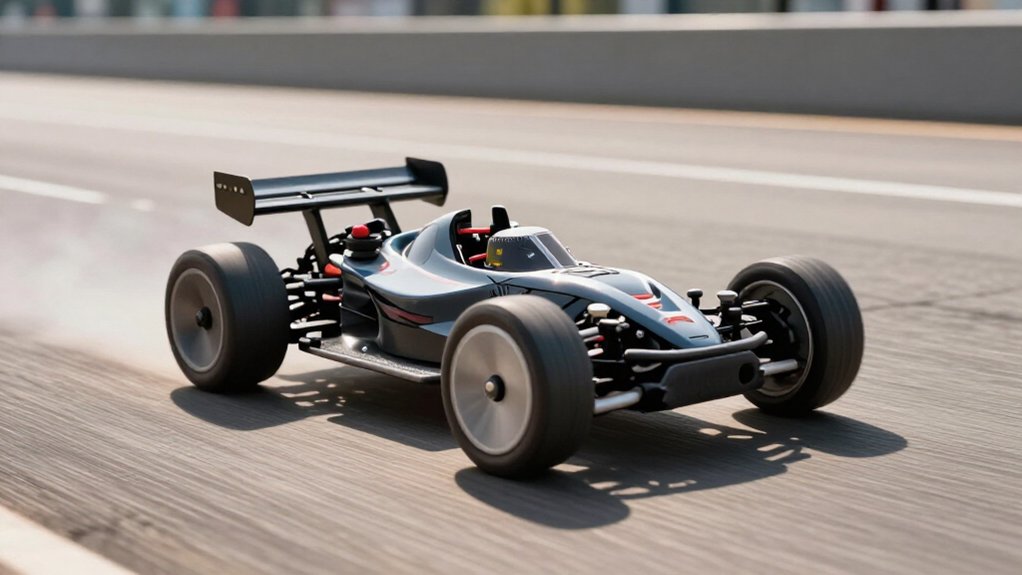
Your RC car may reach 30 to 70 km/h as a beginner model, 60 to 100 km/h as a basher, or exceed 100 km/h as an on-road speed build; dedicated cars can top 150 to 200 km/h.
Motor KV sets unloaded RPM per volt, while battery voltage, gearing, tyre diameter, and drivetrain losses determine speed. Taller gearing or higher voltage can raise top speed but adds heat and stress.
Verify performance with GPS on a course; the details ahead show safe tuning.
RC Speed Benchmarks
RC speed benchmarks vary by class: beginner-friendly hobby-grade cars typically reach 30 to 70 km/h, while brushless off-road bashers commonly hit 60 to 100 km/h. Treat those figures as practical operating ranges, not guaranteed results: your actual speed depends on motor output, battery voltage, gearing, tires, surface, and vehicle setup. Verify performance with GPS or a radar gun on a long, clear course.
Wheelspin, uneven pavement, wind, and battery sag can reduce recorded speed. You’ll get the most useful comparison by testing under repeatable conditions, using the same surface, battery state, and measurement method. Compare results under comparable conditions. Keep acceleration and control in view; a higher peak reading doesn’t guarantee a faster, more consistent run. Check manufacturer specifications before testing.
Top Speeds by RC Car Type
Top speed varies sharply by RC car type because each design balances power, grip, and control differently. Choose a platform for your surface and driving goal, not its headline speed. Brushless off-road bashers commonly reach 60 to 100 km/h, though setup and terrain change the result. On-road speed cars often exceed 100 km/h; dedicated builds can hit 150 to 200 km/h or more.
| RC type | Typical performance |
|---|---|
| Drift car | 30 to 60 km/h; hard tyres control slides |
| Rock crawler | Low-speed torque and obstacle grip |
Beginner-friendly hobby-grade cars usually reach 30 to 70 km/h. Touring cars favor precise, consistent lap performance over outright pace. Crawlers use low gearing and grippy, oversized tyres to clear obstacles with torque and low-speed control. These figures describe separate roles, so compare cars by usable speed on your course rather than maximum potential.
Motor KV Versus RPM
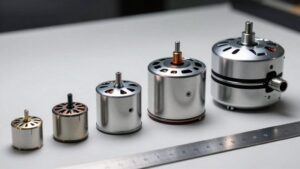
Motor KV tells you how quickly a motor spins per volt with no load: a 3,500KV motor on 10 volts turns at about 35,000 RPM. At the same voltage, a higher-KV motor generally spins faster, giving your car greater potential top speed. But KV doesn’t translate directly into road speed: gearing determines how that motor RPM reaches the wheels, while tire diameter, vehicle weight, and motor torque shape acceleration and achievable speed.
A taller gear can increase wheel speed, yet it may demand more torque and create extra heat. Match the motor’s KV to your intended setup rather than choosing the highest rating. Higher RPM can raise operating temperatures, so confirm your motor and ESC can handle the combination under load. Monitor temperatures during testing, then adjust gearing if the system runs too hot. This balance helps you turn motor speed into usable performance without overstressing components during hard runs.
Battery Voltage and Speed Ranges
Higher voltage lets a compatible motor spin faster: common LiPo packs range from 2S (7.4 V) to 6S (22.2 V), with each step offering more power and speed potential. Your actual speed depends on motor KV, gearing, tyre size, and setup—not voltage alone. Check that your motor, ESC, drivetrain, and tyres support the cell count, then increase voltage gradually and monitor temperatures.
Voltage And RPM
A brushless motor’s theoretical RPM is roughly its KV rating multiplied by battery voltage, so a 3,500KV motor on 10V can reach about 35,000 RPM.
Voltage sets the motor’s unloaded speed ceiling: raising it generally increases RPM and potential top speed. A move from 2S to 3S, or from 4S to 6S, can produce a gain, provided your powertrain supports it. But RPM doesn’t translate into road speed. Your KV rating, gearing, tyre diameter, vehicle weight, and drivetrain losses determine how much motor speed reaches the ground.
Check the motor, ESC, battery, and vehicle voltage ratings before increasing supply voltage. Extra power can raise temperatures and drivetrain stress, reducing performance or causing component failure. Match voltage to your setup and monitor heat.
Common Battery Configurations
Battery cell count gives you a practical way to compare RC power setups: 2S LiPo packs supply 7.4 V for beginner-friendly driving and everyday use, while 3S packs supply 11.1 V and can noticeably boost acceleration and potential top speed. If your vehicle’s ESC and motor support the increase, you can use the higher voltage effectively; otherwise, you risk overload or damage. A 4S pack provides 14.8 V for higher-performance builds, while 6S supplies 22.2 V for very high-power applications.
Higher voltage lets a compatible motor spin faster, but voltage alone doesn’t determine wheel speed. Your motor KV, gearing, tyre diameter, and vehicle weight also shape performance. Before upgrading, check the manufacturer’s voltage and cell-count limits; higher voltage increases stress on those components further.
Typical Speed Ranges
Expect roughly 30 to 70 km/h from many hobby-grade beginner RC cars and 60 to 100 km/h from brushless off-road bashers. A 2S LiPo (7.4 V) gives you a practical pace for learning and everyday driving; 3S (11.1 V) typically delivers sharper acceleration and greater speed potential. Higher voltage can raise motor RPM, so 4S (14.8 V) and 6S (22.2 V) setups can push performance further when matched to the vehicle.
On-road speed cars often exceed 100 km/h, while dedicated builds may reach 150 to 200 km/h or more. Traxxas marketed the XO-1 as an RTR capable of 100 mph, over 160 km/h. Treat these figures as typical or claimed, not guaranteed: gearing, motor, vehicle, tyres and running conditions all affect the speed you’ll record in your own real-world test runs.
Voltage Limits And Compatibility
Voltage can increase an RC car’s speed, but only within the limits of its power system. LiPo packs include 2S (7.4 V), 3S (11.1 V), 4S (14.8 V), and 6S (22.2 V) configurations. Higher voltage can raise motor RPM and potential top speed. Moving from 2S to 3S delivers quicker acceleration and a higher top speed; 4S and 6S can provide more power, but they place greater stress on the drivetrain and electronics.
Never exceed the vehicle’s, ESC’s, or motor’s voltage limits. Check approved cell counts and gearing in the manufacturer’s documentation. Confirm pack dimensions, connector type, and discharge capability. Your ESC must handle the battery’s voltage and current demands. Increase voltage only when the power system is compatible. Monitor motor and ESC temperatures after changes; added power can increase heat.
Real-World Speed Factors
Although higher voltage can raise motor RPM, your RC car’s real-world speed depends on the whole setup: motor KV, gearing, weight, tyres, and drivetrain losses.
A 2S (7.4V) pack suits beginner and everyday driving; 3S delivers a noticeable speed and acceleration boost, while 4S to 6S supports progressively higher performance.
Hobby-grade beginner cars commonly reach about 30 to 70 km/h; brushless off-road bashers often hit 60 to 100 km/h, depending on vehicle and setup.
Many on-road speed cars exceed 100 km/h, and dedicated builds can reach 150 to 200 km/h or more.
But these speeds demand suitable components and conditions. Higher voltage can increase acceleration and top speed, but it also stresses your drivetrain, tyres, ESC, and motor. Match your pack to supported electronics, then monitor temperatures to protect components at speed.
GPS Speed Testing
GPS Speed Testing
To measure an RC car’s actual ground speed, use a GPS speed meter or a phone app that records GPS speed rather than relying on calculator estimates.
Choose a long, flat, clear test area, and keep the car pointed straight, well away from people, traffic, animals, and obstacles. Make several runs in opposite directions, then compare the readings; this helps limit measurement error and reveals inconsistent results.
For repeatable comparisons, record battery voltage, pinion and spur gears, tire diameter, and test conditions. Change one setup variable at a time so you can identify what affects speed. Begin with a short run, then check motor and ESC temperatures against their manufacturers’ limits before repeating the test. Save each result with its configuration details.
Wind and Surface Effects
Wind and surface conditions can change an RC car’s measured top speed as much as its setup.
A headwind increases aerodynamic drag, cutting your car’s top speed; a tailwind can raise its speed over the ground. You’ll notice wind effects more on lightweight cars, while gusts can destabilize high-speed runs.
Smooth, level pavement usually minimizes rolling resistance and delivers more predictable grip than rough or uneven ground. Loose dirt, grass, and gravel create greater resistance, reducing speed; available traction also varies with tire tread and compound. For useful comparisons, run your car on a large, clear, consistent surface in calm conditions. That approach limits environmental variation and lowers risk, helping you distinguish real speed differences from changing wind or terrain across repeated speed tests.
Stock Versus Modified Builds
A stock RC car runs the motor, ESC, battery, and gearing specified by its manufacturer, so its speed depends on the model and approved setup.
With a modified build, you can raise top speed with taller gearing, a higher-KV motor, or a higher-voltage battery, provided your ESC and drivetrain support the change. A larger pinion usually increases speed but cuts acceleration and adds heat, so make small adjustments and check temperatures after brief runs.
Brushless systems can deliver more power than comparable brushed setups, but match the motor, ESC, battery, tires, and gearing to your car. Modified power can strain tires and drivetrains; belted tires help limit ballooning at speed. Test each change for stability and heat before pushing for peak performance in practice.
Gear Mesh and Drivetrain Checks
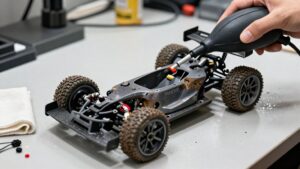
Before changing gearing, check that the wheels spin freely and the drivetrain moves smoothly; binding bearings or gears waste power and create heat.
- Check mesh for slight backlash.
- Turn wheels by hand after assembly.
- Stop if temperatures climb too rapidly.
Set gear mesh according to your vehicle’s manual: a tight pinion-to-spur fit can bind, while a loose fit can wear or skip teeth. Inspect bearings for resistance; remove debris and replace damaged gears to reduce drag and protect the motor and ESC. After each gearing change, run briefly, then check motor and ESC temperatures with a temperature gun or compatible telemetry. Change gearing one step at a time; a larger pinion can raise potential top speed, but it increases drivetrain workload and heat.
Wheel Circumference Calculation
Once the drivetrain spins freely, calculate how far each wheel revolution moves the car: measure the tire’s outer diameter in millimeters and multiply it by π.
Use the tire’s actual diameter; changing tire size changes distance traveled per rotation. A 100 mm tire has a circumference of about 314 mm. Divide millimeters by 1,000 to convert: 314 mm equals 0.314 m per revolution.
- Calculate circumference with π × tire diameter.
- Convert millimeters to meters before estimating speed.
- Multiply wheel RPM by circumference and 60, then divide by 1,000 for km/h.
This theoretical figure assumes steady wheel RPM and no slip. Larger tires cover more ground per rotation, increasing speed at identical RPM; measure accurately to compare gearing fairly.
Conclusion
Your RC car’s top speed depends on its motor KV, battery voltage, gearing, tires, and running surface. Use the benchmarks as a starting point, then verify performance with GPS testing under consistent conditions. Check gear mesh and drivetrain health before increasing gearing, and calculate wheel circumference accurately when estimating speed. Make changes one at a time, monitor motor and battery temperatures, and choose a setup that delivers repeatable speed without sacrificing reliability or control on your course.
RC Car Gear Ratio & Top Speed Calculator
Work out final drive ratio, rollout, wheel rpm and theoretical no-load top speed from your motor KV, battery, gearing and tire size.
RC Battery Runtime & Voltage Calculator
Get LiPo or NiMH pack voltage (nominal and full), estimated runtime and C-rating current from cells, mAh, C and average amp draw.
Nitro Fuel Runtime & Cost Calculator
Enter your tank size, timed minutes per tank, sessions and fuel price to estimate nitro fuel used and its cost per session and per month.
Tire Swap Speed & Gearing Compensator
Enter motor KV, cells, gearing and old vs new tire diameter to see the theoretical no-load speed change and rollout from a tire swap.