Nitro Vs Electric RC Cars: Which Is Better in 2026?
Choose electric in 2026 if you want the best all-around RC experience: brushless torque is immediate, throttle and braking are repeatable, and 60 to 100+ mph performance comes without nitro’s 85 to 95 dB exhaust noise.
You’ll get 12 to 30 minutes per LiPo pack, simpler starts, and lower long-term costs, though you must charge safely. Choose nitro for rapid 20 to 30-second refueling, engine tuning, and outdoor track character.
The comparisons below show where each platform gains its best edge in use.
Noise and Neighborhood Restrictions
Nitro RC cars typically generate 85 to 95 dB, a sound level that can quickly disturb nearby homes and violate neighborhood or park noise limits. You should confirm posted decibel caps, operating hours, and property-line rules before tuning or running. Exhaust adds another compliance variable; review municipal and site restrictions near homes, trails, and public spaces.
| Environment | Typical concern | Your best check |
|---|---|---|
| Residential streets | Complaints | Local ordinance |
| Public parks | Permit limits | Site manager |
| Indoor facilities | Air and noise rules | Facility policy |
A disciplined pre-run assessment protects access. Select locations with adequate setback, run only during approved hours, and monitor sound at the boundary rather than beside the car. Electric RC cars register 40 to 60 dB without exhaust, expanding residential, park, and indoor venues while reducing shutdown risk.
Nitro Engines vs. Brushless Motors
Beyond venue access and noise limits, the power system determines how an RC car delivers speed, responds to throttle, and demands maintenance. Nitro uses a methanol-based blend of nitromethane and oil; its glow plug ignites the charge while the carburetor meters air and fuel. You get a progressive, powerband-driven delivery that rewards precise tuning, but priming, needle adjustments, and engine care remain essential.
A brushless system draws from a high-discharge LiPo pack, with the ESC controlling motor output. It produces near-instant torque, sharper throttle response, and rapid acceleration with less mechanical upkeep: you’ll mainly charge batteries and clean components. Both systems are fast. A well-tuned nitro car commonly reaches 55 to 75 mph, while brushless electric models can reach 60 to 100+ mph. Match power to priorities.
Lap Times and Battery Runtime
Electric RC cars often produce more consistent lap times because their power delivery stays predictable across a run, with far less sensitivity to weather or engine tuning.
That consistency lets you brake, rotate, and apply throttle at repeatable points, which can reduce average lap times on technical layouts. Instant torque also improves your corner exits, provided your tires maintain traction.
Runtime changes the comparison. Your 5,000 to 8,000 mAh LiPo usually delivers 12 to 30 minutes, with loose terrain and aggressive throttle shortening the window. For extended electric running, you’ll need spare packs; a pack swap minimizes downtime. A nitro tank generally lasts 10 to 18 minutes, but you can refuel in roughly 20 to 30 seconds, preserving track time during long sessions.
Choose according to heat length and pit strategy.
Glow-Plug Tuning vs. Charging
Preparation separates these power systems more than outright speed: a nitro car requires you to charge the glow igniter, prime the fuel line, and set the carburetor’s fuel-air mixture before it runs cleanly. That process rewards precision: you must verify plug condition and refine mixture settings as conditions shift, or sacrifice starting consistency, throttle response, and engine durability. Afterward, a 10 to 20-minute tank can be refilled in roughly 30 seconds, letting you resume quickly.
With electric, you charge and install a LiPo pack, then connect it to the ESC. Setup is simpler and repeatable, but your 5,000 to 8,000 mAh pack typically delivers 12 to 30 minutes; depleted packs require a charged spare or recharge. Choose nitro for pit-speed refueling; choose electric for predictable, low-complexity preparation before each run.
Waterproofing and Cold-Weather Fit
Cold-weather usability generally favors electric RC cars because they start consistently without carburetor tuning, though low temperatures reduce LiPo voltage delivery and runtime. Keep packs warm before driving, then monitor voltage sag; cold cells limit punch and can trigger low-voltage cutoff earlier. Waterproofing is component-specific: verify the manufacturer’s water-resistance rating for chassis electronics, ESC, receiver, and servo instead of treating the vehicle as waterproof.
Don’t submerge either platform, since water reaches bearings, connectors, and driveline hardware even when electronics resist splashes. Nitro operation becomes less practical in cold, wet conditions: starting and tuning degrade, while moisture increases post-run service. After snow or rain runs, disconnect and dry the battery and electronics, then clean and dry the chassis and metal parts to reduce corrosion.
Fuel Prices vs. Battery Replacements
Although nitro cars refuel in roughly 20 to 30 seconds, their operating cost rises with every 10 to 20-minute tank, and fuel can be expensive or unavailable locally.
If you drive often, recurring purchases exceed the upfront price gap. Electric models eliminate fuel purchases, but LiPo packs remain consumable components; heavy cycling may require replacement in one to two years. A pack runs 12 to 30 minutes, so matching nitro’s session length requires charged spares or recharge time. Extra packs raise initial cost but reduce downtime when you manage charging capacity.
Over three years or more, electric generally delivers lower ownership cost. Your outcome depends on tank use, local fuel prices, battery lifespan, and driving frequency. Nitro gives you pit-stop continuity; electric gives you lower, predictable long-term energy costs.
LiPo Fires and Fuel Spills
Electric and nitro RC cars carry different but manageable fire risks: LiPo packs can ignite after damage, improper charging, or incorrect charger settings, while nitro fuel can ignite if spilled near heat, sparks, or an operating engine.
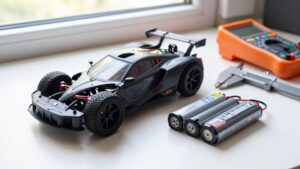
For LiPos, use a compatible balance charger and stay within the maker’s charge-rate limits. Charge on a nonflammable surface, never unattended, and retire packs that swell, overheat, smell strongly of chemicals, or show damage. If one burns, keep people clear: it may reignite, so contact emergency services and follow local guidance. Refuel nitro outdoors only with its engine off and cool. Keep fuel from exhausts, sparks, and flames; seal it in its labelled original container, away from heat and children, then clean spills promptly per maker instructions.
Parts Availability and Upgrade Paths
You’ll keep either platform running longer when replacement parts are readily available from reliable suppliers. Electric models typically offer wider upgrade compatibility across brushless motors, ESCs, batteries, and chargers, while nitro support centers on engines, glow plugs, filters, and clutch components. Check model-specific fitment before buying, especially if you’re new to nitro and may need engine parts quickly.
Replacement Parts Availability
Parts availability directly affects an RC car’s long-term performance, downtime, and upgrade value. Before you buy, verify that the exact model—not just its brand—has reliable stock of suspension arms, drivetrain gears, shafts, bearings, and bodywork. Crash-prone parts determine whether a hard landing causes a short repair or weeks off the track.
Nitro ownership adds engine-service inventory: glow plugs, air filters, clutch shoes, bearings, pull-start parts, and engine internals. If these consumables are scarce, tuning and reliability suffer. Electric models simplify routine mechanical service, but you must budget for LiPo batteries, motors, and ESCs. With heavy running, LiPo packs commonly need replacement every one to two years. Check hobby shops and established online suppliers before committing. Dependable parts support keeps repairs economical and preserves consistent performance.
Upgrade Ecosystem And Compatibility
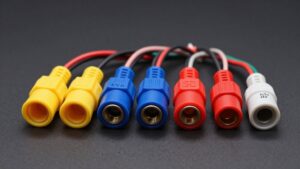
A strong upgrade ecosystem lets you increase performance without creating electrical, mechanical, or supply-chain conflicts. For electric RC cars, verify motor, ESC, battery-voltage, and connector ratings as one system before installing brushless power or higher-capacity LiPos. You’ll also need batteries that fit the tray and a charger that supports their chemistry and cell count. RTR inclusions vary, so don’t assume a battery or charger is supplied.
With nitro, match engine components, glow plugs, air filters, and clutch hardware to your exact engine and chassis. Confirm local access to compatible fuel, too, because tuning potential means little if consumables disappear. Choose platforms with widely stocked parts and documented fitment. That reduces downtime, preserves upgrade options later, and prevents a performance gain from causing reliability losses.
Indoor Tracks Favor Electric
On indoor tracks, you avoid exhaust fumes and keep sessions venue-friendly with an electric RC car. Its 40 to 60 dB operation is far quieter than nitro’s 85 to 95 dB, while instant torque gives you precise throttle control through tight turns. Check the facility’s vehicle and LiPo rules before you run.
Zero Exhaust Fumes
Electric RC cars eliminate exhaust emissions, so they maintain cleaner air in enclosed tracks, garages, and other indoor venues. That advantage directly affects where and how hard you can run. A battery-powered drivetrain releases no combustion byproducts, preventing the localized buildup of hydrocarbons, particulates, and oil-laden residue that can compromise air quality in confined spaces.
You can operate repeatedly without requiring ventilation systems to clear engine exhaust between heats. This makes electric platforms a more practical choice for climate-controlled facilities, home garages, and temporary indoor layouts where occupants share limited air volume. Nitro engines emit exhaust, so they suit open fields or dedicated outdoor tracks better. With electric, you charge the pack, connect it, and drive immediately indoors.
Quiet Running Sessions
Beyond cleaner air, electric RC cars keep indoor sessions far quieter than nitro models, whose engines commonly produce 85–95 dB. That noise gap matters when you run in enclosed facilities, where engine sound reflects from walls, limits communication, and can disrupt neighboring businesses or residents.
An electric drivetrain produces mainly gear, tire, and cooling-fan noise, so you can hear tire scrub, impacts, and mechanical issues more clearly. This improves your ability to monitor chassis behavior and make setup decisions during technical practice.
Nitro’s exhaust note may suit outdoor racing, but many indoor venues restrict or prohibit it because of sound limits and fumes. Before you pack your pit bag, check facility’s noise policy. For consistent access to indoor tracks, electric is practical performance choice.
Instant Throttle Control
Indoor tracks reward immediate, repeatable inputs, and electric RC cars respond almost instantly when you squeeze the throttle. A brushless system combines a LiPo battery and ESC, so motor output follows your trigger command with minimal delay. That precision lets you meter acceleration off tight indoor corners, hold entry speed, and correct line changes before they cost lap time.
Unlike a nitro engine’s gradual powerband, electric delivery stays smooth and consistent through repeated braking and acceleration zones. You can build predictable laps, adjust setup efficiently, and return quickly between heats. Virtually silent operation also suits indoor facilities and noise-sensitive venues, where electric racing cars can run without disrupting other users. For tight layouts, that control gives you a measurable advantage in repeatable corner-exit performance.
Electric Wins for First-Time Owners
For first-time RC owners, electric cars provide the fastest path from unboxing to controlled, repeatable driving: charge and connect the battery, switch on, and run. You skip fuel mixing, priming, glow igniters, engine break-in, and carburetor tuning, so your early sessions focus on steering, braking, and throttle discipline. Brushless power systems deliver immediate torque and precise acceleration, helping you build control without waiting for an engine to spool up.
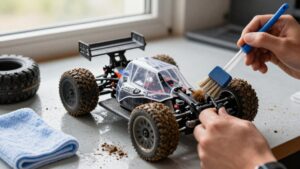
Your maintenance routine stays simple: charge batteries correctly, clean the chassis, and inspect driveline and suspension hardware. Electric operation is also quiet and exhaust-free, letting you use parks or neighborhoods where a nitro engine’s 85–95 dB noise level won’t be accepted. Although batteries and chargers raise initial cost, electric usually costs less over three years.
Conclusion
Choose electric if you want the fastest route to consistent lap times, low maintenance, quiet operation, and legal neighborhood running. Brushless power delivers immediate torque, programmable control, and indoor-track compatibility, while modern LiPos provide competitive runtime when you manage charging safely. Choose nitro only if you value engine tuning, refueling speed, exhaust character, and longer continuous sessions. For most first-time owners in 2026, electric gives you higher performance, cleaner ownership, upgrades, and fewer constraints overall.