RC Brushless Motor Size Chart: Can Sizes and kV by Scale
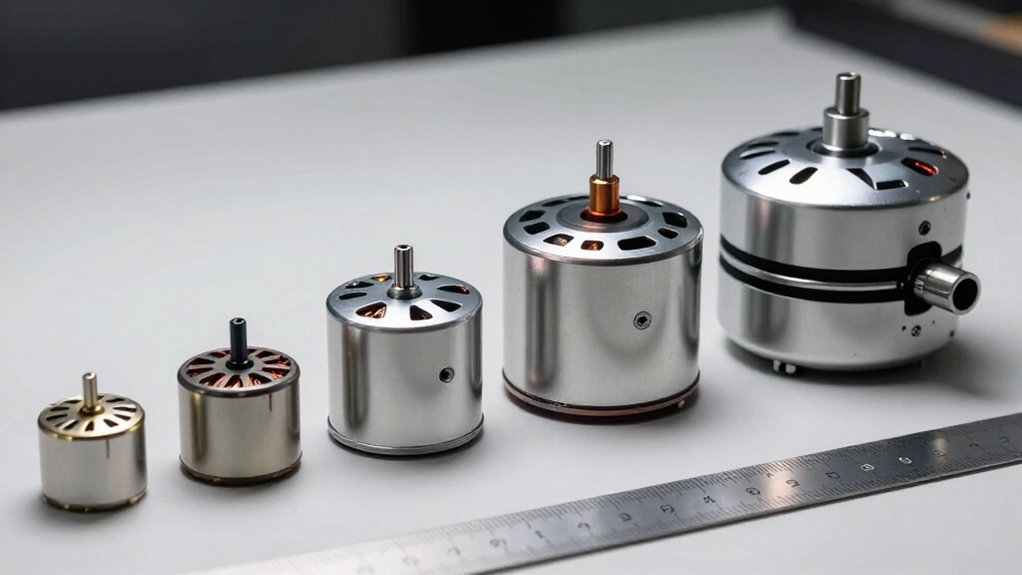
Choose an RC brushless motor by matching its can dimensions, kV, battery voltage, gearing, and chassis space. For 1/10-scale vehicles, start with a 3650 to 3660: 36-mm diameter and 50 to 60-mm length. At 1/8, consider 4074 to 4092; at 1/5, start around 4274. Lower kV often runs cooler; higher kV favors speed.
Verify the motor’s voltage rating and ESC limits, then recheck gearing after battery changes. Check mounting pattern, shaft fit, and clearance before installation. More fit and heat checks follow.
Scale-to-Can Size Guide
Match motor size to both vehicle scale and chassis clearance: 1/18 to 1/16-scale micro trucks commonly use 370 to 380 motors, with a 380 measuring about 24 × 30 mm; 1/10-scale models often use 3650 or 3660 cans, roughly 36 mm in diameter and 50 to 60 mm long.
For 1/8-scale rigs, choose a 4074 to 4092 class motor; a 4068 can suit a buggy, while heavier truggies and monster trucks commonly need a 4076. At 1/5 scale, start with a 4274-or-larger unit. Can-size labels vary by convention, so verify the actual motor against your chassis before you buy. You’ll get a reliable match when you account for your vehicle’s scale and available mounting space. Don’t assume a familiar label guarantees compatibility; confirm the manufacturer’s stated dimensions and mounting arrangement for your specific model carefully.
Can Length and Diameter
Scale narrows the options, but can dimensions determine whether a motor fits your chassis. Check diameter and length against your motor mount and available clearance; scale alone won’t confirm fit.
| Can | Diameter | Length |
|---|---|---|
| 540 | ~36 mm | Standard |
| 550 | ~36 mm | 10 mm longer |
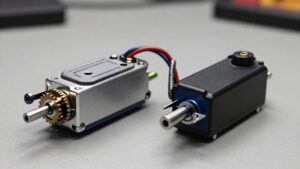
A 550 shares the 540’s approximate 36 mm diameter but adds 10 mm of length. In designations such as 4068 and 4076, 40 indicates an approximate 40 mm diameter; 68 and 76 indicate can length. For a 1/8-scale buggy, you’ll commonly find a 68 mm can. Heavier truggies and monster trucks often use 76 mm cans. Compare the stated dimensions with your chassis limits, including mount and component clearance, before choosing. A common size won’t guarantee a fit.
Understanding Motor kV Ratings
A brushless motor’s kV rating estimates its no-load revolutions per minute per volt, not kilovolts. Multiply the rating by battery voltage to estimate unloaded speed: a 1,390 kV motor on an 11.1 V battery yields about 15,429 RPM. That figure isn’t a prediction of operating speed; load and efficiency reduce actual RPM.
At the same voltage, a higher-kV motor generally spins faster, while a lower-kV motor often favors torque, finer control, and cooler operation. However, kV alone doesn’t tell you a motor’s power or suitability. Two motors with identical ratings can differ in dimensions and capacity, producing different results under load. Choose a kV rating alongside motor dimensions, battery voltage, gearing, and manufacturer specifications. Use those details together to assess expected performance, rather than treating the kV number as a complete measure of motor capability.
Motor Size by Vehicle Scale
For 1/18 to 1/16 trucks, you’ll commonly find 370–380 motors; 1/10 models typically use 3650–3660 cans (about 36 mm in diameter and 50 to 60 mm long). Many 1/8 rigs use 4074 motors, while 1/5 trucks often need 4274 or larger, so check chassis clearance and drivetrain limits before choosing a can. Match kV to your vehicle’s scale, gearing, and intended load to manage speed and motor temperature.
1/18 Scale Motor Sizes
Compact 1/18-scale RC vehicles commonly use 370 to 380-size motors; a 380 motor measures about 24 mm in diameter and 30 mm long. The LaTrax Teton 1/18 4WD RTR, for example, uses a brushed 370-size motor, showing that the nominal size can vary within this scale.
Before you select a replacement, inspect your chassis and compare the motor’s diameter, length, shaft position, and mounting pattern with the available space and hardware. A motor labeled 370 or 380 won’t necessarily fit every 1/18 vehicle; can dimensions and mounting arrangements can differ. If you’re upgrading to brushless, verify physical fit first, then check that your ESC supports the motor and your battery’s voltage. Match those specifications before installation to avoid incompatible wiring or operating conditions. Don’t choose by scale label alone: confirm the chassis clearance and mount, and use the motor and ESC ratings specified for your setup in your vehicle.
1/10 Scale Motor Sizes
Moving up from 1/18 to 1/10 scale, most trucks and buggies use 3650 or 3660 brushless motors, each about 36 mm in diameter.
A 3650 is roughly 50 mm long; a 3660 is about 60 mm, with the same nominal diameter. The can lengths distinguish these sizes; diameter alone won’t tell you whether either fits. Both are common brushless upgrades for 1/10 vehicles that may use a 540 or 550 brushed motor. Before choosing, check your chassis motor-mount dimensions and clearance. Confirm your electronic speed controller (ESC) supports the motor; physical fit alone doesn’t guarantee compatibility.
Dimensions and ESC limits vary by vehicle, so compare specifications with your manuals. Choose the can that fits and meets your setup’s output requirements.
1/8 Scale Motor Sizes
In 1/8-scale RC vehicles, brushless motors commonly range from 4074 to 4092: both measure about 40 mm in diameter, while their lengths vary from 74 to 92 mm. That code lets you compare cans: its first two digits indicate approximate diameter; its final two give length in millimeters.
For a 1/8-scale buggy, you’ll often see a motor around 68 mm long, shorter than the 4074 example. Truggies and monster trucks may use 76 mm motors, whose length can support the torque demands of heavier vehicles. Don’t choose by length alone. Check the motor’s mounting pattern, shaft position, and clearance against your chassis, then verify that its current and power demands stay within your ESC’s limits. A longer can may help, but only if your installation and electronics can accommodate it.
1/5 Scale Motor Sizes
For 1/5-scale RC trucks, brushless motors often start at size 4274 or larger; the designation generally indicates a can about 42 mm in diameter and 74 mm long, though manufacturers may vary. Before you choose one, measure the motor mount and available chassis space; a 4274 may not fit every 1/5-scale platform. Check the motor’s required current and battery voltage, then select an ESC rated to support both.
Don’t assume a physically larger can will work with existing electronics: an oversized or mismatched system can overload components. You should also inspect the drivetrain before upgrading. Confirm that your gearing and gears can handle the added motor power, since unsuitable ratios or weak gears can fail under load. Treat size as a fit and compatibility starting point, and verify the vehicle and component specifications before installation. Use the manufacturer’s dimensional drawings and electrical limits to confirm clearance, voltage, and current compatibility before you commit to the upgrade.
Matching kV to Scale
How should you match motor kV to vehicle scale? Treat scale as a starting point, not a kV specification; vehicle mass, battery voltage, gearing, and target speed determine the useful range.
At 1/18 to 1/16 scale, compact 370–380 motors are common, but you should select kV around the vehicle and gearing. For 1/10, 3650–3660 cans are typical; match kV to truck weight, pack voltage, and intended speed.
At 1/8 scale, a 4074 motor is common. Lower kV generally supports torque and cooler operation in heavier rigs; higher kV prioritizes speed. Large 1/5 trucks often use 4274-or-larger motors. Choose kV with battery voltage and gearing to limit heat.
Before buying, compare motor dimensions and kV, check chassis fit, and confirm your ESC supports the battery voltage.
Battery Voltage Compatibility
Before connecting a battery, check the motor’s specified limit, often listed as 2S or 3S, because exceeding the recommended voltage can rapidly overheat and damage the motor. A motor doesn’t include a physical voltage limiter, so you must rely on its published rating. Higher voltage raises no-load RPM: a 1,390 kV motor on 3S (11.1 V) reaches an estimated 15,429 RPM. This figure describes unloaded speed, not operating speed under vehicle load.
Choose a motor and ESC rated for your pack’s voltage, then verify that your gearing suits the higher speed. After changing voltage, monitor motor temperature during initial runs; excessive heat signals an overloaded setup and can also damage the ESC. Stop and reduce load or voltage if temperatures rise beyond component limits.
Mounting Hole Compatibility
Even when a motor’s can size matches, its mounting holes may not align with your chassis. Can size identifies the motor’s physical dimensions; it doesn’t define a universal bolt pattern. Before you buy, compare the motor’s hole spacing and screw size with the chassis or motor-mount specifications. Check the specified thread type and usable screw depth, too, so fasteners seat securely without bottoming out or contacting internal components.
Then verify the motor’s diameter and length against the available mount space. For example, both 540 and 550 motors measure 36 mm in diameter, but a 550 is about 10 mm longer. That added length can affect clearance even when the diameter matches. If the hole pattern or dimensions don’t fit, use a compatible adapter or replacement mount, if available; don’t assume the can label guarantees fit. Check manufacturer dimensions before installation.
Example: 1/10-Scale Truck Setup
For a typical 1/10-scale truck, start with a 3650 or 3660 motor, about 36 mm in diameter and 50 to 60 mm long. Choose the can length around your truck’s weight and available chassis space: a longer 3660 can deliver more torque, but its extra length may interfere with the chassis or components. For speed-focused setups, consider roughly 4,000 to 6,000 kV; for stronger torque and cooler operation, look near 1,800 to 2,500 kV.
These ranges are starting points, not universal targets. Before you upgrade, match the motor’s kV and physical size to your ESC, battery voltage, and gearing. Check the truck and motor manufacturers’ limits, including permitted can dimensions and electrical ratings. Confirm that your chosen combination suits your driving surface and intended performance, and verify chassis clearance before installation.
Diagnosing Motor Overheating
Diagnose overheating by checking the motor with a temperature gun after a short run; aim to keep it below 180°F. Your readings reveal whether gearing, voltage, or timing is stressing the motor. If you can’t hold a finger on the case for 2–3 seconds, stop and let it cool before another run.
- A higher-kV motor may be over-geared; install lower gearing, then repeat the same short run and compare temperatures.
- Don’t exceed the manufacturer’s battery-voltage rating: a 3S pack on a 2S-rated motor can trigger rapid overheating and failure.
- Added timing raises heat and lowers efficiency; change it in small increments, then recheck temperature.
- Use the same run duration and driving load for each comparison; changing both can obscure the cause.
- Log readings.
Motor Shaft Diameter
Motor shaft diameter is distinct from can size: the can describes the motor body, while the shaft connects to the pinion gear. When you select a pinion, match its bore to the shaft—not the motor’s can label. Check the manufacturer’s specifications before ordering, because shaft diameters vary by model and application; these size charts don’t establish standard diameters by scale.
- Verify the listed shaft diameter in millimeters or inches.
- Match the pinion bore exactly to that measurement.
- Confirm the shaft’s usable length suits your pinion.
- Check that the gear engages the drivetrain.
- Make sure the pinion won’t rub against the motor mount.
After installation, rotate the drivetrain by hand and inspect clearance before powering the motor. Don’t infer shaft dimensions from can size alone.
Conclusion
Choose your motor by checking can diameter and length, vehicle scale, and realistic kV for your battery voltage and gearing. Confirm mounting-hole spacing and shaft diameter before ordering; these mechanical details determine whether the motor fits your chassis and drivetrain. After installation, monitor motor temperature during a short test run, then adjust gearing or timing if it overheats. Use the chart as a starting point, not a guarantee: your vehicle’s weight, terrain, and driving style affect the final setup.
RC Car Gear Ratio & Top Speed Calculator
Work out final drive ratio, rollout, wheel rpm and theoretical no-load top speed from your motor KV, battery, gearing and tire size.
RC Truck Scale Size Converter
Convert a real truck's length, width and height to any RC scale from 1/6 to 1/24, or find the scale implied by a model's length.
Basher Motor, ESC & LiPo S-Count Matcher
Compare your motor kV, ESC max S and LiPo cell count from your own spec sheets and see the theoretical no-load RPM (kV × S × 3.7).