How to Choose Your First RC Car: A No-Regrets Beginner Guide
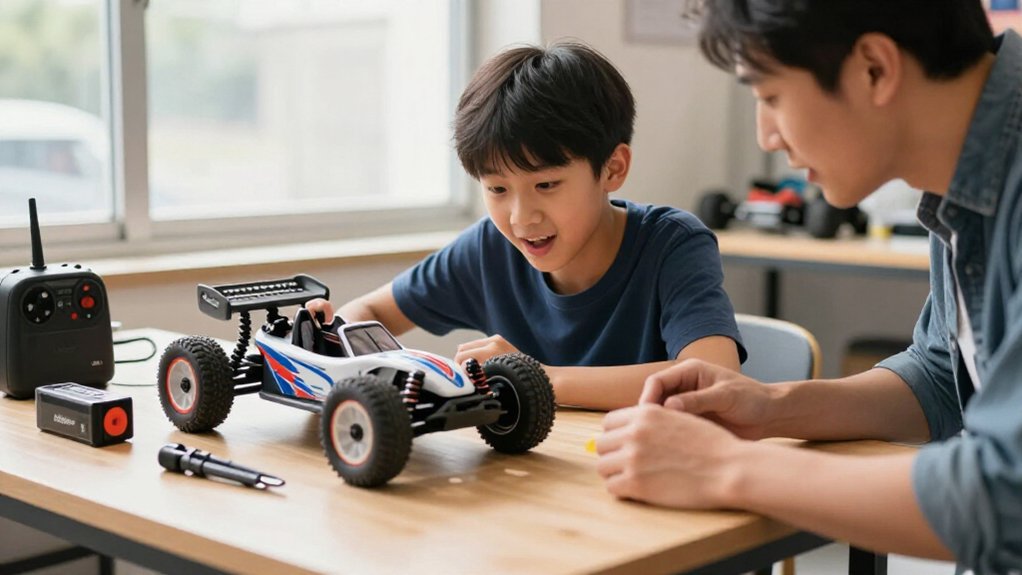
Choose an RC car for your terrain and driving style: a small model suits indoor floors, while a buggy or truck handles dirt and rough ground. Set a startup budget that includes batteries, a charger, and tools.
Electric RTR cars are usually easiest for beginners.
Look for proportional controls, training mode, compatible batteries, and available parts. Check warranty terms and package contents before buying. These checks simplify choosing; guidance ahead can help you get started.
Terrain and Driving Location
Before choosing a first RC car, consider where you’ll drive it most. Smooth floors and low-pile carpet suit small 1/24- or 1/18-scale models. However, delicate indoor designs may not withstand rough outdoor use.
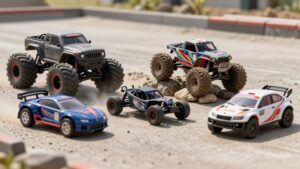
For dirt tracks and rocky paths, choose an off-road buggy or truck with grippy tread tires, rugged suspension, and ground clearance. A buggy makes a versatile first choice: it balances speed with light off-road ability and is easier to handle than a monster truck. Choose a monster truck for rough terrain and obstacles; its large tires and high clearance help it cross them, though it may feel harder to control and travel more slowly.
Match your car to the surfaces you’ll use. Start on open terrain; drive slowly to avoid damage.
Set a Spending Limit
Set a budget of $100 to $200 for your first ready-to-run RC car, and keep about $50 extra for startup costs. That range covers many capable beginner models without pushing you toward features you may not need. Before you buy, check what’s actually in the box: batteries, a charger, tires, or even the body shell may cost extra. Compare the complete startup price, not just the advertised car price, and use your extra $50 for essentials such as a spare rechargeable battery, a compatible charger, or basic tools.
Choose a good-value model from a brand with replacement parts and support, so a minor break won’t sideline you. Upgrade gradually as your skills develop; you don’t need to pay for a high-end car upfront at the outset.
Beginner-Friendly Control Modes
Once you’ve set your budget, look for a beginner-friendly RC car with a training mode or adjustable speed governor. It limits acceleration while you learn. Start around 10 to 15 mph, then raise the limit as your control improves. Proportional throttle, steering, and braking let you make gradual adjustments rather than relying on on/off inputs. A 2.4 GHz radio system offers straightforward, responsive control. Practice at reduced speed first; it can help prevent collisions and damage while you build confidence.
| Control | What it does | Your benefit |
|---|---|---|
| Training mode | Limits acceleration | Learn with less risk |
| Speed governor | Caps top speed | Raise it gradually |
You’ll gain confidence without rushing; adjust settings when smooth control feels familiar.
Electric vs. Nitro Powerinf
Electric RC cars run on batteries, so you can focus on driving without engine tuning; nitro cars use combustion engines that bring more sound and smoke, but need more upkeep. Your choice also affects costs, noise, and runtime, so consider how much maintenance you’re willing to handle. If you’re new, electric is usually the simpler start, while nitro suits you if you enjoy hands-on engine work.
Electric vs. Nitro Basics
For a simpler start, choose an electric RC car: it runs on a rechargeable battery, delivers power instantly, and needs little upkeep or tuning. You can focus on steering and handling rather than learning engine adjustments. Beginner-friendly NiMH batteries offer a straightforward option; LiPo packs provide more power, but you’ll need to charge, handle, and store them carefully.
A ready-to-run electric model arrives assembled, so you can charge its battery and get driving. Nitro cars use miniature combustion engines, creating engine sounds and exhaust smoke. Choose nitro if you’re interested in how engines work and don’t mind setup and tuning. For most drivers, electric gives you an easier way to learn the controls and enjoy your car without adding engine mechanics to the experience.
Cost and Maintenance
Beyond how they drive, electric and nitro cars differ in what they cost to own and maintain. Electric models make the affordable, beginner-friendly choice because you avoid engine tuning and handle less upkeep. Nitro adds costs for fuel and glow plugs, plus cleaning and maintenance as you learn to tune the engine.
Check the startup price, not just the car: does it include a battery and charger? Set aside $50 for extras such as tools or another battery. NiMH batteries cost less and are straightforward to use. LiPo packs offer more power, but you must charge, handle, and store them carefully. An RTR electric model keeps setup costs and maintenance simple. Choose nitro later, when you’re comfortable with its expense and upkeep.
Noise and Runtime
If you’ll drive near neighbors or indoors, an electric RC car’s quieter motor is a practical advantage over nitro’s engine noise and exhaust smoke. Electric models run on rechargeable batteries, and you can start driving without tuning an engine. Check the listed runtime before buying; aim for at least 20 minutes per charge.
Your run time varies with driving style, terrain, and battery condition, so a charged spare lets you get back on the track sooner. NiMH packs offer a straightforward option, while LiPo batteries can deliver more power and longer sessions. However, LiPos need careful charging, handling, and storage, so follow the manufacturer’s instructions. Nitro gives you engine sound and smoke, but you’ll need to tune and maintain its engine more often.
Best Choice for Beginners
Electric is usually the best choice for your first RC car: it’s easier to operate and maintain than nitro, with no engine tuning required. Electric cars run on rechargeable batteries and deliver power as soon as you squeeze the throttle. For an affordable, practical start, choose a model with a beginner-friendly NiMH battery. You can charge it, install it, and get driving without learning engine settings.
Nitro may appeal if you want engine sound and smoke, but its combustion engine requires more tuning and upkeep. That can complicate learning to steer and control speed. For a start, choose an electric ready-to-run (RTR) car with a battery and charger. Begin with NiMH; consider LiPo only when you’re ready to follow charging, handling, and storage requirements.
Racing, Crawling, or Bashing
Choose racing if you want speed and precise handling on a prepared track, crawling for controlled climbs over rocks, or bashing for casual runs in the backyard. Match your car to the terrain: small scales suit indoor spaces, while larger off-road models handle outdoor ground better. If you’re unsure, an RTR buggy offers a flexible start with speed and light off-road ability.
Racing Performance
Racing Performance
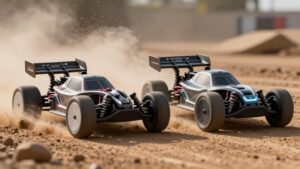
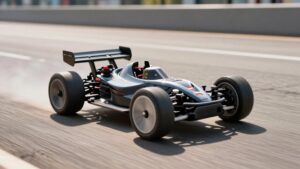
Your RC car’s performance depends on where you plan to drive it. For asphalt or carpet, choose a low, sleek on-road car with smooth handling; a Tamiya TT-02 is one example. A buggy balances speed and off-road ability on dirt tracks, while a truggy’s larger tires can help you stay controlled over obstacles.
For bashing, pick a rugged truck or buggy with shock absorbers and replacement parts you can find easily. Choose a model that fits your space: 1/24- or 1/18-scale cars suit indoor driving, while 1/10 scale works well outdoors. Before you buy, check whether your local track allows your chosen class and surface. A car that matches your venue will feel easier to control and help you enjoy racing from your first run today.
Rock Crawling
If you want to tackle rocks slowly and precisely, a crawler is a better fit than a speed-focused racing buggy or a jump-ready basher.
Choose a 4WD model with low gearing, grippy tires, and high clearance for climbing obstacles. A low center of gravity, soft suspension articulation, and a locked or locking differential help maintain traction on uneven rocks. For a practical first rig, consider a 1/10-scale crawler, with outdoor capability and plenty of replacement parts and upgrades.
An electric ready-to-run model means you’ll get started easily, with little fuss. Choose proportional throttle and steering for precise adjustments on steep climbs and descents. Start slowly on suitable terrain, then check tires, suspension, and loose parts after driving over rocks to catch wear or damage early.
Backyard Bashing
Backyard Bashing
For backyard bashing across grass, dirt, and bumps, you’ll want a rugged electric off-road truck or buggy with grippy tires, sturdy suspension, and easy-to-find replacement parts.
A buggy makes a balanced first choice: it’s usually easier to manage than a monster truck while still handling jumps and uneven ground. If your yard is especially rough, a monster truck’s big tires and high clearance can help, though its taller stance may make it harder to control. Don’t chase maximum speed at first; a manageable setup gives you room to learn steering and throttle without turning every bump into a crash.
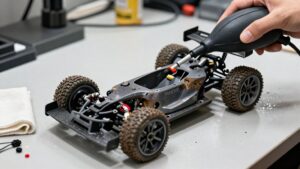
Choose a model with parts you can actually buy, since bashing can wear or break components. After each run, check the tires for looseness or damage and inspect the suspension for bent or worn pieces. Catching small problems early helps keep your truck dependable and gets you back to driving sooner.
Match Your Terrain
Where you drive should guide your choice: on-road cars suit smooth asphalt or carpet, buggies handle dirt tracks and mixed terrain, and rugged high-clearance vehicles tackle rocks or rough backyard ground. For racing on even surfaces, an on-road model such as the Tamiya TT-02 delivers speed and predictable handling.
On dirt, a buggy balances pace with off-road ability; grippy tread tires help you stay in control. If you want to crawl over rocks and obstacles, choose a rugged, high-clearance rig. A truggy’s larger tires can help it climb, while a monster truck suits backyard bashing, using big tires and ground clearance to cross bumps, though it’s slower than an on-road car. For indoor use, choose 1/24- or 1/18-scale; 1/10-scale and larger models suit outdoors.
Battery Connector Compatibility
Before buying a battery, check that its connector matches the car’s electronic speed controller (ESC); plugs that look alike may still be incompatible.
Check the manual or listing before buying spares, then compare its connector with the battery’s plug. Don’t rely on appearance alone: connector shapes can hide differences in fit. If they don’t match, use only an adapter rated for your car’s current draw, or have a competent person change the connector with soldering. Also confirm your car and charger support the battery’s voltage and chemistry; a matching plug doesn’t guarantee compatibility.
Never force or reverse a connection, since you could damage the electronics. Disconnect the battery when you’re done driving. Checking before purchase helps prevent a mismatch and lets you connect power safely. Keep the manual handy, and inspect the plug without pulling on its wires; connect it only when the shapes and polarity align.
Parts Availability and Support
Check parts availability before buying, since a broken suspension arm or worn tire can sideline your car. Before choosing a model, confirm you can find common spares such as shock absorbers and body shells too. Established hobby-grade brands like Traxxas, Arrma, Team Associated, Redcat, and HPI Racing have parts through hobby shops and online retailers.
Still, check verified reviews and RC forums for reports of shortages, long repair delays, or difficult-to-service designs. Ask your hobby shop or an RC group whether they stock parts for that model and can help with repairs or setup. Widely available spares let you replace damaged components and upgrade gradually, instead of replacing the car. This matters when you’re learning, because a crash shouldn’t end your season.
Unclear Warranty Terms
Parts support can keep your RC car running, but unclear warranty terms may leave you paying for repairs you thought were covered.
Before you buy, check the warranty length; some coverage lasts just 90 days. Read the fine print so you know what help you can actually expect:
- Check whether defects in materials or workmanship qualify, and whether crashes or normal wear don’t.
- Ask if batteries, chargers, and included electronics share the car’s coverage period.
- Find out whether you contact the retailer or manufacturer, and what proof you’ll need.
- Confirm who pays shipping and repair costs before you assume service is free.
- See whether a local hobby shop can handle warranty service, saving you a long-distance shipment.
Clear terms help you buy with confidence.
Included Tools and Spares
An RC car’s included tools and spares can get you through simple repairs, but what comes in the box varies by model.
Check whether an RTR car includes tools for basic tightening and repairs; kits may require you to buy them separately.
- Compare packages before buying: batteries, chargers, tools, and spares can differ.
- Look for useful extras such as suspension arms, body clips, or tires.
- A spare can get you driving again after minor breakage.
- Confirm replacement parts are readily available, so you won’t rely only on box contents.
- Set aside roughly $50 beyond the car’s price for startup needs, including tools and extra batteries.
Check package details and the model’s parts support before you buy; can prevent downtime later.
Conclusion
Choose your first RC car by matching it to where you’ll drive and how you want to play. Set a spending limit before you shop, then compare beginner-friendly controls, power type, and vehicle style. Check battery connectors, replacement parts, warranty terms, and included tools or spares.
You’ll avoid frustrating surprises and get more time behind the transmitter. Start simple, learn at your pace, and upgrade when your skills and interests grow. Enjoy the drive ahead.