LiPo vs NiMH RC Battery: Power, Safety and Cost Compared
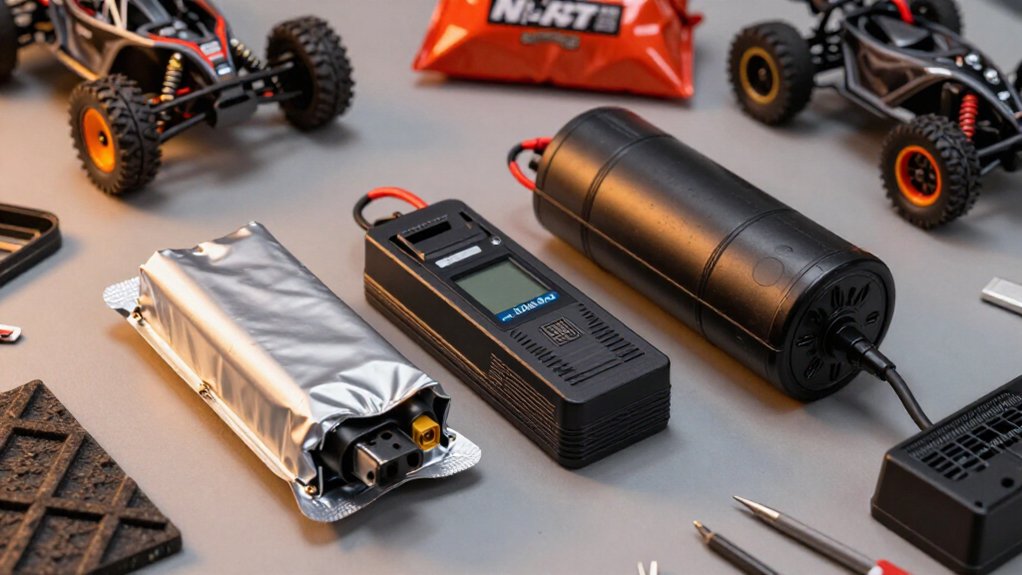
Choose LiPo if you want harder acceleration, lower weight, and steadier voltage under load: a 2S pack is 7.4 V nominal, but its high discharge capability demands balance charging, correct ESC low-voltage cutoff, and careful handling.
Choose six-cell 7.2 V NiMH for lower cost, simpler charging, and better abuse tolerance, accepting more voltage sag and weight.
Check ratings, fit, connectors, and temperatures before changing chemistry. The details below help match battery behavior to driving style.
Cell Voltage and C-Rating
Voltage and discharge capability determine whether a battery suits your RC model. A NiMH cell supplies 1.2 V nominally; six cells produce 7.2 V. A LiPo cell supplies 3.7 V, so a 2S pack produces 7.4 V. That close voltage match doesn’t guarantee compatibility: verify your motor and ESC support the pack voltage before changing types.
| Pack type | Typical discharge rating |
|---|---|
| LiPo | 20C to 50C |
| NiMH | 5C to 10C |
C-rating estimates continuous current: multiply amp-hour capacity by C. For example, a 5 Ah 50C LiPo can deliver 250 A continuously. Higher current capability can meet demanding acceleration loads, but it also increases fault energy. Don’t assume a higher-C replacement is automatically safe; confirm connector, ESC, motor, and wiring current limits before installation and operation under expected load conditions.
Electrode Chemistry and Construction
NiMH and LiPo packs achieve similar RC pack voltages through fundamentally different cell chemistry and construction. When you select either type, understand what sits behind the label: NiMH uses nickel oxide hydroxide at its positive electrode and a hydrogen-absorbing alloy negative electrode. LiPo uses a cathode, anode, separator, and gel-like polymer electrolyte enclosed in a flexible pouch.
- NiMH cells provide 1.2 V nominal each.
- Six NiMH cells create a 7.2 V nominal pack.
- LiPo cells provide 3.7 V nominal each.
- Two LiPo cells create a 7.4 V nominal pack.
- LiPo pouches need protection from puncture and crushing.
Unlike conventional lithium-ion cells with liquid electrolyte and rigid casings, LiPo’s polymer-based pouch construction requires you to prevent mechanical damage, which can compromise internal separation and safety.
Runtime Under Sustained Load
Under sustained load, LiPo packs usually run longer than comparably weighted NiMH packs because they store substantially more energy—about 150 to 350 Wh/kg versus 60 to 120 Wh/kg. That advantage gives your model more usable watt-hours at the same mass, extending demanding runs. LiPo cells also hold a flatter discharge curve: under high current, they retain voltage and help your motor maintain power.
NiMH packs provide steady service at moderate loads, but they’re heavier for equivalent stored energy and sag more during discharge. Don’t equate a higher LiPo discharge rating with longer runtime; capacity, average current, gearing, vehicle weight, and conditions determine duration. Check pack condition and voltage during use to prevent over-discharge.
Storage matters: standard NiMH may lose 25 to 30% monthly, versus roughly 5% for LiPo, reducing availability.
LiPo Balance-Charging Learning Curve
LiPo balance charging adds a safety-critical setup step: you must use a balance charger that monitors each cell individually and helps prevent imbalance or overcharging. That requirement creates a steeper learning curve than basic charging: you must verify settings before energy enters the pack.
- Identify the pack’s cell count and capacity.
- Connect the main lead and balance lead correctly.
- Select LiPo mode, matching cell count, and charge current.
- Use 1C, 1 A for a 1,000 mAh pack, unless manufacturer instructions state otherwise.
- Charge in a fire-resistant area, remain present, and stop for swelling or unusual heat.
Only choose 2C–5C charging when the manufacturer explicitly approves it. Treat charger prompts as verification, not assumptions; an incorrect program or connection can create an avoidable thermal event.
ESC Low-Voltage Cutoff Compatibility
Before you install a LiPo pack in a vehicle built for NiMH, verify that its ESC explicitly supports LiPo chemistry and provides a configurable low-voltage cutoff (LVC). LVC protects your pack by reducing or stopping power before cells fall below 3.0 V per cell, where over-discharge can cause damage and create safety risks. Check the ESC manual and program the cutoff for the pack’s series count: a 2S LiPo is nominally 7.4 V, while an 11.1 V pack is typically 3S.
Don’t assume a generic voltage setting is correct; an unsuitable threshold can either over-discharge the pack or end a run prematurely. If your ESC lacks LiPo-compatible LVC, fit an appropriate external low-voltage alarm or use a battery chemistry the ESC explicitly supports.
Cycle-Life Cost per Run
Battery value depends on the cost of each usable run, not just the purchase price. Calculate it by dividing purchase cost by realistic completed runs, then add any charger expense. Your usage pattern matters: a carefully maintained LiPo can deliver stronger performance and longer runtime, while NiMH often wins on durability and lower entry cost.
- NiMH packs commonly reach 500 to 1,000 cycles.
- Properly maintained LiPos typically reach 300 to 500 cycles.
- Frequent driving can justify LiPo’s higher investment.
- Hard use or poor care can cut LiPo life below 50 cycles.
- Use the same run definition for both chemistries.
Inspect packs, charge with appropriate equipment, and retire damaged batteries; preventing abuse protects safety and preserves the cycle-life assumptions behind your calculation for a fairer overall ownership estimate.
Cold-Weather Voltage Sag
Cold weather raises internal resistance, causing both LiPo and NiMH packs to sag in voltage when your RC model demands high current. You’ll notice weaker acceleration, reduced motor power, and, in some setups, an ESC low-voltage cutoff that arrives earlier than expected. NiMH packs can show a particularly obvious power decline during demanding runs.
LiPo packs benefit from a flatter discharge curve, so they usually deliver steadier output, yet high-current bursts can still produce significant cold-weather sag. Check your battery manufacturer’s operating limits and test the pack under your model’s normal load. Don’t charge either chemistry while it’s too cold. First warm the pack into the manufacturer-approved temperature range, then inspect voltage behavior cautiously before committing to operation.
Puffing Risk and Durability
If your LiPo pack swells, treat it as damaged and don’t charge or run it, because internal failure can trigger thermal runaway. You can reduce puffing risk by avoiding deep discharge and heat, then storing the pack at roughly 50% to 70% charge. Expect about 300 to 500 LiPo cycles versus 500 to 1,000 for properly maintained, more physically tolerant NiMH packs.
LiPo Swelling Warning Signs
LiPo swelling, often called puffing, signals internal cell damage from causes such as overcharging, deep discharge, overheating, or physical impact. You should treat any deformation as a safety failure, not a cosmetic defect.
Inspect each pack before and after use for:
- A pouch that no longer lies flat.
- Bulging seams or separated outer layers.
- Leaks, sweet odors, or residue around terminals.
- Unusual heat during charging, running, or rest.
- Soft spots, dents, or damage after a crash.
If you find any sign, stop using and charging the pack immediately. Don’t puncture, compress, or attempt to repair its pouch; these actions can trigger thermal runaway. Isolate it in a fire-resistant area and follow local hazardous-waste disposal rules. A damaged pack’s remaining runtime doesn’t reliably indicate safety.
Cycle Life and Care
Battery lifespan depends as much on care as chemistry: NiMH packs may provide roughly 500 to 1,000 charge cycles, while properly maintained LiPo packs typically deliver about 300 to 500.
That advantage doesn’t make NiMH maintenance-free: overcharging and heat exposure shorten its service life. You should store both chemistries away from heat and never leave either discharged for long periods. For LiPo durability, stop before deep discharge, obey the manufacturer’s charge limits, and store packs half charged, approximately 3.8 V per cell. Damage, overcharge, or excessive discharge can cause LiPo puffing. If a pack swells, don’t charge, use, puncture, or compress it; isolate it and arrange battery disposal.
Heavy running, temperatures, and charging practices reduce cycle life regardless of chemistry. Inspect connectors, leads, and case condition before session.
Bashers, Crawlers, and Racers
For bashing, you’ll get stronger burst power and less weight from LiPo, while NiMH offers a lower-cost, more forgiving setup for casual runs. For crawling, prioritize controlled runtime and confirm that your ESC supports a LiPo before switching from a 7.2V NiMH pack to a 7.4V 2S LiPo. For racing, LiPo maintains more consistent speed under heavy acceleration, but you must use balance charging and low-voltage protection.
Bashers: Burst Power
When your basher needs hard acceleration and rapid recovery after jumps, LiPo packs deliver stronger burst current and hold power more consistently than NiMH. Their flatter discharge curve limits voltage sag, so you retain punch as the pack drains; NiMH often softens under heavy throttle. Before upgrading, verify:
- Voltage matches your motor and ESC.
- ESC supports LiPo and has low-voltage cutoff enabled.
- C-rating: 5,000mAh equals 5Ah; 50C rates 250A continuous.
- Connectors and wiring safely handle expected current.
- The pack is undamaged, secured, and cool before use.
Don’t treat the rating as a guarantee: drivetrain load, temperature, and pack condition affect real output. Stop if you notice swelling, heat, or voltage-cutoff activation. Use a suitable charger and never leave charging unattended at home or track.
Crawlers: Controlled Runtime
Rock crawlers prioritize low-speed control and usable runtime over maximum punch, so NiMH packs can suit drivers who want predictable, moderate power and gradual throttle response.
For technical crawling, this softer delivery can help you meter torque and preserve traction on uneven surfaces. However, NiMH voltage sags under load, so your crawler’s power and speed will decline as the pack drains.
A LiPo holds voltage more steadily, but its added output may not improve controlled crawling. Before installing one in a NiMH-designed crawler, verify that your ESC and motor support its voltage and that the ESC includes a LiPo low-voltage cutoff. Choose capacity for the runtime you need and confirm the pack fits securely in the battery tray and stays safely restrained during use.
Racers: Consistent Speed
Racers usually favor LiPo packs because their high discharge capability and flatter voltage curve sustain stronger acceleration and more consistent speed through a run. You get lighter packs than comparable-capacity NiMH options, which can sharpen handling and reduce mass during braking and direction changes.
- Check ESC voltage rating.
- Enable a LiPo low-voltage cutoff.
- Confirm motor temperature limits.
- Inspect drivetrain gears and shafts.
- Balance-charge packs and use a fire-safe charging area.
NiMH can work, but voltage sag under hard acceleration often reduces speed as capacity falls. Before converting, you should verify that the ESC, motor, and drivetrain tolerate the selected cell count. Monitor temperatures after early runs, since LiPo power can expose weak gearing, overloaded electronics, and accelerate wear without proper setup under load in competition.
Start NiMH, Upgrade Later
Start with a six-cell NiMH pack if you’re new to RC, because its 7.2V output, lower purchase cost, and straightforward charging make it a forgiving baseline for compatible entry-level models. NiMH cells deliver 1.2V each and tolerate a simpler charging routine, helping you focus on vehicle control and maintenance.
When you need lower weight, harder acceleration, or higher discharge capability, consider a 2S LiPo at 7.4V. Don’t treat that voltage difference as automatic compatibility: verify that your ESC supports LiPo chemistry and includes a low-voltage cutoff. Also confirm motor limits and battery-compartment dimensions. Budget for a balance charger, then charge LiPos on a nonflammable surface, monitor them, and store them safely. This staged approach limits initial expense while ensuring your electronics and safety procedures are ready.
Conclusion
You’ll get higher voltage, lower weight, and stronger sustained power from LiPo packs, but you must use balance charging, a compatible low-voltage cutoff, and disciplined storage practices to control fire and puffing risks. NiMH costs less upfront, tolerates simpler handling, and remains practical for beginners, cold conditions, and low-demand vehicles. Match chemistry to your ESC, driving style, and maintenance habits. Start with NiMH if safety routines aren’t established; upgrade to LiPo when you manage them reliably.
RC Battery Runtime & Voltage Calculator
Get LiPo or NiMH pack voltage (nominal and full), estimated runtime and C-rating current from cells, mAh, C and average amp draw.
LiPo Charge Time & Charger Wattage Checker
Estimate how long a LiPo pack takes to charge and check whether your charger's watts and amps cover the charge current you enter.
Nitro Fuel Runtime & Cost Calculator
Enter your tank size, timed minutes per tank, sessions and fuel price to estimate nitro fuel used and its cost per session and per month.