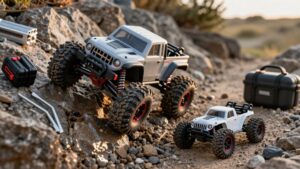
How to Choose an RC Rock Crawler: Scale, Axles, Servo and Gearing
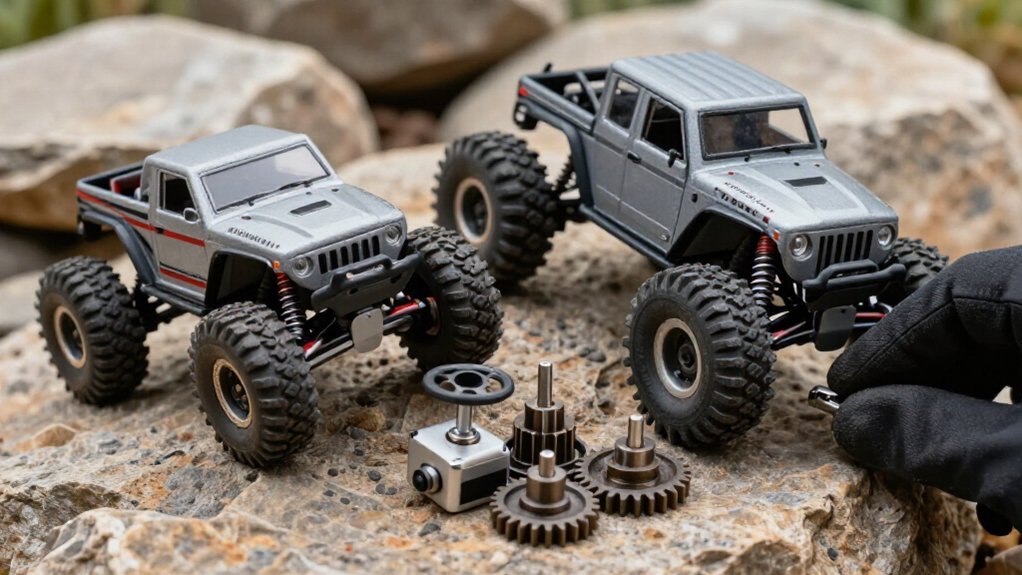
Choose a 1/10-scale crawler for versatile trail and rock use, then match its layout to your goals: axle-mounted steering favors crawling performance, while chassis-mounted steering suits scale realism.
Pick a servo rated for at least 300 oz-in, or 400 oz-in for demanding competition builds, and verify voltage and fit.
Set gearing for your terrain, and check battery clearance through suspension travel. Confirm replacement-part support and electronics’ water ratings before buying.
The details below will help you compare options.
Scale, Axles, Servo and Gearing
When you compare 1/10-scale crawlers, check how the steering layout, servo, and gearing suit your terrain and build. Most 1/10-scale crawlers use standard-size servos, roughly 40 × 20 × 38 mm; check chassis fit and voltage compatibility. For reliable steering, choose metal gears and at least 300 oz-in of torque; heavier rigs suit 400 oz-in or more. Servo speed uses seconds per 60 degrees; aim for 0.15 to 0.20 seconds for adjustments.
With axle-mounted steering (AMS) on the SCX10 Pro, the servo sits behind the axle and supports a 4-link setup. Chassis-mounted steering (CMS) pairs a 3-link and panhard bar for a scale appearance. Calculate gear ratio by dividing ring-gear teeth by pinion-gear teeth: a 12-tooth ring gear and 4-tooth pinion produce 3:1, affecting power transfer and speed.
Choose Your Preferred Crawler Scale
Choose Your Preferred Crawler Scale
Choose a scale based on your driving space, terrain, and storage needs: 1/10 crawlers suit most trail and rock crawling, while smaller models fit tight spaces and are easier to carry.
Before choosing, compare the model’s footprint with your usual routes and storage area. A compact crawler can navigate desks, indoor obstacles, or narrow garden features, but its smaller tires and chassis may limit clearance on rough ground. Larger rigs provide more room for detailed bodies and components, yet their added weight can demand stronger steering parts and carefully matched gearing. Check parts availability before you commit; compatible tires, servos, and drivetrain upgrades simplify maintenance and customization.
For 1/10 scale, a standard-size servo measures about 40 × 20 × 38 mm, but verify the mounting space in your chosen model rather than assuming it’ll fit. Then consider how you’ll transport and store the rig; choose the scale you can use regularly, not simply the largest one available for your needs.
Axle Configuration Choices
Axle-mounted servo (AMS) and chassis-mounted servo (CMS) setups trade crawling performance for scale realism. The Axial SCX10 Pro supports both, so choose according to terrain and competition priorities.
| Configuration | Suspension | Practical trade-off |
|---|---|---|
| AMS | 4-link | Servo behind axle lowers center of gravity; geometry favors performance, but exposure may cost scale points. |
| CMS | 3-link + panhard bar | Servo mounts low and forward for scale realism, stays protected; higher position raises center of gravity and geometry is less optimized. |
For trail use, weigh obstacle clearance and articulation against body detail and judging rules. AMS suits you when axle behavior matters most; CMS fits builds where a protected installation and scale appearance matter more. Confirm linkage compatibility before changing configurations, since each arrangement relies on matched suspension geometry.
Servo Torque and Speed
For a 1/10-scale crawler, aim for 300–500 oz-in of servo torque and check ratings at the voltage you’ll use. Balance torque with speed: about 0.15 to 0.20 seconds per 60 degrees gives you responsive, precise steering. Choose more torque for heavy rigs or rock-loaded steering, and enough speed to suit your crawling style and reposition tyres quickly.
Understanding Servo Torque
Servo torque is the rotational force a servo applies to the steering linkage, measured in ounce-inches (oz-in) or kilogram-centimetres (kg-cm). For a 1/10-scale crawler, aim for at least 300 oz-in (21.6 kg-cm); 300–500 oz-in suits most rigs. Larger tyres and heavier chassis increase steering load, so choose enough torque to turn the wheels under traction.
Heavy or competition builds may need more than 500 oz-in. Check the torque rating at the voltage you’ll use, since voltage can raise output. However, use an HV servo at 7.4 V or 8.4 V only if your receiver and other electronics support that supply. A rating measured at a different voltage may not reflect performance in your crawler. Match the servo’s operating range to your system.
Balancing Torque and Speed
Torque and speed ratings work together, but crawling favors holding force over outright pace. Your servo must hold steering against tire friction, obstacles, and vehicle weight, so prioritize torque over a fast no-load rating. For a 1/10-scale crawler, target at least 300 oz-in (21.6 kg-cm); 300 to 500 oz-in suits most rigs, while heavier builds or larger tires may need more.
Pair that output with a speed near 0.15 to 0.20 seconds per 60 degrees. This range gives you prompt, controlled steering corrections without making the wheels snap too quickly. Compare both ratings at the voltage you’ll actually supply. An HV servo may deliver more torque and speed at 7.4 or 8.4 V, but use those levels only if your receiver, ESC, and other electronics support them reliably.
Choosing Torque for Terrain
When tyres bind against rocks, steering loads can make an undersized servo fade, stall, or overheat, so prioritize torque over speed. For a 1/10-scale crawler, target at least 300 oz-in (21.6 kg-cm); 300 to 500 oz-in covers most rigs. Heavier builds or larger tyres may demand more.
On an SCX10 Pro, consider at least 400 oz-in to maintain steering under vehicle weight on sidehills; top competitors may exceed 1,000 oz-in. Check ratings at the voltage you’ll supply: higher voltage can raise torque and speed, but verify that your servo and electronics support it. A 0.15 to 0.20-second transit per 60 degrees gives responsive, precise adjustment; don’t trade away holding force to chase quicker movement. Use the manufacturer’s rating under load, not an unloaded estimate, when comparing candidate servos.
Matching Servo Speed to Crawling Style
How quickly your steering needs to react depends on your crawling style. For most crawling, choose a servo rated at 0.15 to 0.20 seconds per 60 degrees. That range gives you responsive control, but speed shouldn’t outrank torque. Aim for at least 300 oz-in (21.6 kg-cm) in a typical 1/10-scale crawler; choose 400 oz-in or more for a heavy rig.
If you often wiggle the tires rapidly to break traction or reposition the front end on ledges and sidehills without throttle, a quicker servo can help. Larger tires and greater vehicle weight increase steering load, so adequate torque helps prevent sluggish response, stalling, and overheating. Compare torque and speed ratings at the voltage you’ll actually use: higher voltage can raise both figures, if your servo supports it.
Trail Rig or Comp Crawler
Start with the terrain you’ll drive and decide whether trail comfort or competition performance matters more. A trail rig favors scale detail and protected components, while a comp crawler prioritizes clearance, steering geometry, and a lower center of gravity. Match the chassis and servo setup to your use: CMS suits realistic trail builds, while AMS favors obstacle performance.
Terrain And Purpose
Where you drive should determine your setup: choose a trail rig for varied outdoor runs and scale realism, or a comp crawler when technical obstacles and steering performance take priority. Match your steering layout to that purpose: a chassis-mounted servo (CMS) suggests a full-size truck’s steering system, while an axle-mounted servo (AMS) generally favors performance over scale appearance. The Axial SCX10 Pro supports both: AMS pairs with a 4-link suspension; CMS uses a 3-link and panhard bar.
On competition side-hills, or with a heavy rig, choose a servo rated at least 400 oz-in to help hold steering under load. Then tune tires to terrain: soft, aggressive-tread tires and dual-stage foams improve grip and conformity. Avoid excess wheel weight; it can bog down your motor.
Trail Comfort Or Competition
If scale appearance and general-purpose driving matter most, choose a trail rig; a hard body, winch, and lights add character, but weight mounted high can reduce stability.
Choose a competition crawler for obstacle performance. A low-center-of-gravity chassis, forward weight bias, and grippy tires help you climb and hold side hills. AMS places the servo low behind the axle for performance; CMS looks more scale and protects it from impacts.
For a competition-focused 1/10 crawler, aim for at least 400 oz-in of steering torque; top competitors may exceed 1,000. A typical servo should turn 60° in 0.15–0.20 seconds. Tune weight, not simply add it: low, forward brass or wheel weights can steady your rig on climbs, but excessive wheel weight can bog down the motor.
Scale Detail Versus Clearance
Your choice between a trail rig and a comp crawler also shapes how you balance scale detail against obstacle clearance.
A trail rig typically favors scale parts such as a hard body, winch, light bar, toolbox, and realistic bumpers over maximum clearance. A comp crawler favors clearance and performance; you’ll often remove bulky parts or avoid high-mounted accessories that catch obstacles. A heavy hard body and roof details raise the center of gravity, reducing stability on side-hills and steep climbs.
A lighter Lexan body can retain a scale look with less penalty. Consider each accessory’s mass and position: low, forward weight can aid stability, while weight high above the chassis increases rollover risk. Keep details you value, but reject additions that reduce clearance or add unnecessary upper weight. Inspect how body panels and bumpers affect approach and breakover angles; low-hanging parts can snag rocks. Judge the added height and mass against the terrain you tackle, and preserve clearance where obstacles routinely contact the chassis and suspension.
Match The Setup
Match the steering layout to the rig’s purpose: a trail rig favors durable, scale-appropriate parts and a chassis-mounted servo (CMS), while a comp crawler benefits from the steering performance of an axle-mounted servo (AMS).
On the SCX10 Pro, AMS mounts behind the axle with a 4-link suspension; CMS sits low and forward, paired with a 3-link and panhard bar. Choose CMS when realism and servo protection matter more than maximum steering geometry. For a heavy comp rig, use at least 400 oz-in of torque so the servo can hold steering on sidehills, and verify that it fits your selected mount. Then gear for your terrain and goal: shorter gearing can raise racing speed, while crawler wheel size and terrain dictate the reduction you need.
Battery Tray Clearance
Before choosing a crawler, check that its battery tray clears the battery, wiring, and connector without restricting suspension movement or contacting nearby components.
Next, compare the tray’s length, width, and height with your pack, allowing room for leads and the plug to bend without being pinched. On a tight chassis, check clearance through the suspension cycle and around links, shocks, and other components; static fit alone isn’t enough.
A low, forward battery position lowers the center of gravity, helping your crawler climb and remain stable on side hills. If the stock pack sits high, moving it lower and farther forward can improve weight bias without adding mass. If your battery won’t fit or its placement compromises clearance, identify a compatible tray or mounting solution before you buy. Confirm that the mount holds the pack under vibration and impacts, while keeping wiring accessible and away from moving parts.
Replacement Parts Availability
Check parts support before you buy: confirm that the crawler’s specific model has replacement axles, driveshafts, suspension links, gears, and servo mounts available. Search the model number, scale, and version rather than relying on a brand-wide parts list; dimensions and mounting points can differ across variants.
A popular platform with established aftermarket support makes repairs and upgrades easier. Verify stock for wear-prone drivetrain components, especially if you’ll install larger tyres or a higher-output motor, which can increase load on gears and driveshafts. Before choosing an aftermarket servo, check that compatible servo horns and mounts fit your steering setup. Compare part numbers and diagrams with your chassis, and note whether listings cover your exact version. It helps you plan and select upgrades that fit without modification.
Poor Parts Support
When parts support is poor, a broken axle, driveshaft, or steering component can leave your crawler sidelined. Before you buy, verify support for the exact model, not just the brand. A part that fits a similar chassis may still need drilling, shimming, or other custom work. Check whether you can service or upgrade the servo, axles, and drivetrain with standard-fit components; difficult swaps can turn a routine repair into a lengthy project.
- Search model-specific manuals and parts diagrams before purchase.
- Compare compatible options from Injora, SSD RC, Vanquish Products, REEFS RC, or Furitek; fit varies by model.
- Favor clear fitment notes and accessible spares, so repairs take less time and upgrades can progress without guesswork.
Check availability before purchase to avoid model-specific delays later.
Waterproof Electronics Rating
After confirming parts support, consider how well the crawler’s electronics handle water on the trail.
Waterproofing helps when you meet puddles or wet ground unexpectedly, but ratings need careful interpretation. A sealed servo can resist dust and dirt as well as moisture, potentially extending its service life. Still, don’t assume every component shares that protection or can survive submersion. Check the conditions you expect, then verify each unit’s limits in its documentation.
- Match the servo’s water protection to the terrain you’ll tackle.
- Check the receiver and ESC ratings separately; they may differ.
- Treat waterproofing as protection, not permission to submerge the entire crawler.
A waterproof servo alone can’t protect other electronics. Before driving through water, inspect seals and follow the manufacturer’s stated operating limits.
Conclusion
Choose your crawler scale first, then match axle configuration to the terrain and chassis width you need. Select a servo with enough torque to steer under load, and gearing that suits trail endurance or competition control. Check battery tray clearance before choosing a pack, and confirm replacement parts are easy to source. Avoid models with poor parts support. Finally, verify the electronics’ waterproof rating against your expected conditions; waterproof protection doesn’t make every component safe to submerge.