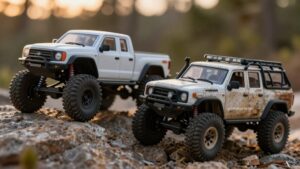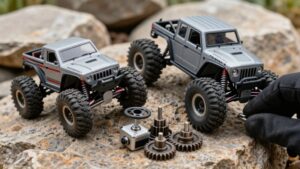
SCX24 vs TRX4M: Which Micro Crawler Should You Buy?
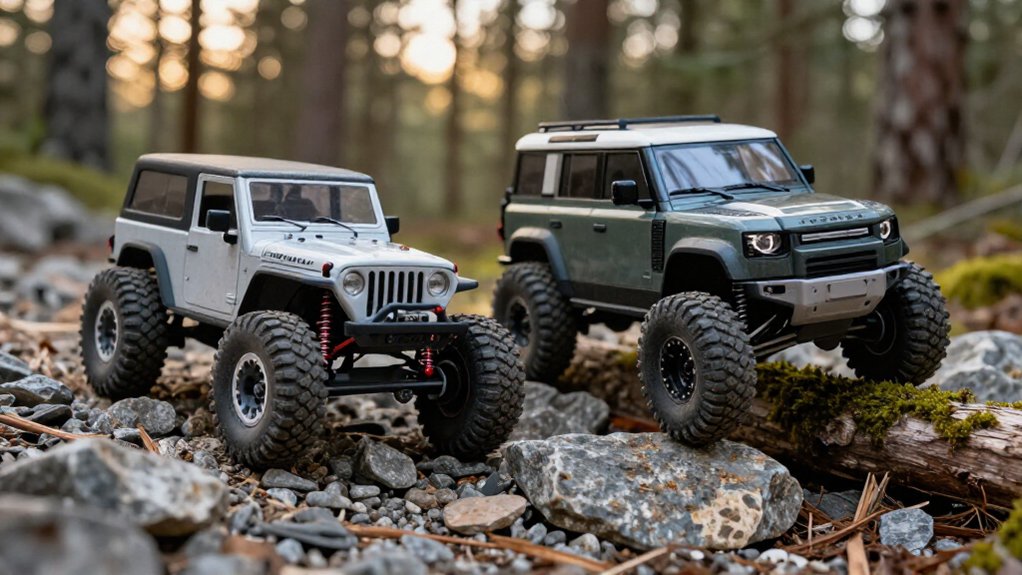
Choose the SCX24 if you want a true 1/24 crawler for desk courses, narrow shelves, and budget-friendly upgrades. Its huge aftermarket aids repairs, but expect less stock tire grip and a weaker servo.
Choose the larger 1/18 TRX4M for portal-axle clearance, stronger out-of-box crawling, realistic scale detail, and backyard rock gardens.
Check local parts, battery connectors, and charger costs before buying. The differences in sand, setup, and upgrades become clearer below as you compare them.
Battery Connectors and Charger Differences
Battery compatibility is one of the easiest details to overlook when comparing the SCX24 and TRX4M. Traxxas gives the TRX4M its ID system, so you get straightforward plug-in charging when you use compatible Traxxas ID equipment. The SCX24 uses a different battery-and-charger arrangement, making connector checks essential before you order spares.
| Truck | Charging takeaway |
|---|---|
| TRX4M | Traxxas ID battery system |
| SCX24 | Verify connector and charger compatibility |
Don’t expect packs to interchange: connector design, voltage, capacity, and charging specifications must all suit the truck. If you’re building a two-rig micro-crawler fleet, choose a multi-chemistry charger and correct adapters. You’ll streamline pit time while retaining proper charge settings. Buy an extra pack for either rig, but confirm its plug and charging requirements first, before any new purchase.
SCX24 1/24, TRX4M 1/18
Scale creates the clearest split between these ready-to-run crawlers: the Axial SCX24 is a true 1/24-scale rig, while the Traxxas TRX4M uses the larger 1/18 format. That difference immediately shapes how you’ll use each truck. The SCX24’s compact footprint fits tight indoor courses, desk-top obstacles, and improvised lines where every inch matters.
It’s also easy to slip into a jacket pocket for spontaneous sessions. The shoebox-sized TRX4M still travels easily in a bag, but it demands more room than the Axial. Its larger 1/18-scale chassis feels more at home when you head outdoors and want a micro crawler that occupies a broader trail footprint. Choose the SCX24 if you prioritize maximum portability and confined terrain; choose the TRX4M if you favor larger outdoor spaces.
Stock Tires and Ground Clearance
The TRX4M starts with a clear obstacle-clearing advantage: its portal axles place the axle housings higher than the SCX24’s straight-axle design, giving it more stock ground clearance over rocks, roots, and trail debris. This geometry keeps clearance at the axles instead of requiring a taller chassis, so you get breakover capability without raising the center of gravity as aggressively.
The SCX24 can navigate tight lines, but its stock tires often surrender traction on loose outdoor surfaces, and its light weight makes off-camber sections precarious. You can transform its composure with grippier tires and strategic brass low in the chassis. The TRX4M also offers a tire-upgrade path: its 1.0-inch wheels accept options, including Pro-Line crawler tires, letting you tune grip for rock, dirt, or terrain.
First-Battery Setup Difficulty
Getting either rig running takes little effort because both arrive ready to run, but the TRX4M makes the first battery connection especially painless with Traxxas’s ID plug-in system. You simply match the intended pack and charger, connect them, and focus on checking steering, throttle, and trim rather than sorting through connector choices. The SCX24 is similarly beginner-friendly, although you should confirm the connector and charging gear specified for your exact version before ordering extras.
Its smaller battery also means shorter sessions, so a spare pack is a practical early purchase if you don’t want frequent pauses. Neither truck turns setup into a build project, but charger and battery costs belong in your opening budget. Verify compatibility first since included batteries, chargers, and connectors differ.
Desk Courses, Backyard Trails
Where you plan to crawl matters more than minor spec differences: the 1/24-scale SCX24 thrives on desk courses, books, rocks, and tight living-room gates that would feel cramped for the shoebox-sized 1/18 TRX4M. Its lighter chassis is easier to thread through compact lines and balance across small indoor obstacles. Add brass weight and grippier tires, and you’ll gain a more planted, controlled feel without overwhelming the course.
For backyard terrain, you’ll notice why the larger TRX4M arrives more trail-ready. Its portal axles raise clearance, while its heavier build tracks better over loose dirt and uneven surfaces. The SCX24 can tip on off-camber sections or lose grip on steep climbs. Better tires and a stronger servo help, but you’ll want the TRX4M for outdoor capability.
TRX4M Replacement Parts Cost More
Expect to spend more on TRX4M repairs and upgrades than on comparable SCX24 hardware. Its larger chassis and components use more material, so replacement parts and weight-focused upgrades typically carry higher prices. That’s especially noticeable when you build a brass-equipped crawler: equivalent TRX4M brass parts usually exceed the SCX24’s roughly $25 to 35 complete brass kit.
Traxxas-branded components can raise your total further, although third-party choices help. With an SCX24, you can shop a deeper aftermarket spanning Injora, RC4WD, and Hot Racing. That breadth gives you more price points for tires, links, wheels, bodies, and other hardware. If you’re planning frequent tuning or trail repairs, the SCX24 stretches your budget farther while preserving plenty of performance paths for different build goals and crawling styles over time.
SCX24 Stock Servo Durability
Budget for one likely SCX24 upgrade beyond brass and tires: the stock servo is a commonly reported weak point. If you crawl steep lines, the tiny factory unit can struggle to hold steering angle under load, especially once added brass increases front-end demand. That doesn’t mean you must replace it immediately: run the stock setup first and judge it by how confidently it centers and holds a line.
But many owners upgrade within the first month when performance fades or durability becomes an issue. The TRX4M gives you a better-performing stock servo, so it suits you better if you want fewer early changes. A stronger SCX24 servo becomes more compelling as you add weight and tackle steeper terrain with precision.
TRX4M Realism, SCX24 Repairability
You get more scale presence and trail-truck realism from the shoebox-sized 1/18 TRX4M, while its portal axles add clearance without a major center-of-gravity penalty. You’ll likely wrench less initially thanks to its stronger stock servo, ESC, and drivetrain. When repairs or customization take priority, the SCX24’s huge aftermarket makes replacement parts and upgrades exceptionally easy to source.
Scale Detail And Realism
The TRX4M delivers stronger out-of-the-box scale realism because its larger 1/18 footprint gives body lines, exterior hardware, and trail accessories more visual presence without sacrificing bag-friendly portability. Its proportions make bumpers, mirrors, grille work, and mounted gear look less toy-like when you’re photographing a trail setup or running alongside larger scale rigs.
The SCX24 trades that size for a more miniature presentation, yet it remains compelling if you want to build a highly specific truck. Bronco, Gladiator, Deadbolt, and Basecamp body options create distinct starting points, while the enormous aftermarket supports appearance upgrades. You can tune its character with bodies, lights, wheels, tires, links, and brass accents. The TRX4M’s 1.0-inch wheels also open broader tire selection, including Pro-Line options. Traxxas offers presence; Axial offers personalization.
Simple Repairs And Parts
Beyond their visual character, these micro crawlers differ sharply in how easily you can keep them running. The SCX24’s long-established platform gives you the easier repair path: servos, links, wheels, and drivetrain pieces are widely stocked, while Injora, RC4WD, Hot Racing, and Vanquish offer choices from budget replacements to premium upgrades. That availability makes it especially forgiving when you’re learning basic wrenching.
The TRX4M aftermarket is smaller but expanding, with practical replacement servos, tires, and brass parts readily available. Its integrated ID battery system simplifies connections, and portal axles add clearance, though they can sound noisier than straight axles. For children or new drivers, remember the SCX24’s stock servo is a common upgrade. Keep hex drivers and a spare battery for either truck.
Rock Gardens, Shelves, and Sand
You’ll get stronger rock-garden traction and sand performance from the TRX4M, thanks to its portal clearance, weight, and capable stock tires. You can place the lighter SCX24 more precisely on cramped shelves and tight indoor ledges, though off-camber grip exposes its stock setup’s limits. For sandy or loose outdoor lines, the SCX24 needs tires and brass, while the TRX4M is ready to keep crawling.
Rock Garden Traction
When the trail turns into uneven rock gardens, shelves, and loose sand, the TRX4M holds the stock advantage. Its portal axles lift the chassis higher, so you can clear ledges and rock faces that may snag the lower SCX24. That extra clearance, combined with the TRX4M’s heavier build, gives you a composed platform over broken terrain and bite when sand shifts beneath the tires.
The SCX24’s lighter weight can become a liability on loose surfaces and steep, off-camber rocks, where it may spin or tip sooner. You can close much of that gap with grippier tires and strategically added brass weight. An upgraded servo also helps you maintain control on steep climbs. Still, if you’re tackling demanding outdoor rock gardens straight from the box.
Shelf Crawling Precision
Shelf crawling shifts the comparison toward scale and placement accuracy. You’ll notice the SCX24’s 1/24-scale chassis lets you build convincing tabletop rock gardens from small ledges, tight switchbacks, and narrow shelves. Its compact footprint makes each wheel placement feel deliberate rather than cramped.
- Set a matchbox-width ridge beside a book; the SCX24 can line up without crowding the edge.
- Thread it through pebble gates and tight turns, where its scale lets you refine every approach.
- Point the TRX4M at taller stacked rocks; its portal axles add clearance over uneven, outdoor-style terrain.
- Give the larger 1/18 rig wider landings and turning room, then exploit its stronger stock capability on rough courses.
Choose SCX24 for indoor precision; choose TRX4M for bigger obstacles.
Sand Performance Limits
Sand exposes the limits of both micro crawlers: the TRX4M’s heavier build and portal-axle clearance give it the stronger stock footing, but neither rig will float across deep, loose sand. On firm sand and packed paths, both manage, but loose grains strip tire bite, load drivetrain, and punish momentum on climbs. Rock gardens and narrow shelves remain their habitat: the surface gives the tires edges to grab, while compact dimensions help you pick lines.
A stock SCX24 loses traction sooner and can tip on uneven outdoor terrain. Fit grippier tires and low-mounted brass, and you’ll improve its stability, though it still won’t match the TRX4M’s confidence in mixed terrain. Choose the TRX4M if your routes include sand; choose the SCX24 for indoor courses instead.
Choose by Local Parts Availability
Local parts access can outweigh spec-sheet differences, especially if you’ll upgrade or repair your crawler often. The SCX24’s broader ecosystem usually puts more parts within reach, but your nearest hobby shop matters more than catalog size.
- Check tires, servos, batteries, and drivetrain parts at local retailers and online suppliers.
- Choose the SCX24 if you want Injora, RC4WD, Hot Racing, Vanquish, and smaller-shop options.
- Expect fewer, pricier niche TRX4M choices, particularly for Traxxas replacements.
- Factor in electronics: the SCX24’s stock servo is a common early swap, while the TRX4M’s stronger system may delay that expense.
If local inventory decides the purchase, buy the truck your retailers regularly support. The SCX24 still offers wider overall coverage, but shelves vary by region and demand week to week.
Conclusion
You’ll get more scale presence, clearance, and stock trail capability from the TRX-4M, especially on backyard dirt, sand, and uneven rock. Its larger 1/18 platform feels more realistic, but its battery and setup demand slightly more attention. Choose the SCX24 if you prioritize compact desk courses, easy repairs, broad aftermarket support, and lower-cost experimentation. Its stock servo remains a weak point. Ultimately, buy the truck your local hobby shop can support fastest when something breaks.