1/10 Vs 1/18 RC Crawler: Size, Capability and Cost Compared
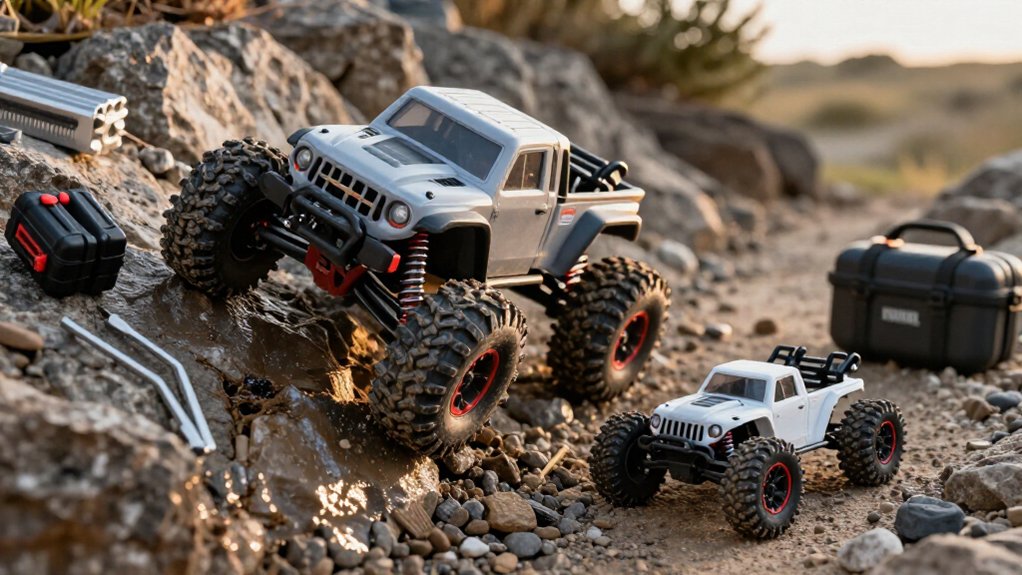
Choose a 1/18 crawler if you need compact storage, tabletop courses, and lower transport and obstacle costs. It handles packed soil, flat stones, small roots, and technical indoor lines, but its shorter wheelbase and smaller tires struggle on rough trails.
Choose a 1/10 for broader outdoor capability, better washout bridging, and usually wider parts and body support. Compare battery contents, spares, dimensions, and club limits; the details below help you match scale, terrain, and budget.
1/10 Vs 1/18 Dimensions
A typical 1/10 RC crawler measures about 18 to 24 inches (45 to 60 cm) long, while most 1/18 models span roughly 10 to 12 inches (25 to 30 cm). You’ll get a visibly larger footprint from a 1/10, but body shape and chassis design can shift real-world dimensions. Don’t assume scale predicts every measurement.
| Size | Space trade-off | Feeling |
|---|---|---|
| 1/10 | Demands more room to turn and store | Big, capable presence |
| 1/18 | Fits compact routes and shelves | Relief for tight budgets and rooms |
Before buying, compare listed width, wheelbase, tire diameter, and ground clearance. Scale alone can’t tell you whether a crawler fits your course or bridges a gap; those specifications do. A 1/18 saves space and may reduce storage costs, while a 1/10 gives you a larger platform. Measure your space first.
Drivetrain Layout and Gear Reduction
Scale doesn’t dictate a crawler’s drivetrain: either a 1/10 or 1/18 can use a motor, transmission, driveshafts, and solid axles, but the exact chassis determines the layout. You should compare each model’s transmission, axle design, and reduction ratio instead of assuming that a larger rig has a better system. More reduction sacrifices wheel speed for torque and precise low-speed control, which matters when you’re selecting electronics or gearing.
Some compact models add premium hardware: the FMS FCX24S Power Wagon S RTR combines a two-speed transmission with portal axles, while the Ascent 18 also uses portals. Portals increase clearance, but they aren’t standard at either scale. To control upgrade costs, confirm replacement gears, driveshafts, and axle parts match your exact chassis version before ordering them.
Loose-Terrain Climbing and Rollover Control
When loose climbs involve rocks, ruts, and larger gaps, a 1/10 crawler generally gains an advantage from its longer wheelbase, larger tires, and typically greater ground clearance. You can use that extra axle spacing to bridge washouts and keep the chassis from high-centering, while a wider track often steadies the truck across off-camber, uneven surfaces. A 1/18 can still feel composed for its cost, but its shorter wheelbase and smaller tires drop into holes or lose momentum on irregular, loose climbs.
Don’t assume scale alone determines rollover control. You should compare wheelbase, tire diameter, clearance, measured width, suspension behavior, body height, and weight distribution. A top-heavy 1/18 may tip sooner than a well-balanced compact model, whereas a carefully set-up 1/10 better manages larger terrain.
Battery Charging and Setup Time
Battery charging and setup time don’t follow a simple 1/10-versus-1/18 rule: battery capacity, charger output, and battery condition determine the wait. You can’t assume a smaller crawler charges faster; compare the pack’s mAh rating, voltage, and the charger’s approved output.
Before buying, check each model’s battery voltage and connector, then use only a charger specified for its battery chemistry. For RTR kits, confirm whether the box includes a compatible charger and transmitter batteries; contents vary. The FMS FCX24S Power Wagon S RTR includes a 7.4 V, 380 mAh pack and USB charger, but don’t treat that as a scale-wide standard. Follow the manual, allow time to connect the pack, inspect controls, and position the crawler. That routine prevents avoidable replacement costs and missed drive time.
Apartment Courses and Trail Access
For apartment use, a 1/18 crawler’s roughly 10 to 12-inch length makes a dedicated indoor course practical, though it still needs wider turns and more retrieval room than a 1/24. Measure your longest lane, tightest turn, and open recovery area before buying, because exact dimensions vary by model and scale alone doesn’t determine fit.
A 1/10’s typical 18 to 24-inch length raises space demands and makes apartment maneuvering less efficient, but it suits rougher outdoor trails. A 1/18 handles compact soil, flat stones, small roots, and controlled grades at lower course-building cost. If you drive both places, prioritize the space you use most, then compare each model’s dimensions and clearance with your route and terrain. This avoids costly course revisions and helps match capability to your available access.
Replacement Parts Pricing
Replacement-part pricing can change the real cost gap between a 1/10 and a 1/18 crawler. You shouldn’t judge either scale by its purchase price alone. Add likely spares to your budget with the vehicle, battery, charger, and storage: links, gears, shafts, tires, and body mounts can turn inexpensive ownership into a higher long-term expense.
Before choosing a model, inspect its official parts page and compare stock availability, not just individual prices. Similar crawler names or versions don’t guarantee interchangeability, so verify that every item specifically fits your chassis. A cheap 1/18 can lose its value advantage if routine spares are scarce, while a 1/10 may justify its higher entry cost through broader support. On the 1/18 Redcat Ascent 18, plastic prop shafts merit cost-and-stock checks.
Waterproofing Limits and Motor Heat
Waterproofing and motor heat can affect operating cost more than scale alone, so don’t assume a 1/10 or 1/18 crawler can handle the same wet terrain. Water resistance varies by model, not scale, so check your manual before crossings or cleanup. It should specify water depth, exposure time, and permitted cleaning. Even rated electronics may not tolerate submersion, mud buildup, or corrosion, which can raise repair costs.
Heat also isn’t a simple 1/10-versus-1/18 issue. Your motor temperature depends on motor design, gearing, vehicle load, terrain, and run duration. A larger crawler doesn’t automatically run cooler. After hard climbs, stop and check motor temperature, then use the manual’s cooling limits before continuing. This prevents heat-related wear and avoids unnecessary motor replacement expenses if overheating occurs.
Aftermarket Body and Tire Availability
You’ll find broader body and tire choices for many 1/10 crawlers, while 1/18 options require closer chassis-specific checks. Verify body mounts, wheel offset, and tire clearance before buying, since scale alone doesn’t guarantee fit. For example, neutral-offset wheels and narrower tires can trim an Ascent 18’s width from roughly 130 mm to 123 to 125 mm without overspending on incompatible parts.
Body Selection by Scale
A 1/10 crawler gives you the broader, often more affordable body-selection ecosystem, with more space for detailed shells, interiors, lighting, and scale accessories; 1/18 options remain more limited and compact. You’ll find that 1/10 bodies better support realistic proportions and functional-looking hardware, while their larger production volume can keep basic replacement shells competitively priced.
With a 1/18 platform, shop by measurements rather than stated scale. Wheelbase, chassis width, mounting points, and clearance determine whether a shell works without extensive trimming or relocation. For example, Redcat’s Ascent 18 uses a 155 mm wheelbase and measures roughly 130 mm wide at its outer edges, so not every mini body fits directly. You can expand its appearance through alternatives such as the Meus MB24 chassis and cage.
Tire Options and Fitment
Tire availability favors 1/10 crawlers, but exact fitment matters more than the scale label: compare tire diameter and width, wheel offset, axle width, and body clearance before buying. You’ll find broader 1/10 tire and wheel catalogs, while 1/18 choices require chassis-specific checking. On a Redcat Ascent 18, stock tires measure about 60 mm tall and 23 mm wide, and they can appear oversized beneath the pickup body.
Neutral-offset wheels plus narrower tires can trim tire-edge width from roughly 130 mm to 123–125 mm, improving proportions without major expense. Smaller alternatives may suit body swaps better; 70 mm Injora tires on the Lil Ripper reportedly outperformed Ascent 18 stock tires. Budget for compatible wheels, hexes, and clearance adjustments. Verify reported +9 mm brass hex compatibility first.
Camping Trips Versus Desktop Crawling
For camping, you’ll get better rough-trail clearance from a 1/10, but its 18 to 24-inch footprint costs more packing space than a portable 10 to 12-inch 1/18. A 1/18 handles compact outdoor terrain efficiently, while desktop courses usually require a 5 to 7-inch 1/24 for tight turns and miniature obstacles. If you have a large desk or dedicated indoor layout, you can run a 1/18 without buying a separate micro crawler.
Packing for Camping Trips
Space often decides whether you’ll pack a crawler for a camping trip: a 1/18 model measures roughly 10 to 12 inches (25 to 30 cm), versus about 18 to 24 inches (45 to 60 cm) for a typical 1/10. That size gap matters when your vehicle already carries tents, food, and recovery gear. You can stow the smaller rig in a tote, lowering transport costs. Its footprint gives you stability across packed soil, flat stones, small roots, and wider gaps than a 1/24 can span.
Choose the 1/10 only when trail capability outweighs cargo efficiency: it handles rougher terrain but requires more room. Before leaving, measure your model, battery case, and storage compartment. Match terrain to scale; don’t expect a 1/18 to conquer deep loose sand, tall grass, or large jagged rocks.
Desktop Course Requirements
A camping-friendly crawler must also fit the space where you’ll run it at home. A 1/18 rig, usually 10 to 12 inches long, suits tabletop technical lines better than an 18 to 24-inch 1/10, which demands wider turns and more recovery clearance. Don’t buy by scale badge alone; measure the actual usable lane, tightest corner, and retrieval zone first.
- Stack books into a low ledge.
- Use foam blocks for controlled climbs.
- Bend cardboard into narrow bridges.
- Add low wooden strips for side-hill lines.
Keep stable obstacles and clear margins so you can reset without knocking over the course. For regular desktop crawling, 1/18 delivers the more practical, lower-cost course setup: you’ll need fewer materials and less dedicated surface. Choose 1/10 only when your course can accommodate its real footprint.
Space and Portability
On a camping trip, a 1/18 crawler’s roughly 10 to 12-inch length packs more easily than a 1/10 rig that typically spans 18 to 24 inches, leaving more room for essential gear. You’ll also spend less on oversized transport bags and need less protected storage. Its compact footprint suits indoor driving, where tighter turns and small obstacle layouts fit on a desktop.
A 1/10 can overwhelm confined courses, but its longer wheelbase and larger footprint better match open trails and broader campsite terrain. If your vehicle and campsite have spare space, the 1/10’s trail capability may justify the bulk. Check dimensions before buying a bag or building obstacles; scale labels don’t guarantee footprint. Choose 1/18 for desktop use and flexible packing, or choose 1/10 when course size is your priority.
Local Club Class Compatibility
Club rules—not the 1/10 or 1/18 label—determine whether your crawler can enter a local event. Before buying, compare your exact model against current class limits; scale names don’t guarantee fit. A typical 1/18 measures 10–12 inches long, whereas a 1/10 spans 18–24 inches, affecting course access and budget.
- Ask for wheelbase and width limits before ordering.
- Check tire diameter and vehicle types.
- Confirm whether the club runs separate scale classes or alternate obstacle lines.
- Verify modifications, from tires to chassis links, before registration.
A compliant 1/18 can reduce upfront costs, but it may need a smaller-course class. A 1/10 often fits trails, yet its tires and upgrades can cost more. Contact organizers first; an eligible build protects your entry fee and parts budget.
Conclusion
You’ll get more capability, ground clearance, and club compatibility from a 1/10 crawler, but you’ll pay more for batteries, upgrades, transport, and replacement parts. A 1/18 costs less, charges with smaller packs, fits apartment courses, and travels easily, yet its shorter wheelbase and lighter mass limit rough-terrain control. Choose 1/10 for outdoor trails and scalable performance. Choose 1/18 if you want affordable, low-space crawling without committing to full-size RC operating costs.