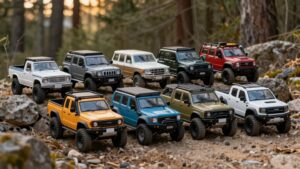
RC Crawler vs Trail Truck: Which Off-Road Style Fits You?
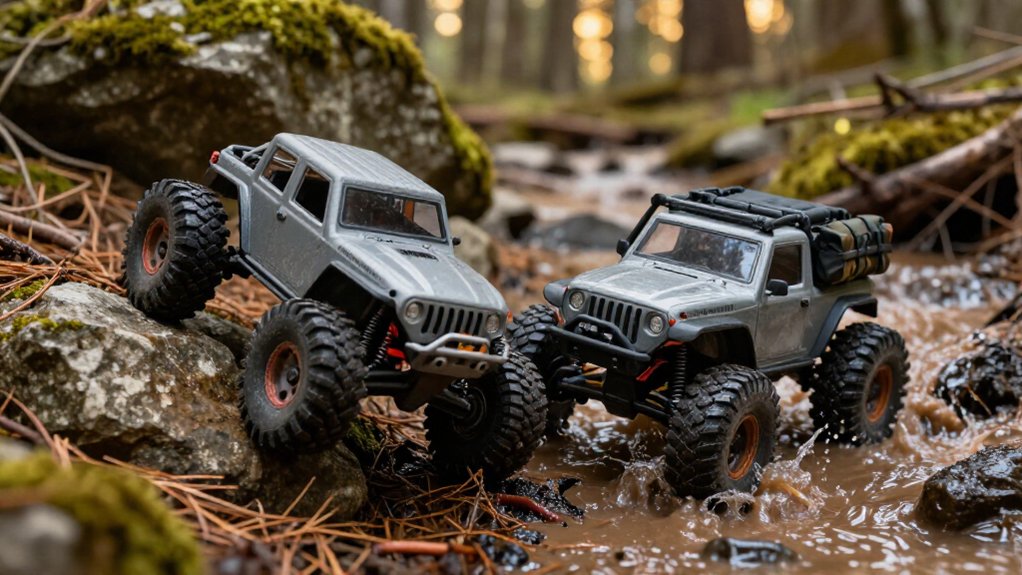
Choose an RC crawler if you want to pick lines over steep ledges and rock gardens at walking pace. Its linked suspension, low gearing, locked diffs, clearance, and grippy tyres maximize articulation and control.
Pick a trail truck if you prefer scale-realistic forest paths, roots, gravel, and moderate obstacles with livelier handling. A two-speed hybrid can bridge both styles. Compare wheelbase, RTR battery contents, waterproofing, runtime, lights, and parts support next to pinpoint your rig.
Articulation vs. Scale Realism
RC crawlers prioritize suspension articulation, ground clearance, and larger tyres so each wheel can stay planted while the chassis climbs rocks, ledges, and deeply uneven terrain. You get maximum grip when axle movement lets tyres follow separate surfaces, making steep lines feel remarkably controlled.
| Choice | Strength | Best terrain |
|---|---|---|
| Crawler | Long-travel articulation | Rock gardens |
| Trail truck | Scale proportions | Paths |
| Hybrid | Tuned links | Mixed routes |
An Axial SCX10’s linked suspension can accept 2.2-inch tyres, giving you a serious clearance advantage over stock-inspired trail rigs. Yet a Tamiya CC-01 or Boom Racing BRX01 delivers body lines and modest tyres for game paths and moderate obstacles. Don’t treat the divide as absolute: add scale details to a crawler, or increase a trail truck’s articulation when you want capability.
Two-Speed Transmissions and Dig
Beyond suspension and tyre choice, drivetrain controls shape how confidently a rig handles changing terrain. A two-speed transmission broadens your operating range: select low for deliberate, torque-rich crawling, then shift high when the trail opens up. Remote selection, as on the 1/18 Hobby Plus Terranaut, keeps you moving instead of stopping to alter gears by hand.
- Low range gives you precise throttle response on technical obstacles.
- High range suits quicker connections between demanding sections.
- Dig alters driven wheels; it doesn’t change gear ratios.
- Use dig to tighten turns or hold control while negotiating obstacles.
- Verify inclusion and operation: models don’t always specify two-speed or dig.
That distinction helps you choose drivetrain tools that match your preferred terrain, driving rhythm, and willingness to manage controls.
Sidehill Stability and Top Speed
Where a crawler uses articulation, four-wheel drive, grippy tyres, and slow throttle inputs to keep its contact patches engaged across a slope, a trail truck trades some of that sidehill confidence for more realistic, stock-like proportions. You’ll feel the difference on off-camber terrain: the crawler’s larger, traction-focused tyres and chassis movement let you pick a line with composure. A trail truck remains capable on moderate cambers, but its scale stance asks you to read the terrain more carefully.
Speed separates them too. Low-ratio crawler gearing multiplies torque and gives you precise wheel placement, not top-end numbers. Your trail truck can link moderate trails at a livelier clip, making stretches feel energetic. Still, neither platform targets buggy- or basher-style velocity; both reward control and driving.
RTR Setup and Learning Curve
An RTR crawler or trail truck gives you an assembled, approachable entry point, but you should confirm whether its battery and compatible charger are included. You’ll spend less time building and more time developing control, yet each platform teaches different habits.
- Choose a crawler for slow, precise throttle and steering inputs on technical terrain.
- Pick a trail truck for moderate paths that reward smooth, deliberate driving.
- Use low speed to correct mistakes before they become rollovers.
- Check parts support; accessible spares keep repairs from interrupting practice.
- Match the recommended age rating to your experience and supervision needs.
Either format lets you start quickly, but a crawler’s measured response builds confidence sooner, while a trail truck challenges you to link steering, throttle, and line choice.
Wheelbase and Obstacle Fit
Wheelbase directly shapes how your RC rig attacks terrain: a longer chassis typically stays steadier on steep climbs, while a shorter one turns more easily through tight wooded trails. For moderate routes, a Tamiya CC-01 or RC4WD Trailfinder lets you thread manageable paths while preserving scale proportions. Their dimensions suit bumps, ruts, and smaller ledges rather than rock piles.
When you want to conquer harsher terrain, an Axial SCX10 or Traxxas TRX-4 combines linked suspension with larger tires to keep the chassis clear and maintain traction over uneven rock. A 2.2-inch tire can add clearance, but match its diameter to wheelbase and your surfaces; oversized rubber can upset fit and handling. Don’t treat either category as fixed: modified trail trucks and crawlers often overlap.
Spare Parts Availability and Costs
Parts support can shape your RC experience as much as trail performance, so check replacement availability before choosing a crawler or trail truck. Slow crawlers usually avoid the high-impact crashes that punish faster trail rigs, but both platforms wear suspension and drivetrain hardware. Compare model-specific support, not just shared design.
- Price suspension links before you bend one.
- Check tyre options for your wheel format.
- Compare driveshaft, axle, and gear costs.
- Ask local hobby shops about stock consistency.
- Use RC clubs and online communities for proven sources.
A well-supported crawler can minimize repair frequency, while a trail truck may demand a larger spares budget if you drive it hard. Either way, accessible parts keep your rig running and your upgrades practical for longer trail days.
Waterproofing Varies by Model
Beyond replacement support, wet-weather capability depends heavily on the specific model’s waterproofing. Don’t assume a crawler’s sealed receiver box or a trail truck’s water-resistant electronics makes either rig submersible. Compare each manufacturer’s ratings for the ESC, motor, receiver, servo, and battery compartment before splashing through puddles, mud, or stream crossings. A model built for damp trails may tolerate spray, while another handles deeper water only with waterproof components and protected connections.
After wet runs, clean debris and dry the chassis thoroughly. Inspect the motor and ESC for moisture, corrosion, or excessive heat before your next drive. Follow the manufacturer’s battery-care instructions, especially for removal, drying, charging, and storage. Smart preparation lets you enjoy wet terrain without turning an off-roader into a costly repair project.
Lighting and Interior Detail
Trail trucks typically give you functional headlights, tail lights, and detailed cabins for convincing scale realism, while crawlers often prioritize obstacle performance. You’ll want to confirm whether a model’s lights work or are decorative and whether seats, dashboards, and other interior pieces come included. Add these upgrades when you want a more realistic rig; skip them when you prefer a simpler, performance-focused crawler.
Functional Lighting Options
Lighting adds both practical value and scale realism to an RC crawler or trail truck. Bright LEDs help you judge terrain at dusk, while taillights keep your rig visible to fellow drivers. Crawlers benefit from precise, low-speed illumination; trail trucks gain visibility during faster runs.
- Verify whether headlights and taillights come installed.
- Check if lights stay on or respond to transmitter controls.
- Choose LEDs that fit your body mounts and electronics.
- Seal connectors and route wiring away from dirt.
- Follow water-resistance limits before crossing wet terrain.
An add-on LED kit can transform a basic model, but compatibility matters more than brightness alone. You’ll get the best result when the lighting system draws safe power, survives vibration, and matches how, and where, you drive in real conditions.
Interior Scale Realism
Why settle for an empty shell when a detailed cabin can make your RC rig resemble a real off-roader? Trail trucks and scale-focused crawlers benefit from seats, dashboard, and a steering wheel, particularly when clear windows expose the cabin. These components turn a body into a convincing miniature vehicle and strengthen its full-size identity.
Add interior LEDs to illuminate gauges, seats, and controls after dusk; you’ll reveal details that dark, small windows might otherwise hide. Unlike functional trail lighting, cabin illumination serves presentation, not traction or clearance.
Measure the body’s interior volume before buying accessories, because oversized parts can clash with mounting points or block visibility. For a trail truck, a fully furnished cockpit often suits its realism-first mission; for a performance-oriented crawler, choose simpler details.
Steep Ledges vs. Forest Trails
You’ll conquer steep rock ledges more confidently with a crawler’s low gearing, grippy tires, clearance, and articulated suspension. On rooty, gravelly forest trails, a scale-focused trail truck delivers a more stock-like, flowing drive through moderate obstacles. Match your rig to your style: choose precise lines and controlled climbs, or enjoy realistic trail cruising, with a versatile crawler bridging both.
Conquering Steep Rock Ledges
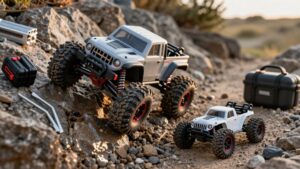
Steep rock ledges expose the key advantage of an RC crawler: high-torque gearing, precise low-speed control, and articulated suspension keep its tires planted as it climbs irregular faces.
You gain a technical edge when soft, high-traction tires conform to broken stone and locked differentials keep torque moving to the gripping wheel. A trail truck may reach moderate shelves, but its scale-oriented setup usually yields less control here.
- Approach slowly.
- Pick a line that clears the chassis.
- Use gentle throttle, not momentum.
- Maintain four-wheel drive for consistent pull.
- Match ground clearance and suspension to ledge height.
With deliberate inputs, you’ll load each tire progressively, limit chassis hang-ups, and turn intimidating rock faces into satisfying, repeatable climbs that reward patient, precise weight transfer at every ledge.
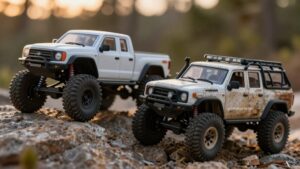
Once the ledges level out, forest trails shift the challenge from maximum climbing ability to consistent traction over roots, gravel, and uneven soil. You’ll still benefit from a crawler’s four-wheel drive, generous clearance, and articulated suspension, which keep tires planted and help the chassis pass over embedded rocks and roots.
However, forest progress depends less on brute torque than on reading changing surfaces. Inspect the path ahead, select a line that won’t unload a tire or drag the belly, and use smooth, steady throttle through loose gravel and off-camber ruts. A trail truck, including the Tamiya CC-01 or RC4WD Trailfinder, handles moderate obstacles and game paths with scale realism. Compared with a crawler, it trades extreme ledge capability for composed, realistic travel across woodland terrain.
Matching Terrain To Driving Style
Matching terrain to your driving style starts with recognizing what each rig does best: crawlers excel on steep ledges and technical rock gardens, while trail trucks shine on winding forest paths. Your choice shapes every input: a crawler’s low gearing, torque, grippy tires, and articulated suspension hold traction at walking speed. That distinction determines whether you attack obstacles or explore longer routes with confidence all day long.
- Pick crawler lines deliberately across uneven ledges; planted tires reduce slips and tip-overs.
- Use a trail truck for roots, gravel, and moderate obstacles at a steady pace.
- Enjoy its scale-focused setup on flowing woodland routes.
- Choose larger tires and linked suspension when mixed terrain demands versatility.
- Let technical gardens reward precision; let forest curves reward relaxed control.
Choose by Battery Runtime
Battery runtime can tip the crawler-versus-trail-truck decision, but the category alone won’t predict your session length. Compare each model’s battery voltage, cell count, and capacity alongside its manufacturer-estimated runtime. A crawler’s low-speed, torque-focused work often draws power steadily, especially on technical climbs.
A trail truck’s faster pace and heavier throttle can drain a pack sooner, although terrain and your driving habits matter just as much. For longer outings, bring a spare compatible battery and verify its connector and dimensions fit the chassis.
You’ll also need a charger matched to the battery type. Follow the maker’s charging and storage guidance to protect performance and get reliable trail time. Steeper terrain, loose surfaces, cold weather, and repeated full-throttle bursts can further change what you get outdoors.
Conclusion
Choose a crawler if you want maximum articulation, low-speed torque, dig control, and precise ledge climbs. Pick a trail truck if you prefer scale realism, higher speed, longer forest runs, and better all-around terrain coverage. You’ll also need to match wheelbase, waterproofing, battery capacity, and RTR complexity to your routes. Neither style wins everywhere: crawlers dominate technical obstacles, while trail trucks make every mile feel adventurous. Choose the rig that best matches how you drive.