RC Crawler Terms Glossary: Portals, Overdrive, MOA and Low CG
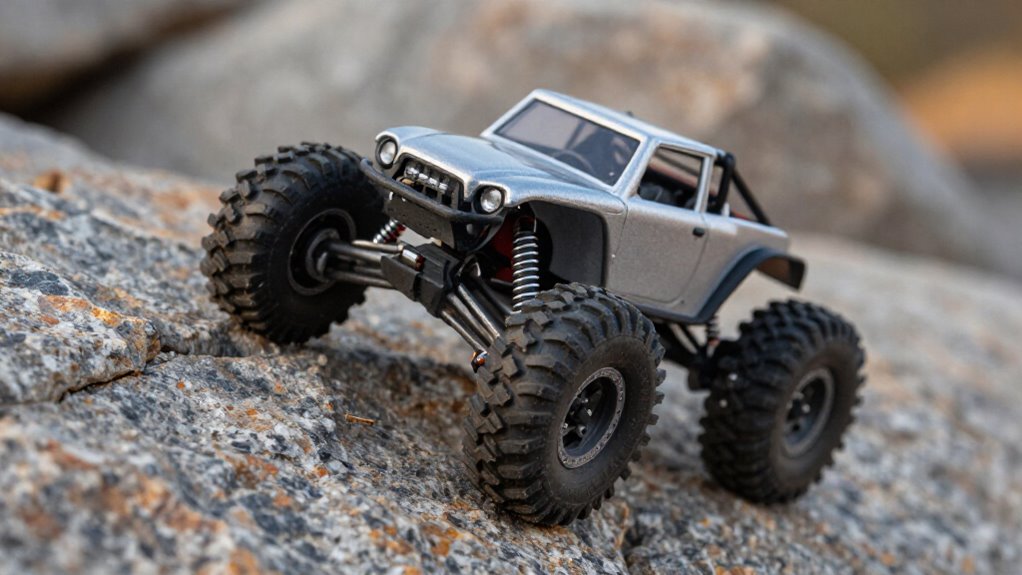
RC Crawler Terms Glossary: Portals, Overdrive, MOA and Low CG
An RC crawler glossary helps you compare parts and predict trail behavior. MOA puts the motor and gearbox on each axle, while low-CG chassis and brass parts lower mass to improve stability.
Portal axles raise the housing above wheel hubs for added center clearance, but don’t lift every component. Overdrive speeds one axle relative to another, changing wheel-speed balance. Confirm platform compatibility before buying, then explore how gearing, clearance, and steering details shape a capable build.
Crawler Platform Compatibility
Crawler platform compatibility determines which parts and upgrades will fit your vehicle. The platform is the base model or vehicle family that manufacturers use to design compatible components. Similar scale doesn’t guarantee interchangeability: an axle listed for an Axial SCX24 may not fit a Traxxas TRX-4M or FMS FCX24. Before you buy axles, wheels, suspension links, or body mounts, confirm the platform and model. Check specifications rather than relying on appearance or scale alone.
Also verify your configuration. RTR, kit, and custom-built crawlers can use electronics, even within a platform family. Compare components and connector requirements with the upgrade’s specifications. This check helps you avoid parts that mount but won’t operate correctly. If details are unclear, consult the manufacturer or seller before ordering.
RC Crawler Term Categories
RC crawler terms group into practical categories that describe drivetrain, motor placement, chassis design, suspension, and geometry. These labels help you connect a component’s position or shape with its effect on trail performance.
| Category | Terms and function |
|---|---|
| Drivetrain and layout | Overdrive changes axle speed; MOA puts motor and gearbox on axle; FMM shifts motor forward. |
| Chassis and running gear | LCG and low brass lower mass; links locate axles; wheelbase and belly clearance affect stability and breakover. |
Portal axles raise the housing through wheel-end gearing. A three-link setup needs a track bar to centre the axle; triangulated links can manage lateral movement without one. Faster front axle rotation may aid cornering and climbing, while clearance from a chassis lift can raise the centre of gravity.
Worm Gear Axle Basics
A worm gear axle places a worm-and-wheel set inside the housing, transferring power to the wheels while multiplying torque for slow crawling. Its strong holding effect can resist rolling on climbs and descents, though it may limit how freely your crawler rolls. Check axle clearance, since the housing and gear layout can affect how it passes obstacles.
Worm Gear Design
Inside a worm-gear axle, a screw-shaped worm drives a toothed gear within the housing. Its high gear reduction produces strong torque at your wheels, helping your crawler creep over rocks and ledges. Because the gear set can resist reverse motion, it can hold your rig firmly on steep climbs and descents.
That resistance is useful when you pause on a slope, but it also makes the drivetrain feel less free-rolling than a conventional axle. The worm and its related components sit inside the axle housing, which shields them from trail debris. For you, this enclosed layout combines substantial reduction and dependable holding with protected internal parts. You should expect a deliberate, resistant feel rather than the easy coasting you may notice with other axles.
Power Transfer Path
When your motor turns the transmission, power travels through the driveshaft to the worm screw, which meshes with a toothed wheel inside the axle housing. From there, the toothed wheel transfers rotation to the axle shafts, which drive the wheels.
This sequence defines the power-transfer path: motor, transmission, driveshaft, worm screw, toothed wheel, axle shafts, and wheels. The worm gearing also reduces speed at the axle, multiplying torque before it reaches the tires. That reduction helps you control slow, deliberate movement over rocks, ledges, and other obstacles, where steady wheel torque matters more than high wheel speed.
The axle housing supports and encloses the gear pair, keeping the mesh aligned as the drivetrain operates. When you trace the system during setup or troubleshooting, check each connection in order; a problem at one stage can interrupt power delivery to both wheels on that axle. Use this sequence to understand axle operation.
Self-Locking Effect
Because the worm screw drives the axle gear through a high-reduction mesh, the wheels can’t easily turn the drivetrain backward. This resistance creates a self-locking effect: your crawler can hold its position more securely on steep climbs or descents. When you release the throttle, the axle may reduce the vehicle’s tendency to roll.
The effect’s strength depends on the axle’s design and gearing, so don’t assume every worm-drive setup holds equally well. You’ll also notice that the axle may feel less free-rolling than conventional gearing, and your crawler may coast less easily. This behavior comes from the gear arrangement itself; it doesn’t replace your motor, ESC, or brakes. Treat it as a mechanical holding characteristic, not as a substitute for controlled braking on terrain.
Torque Multiplication
A worm gear axle uses a worm screw to drive a gear inside the axle housing, reducing wheel speed and multiplying torque at the wheels. This reduction lets your motor turn faster while your crawler’s wheels rotate more slowly, giving you controlled power for technical climbs. This helps you climb.
The worm drive’s high friction also provides strong holding power, which can help keep your crawler from rolling downhill when you release the throttle. However, that friction makes the drivetrain feel less free-rolling than a conventional gear axle. You may notice greater resistance when you’re pushing or towing the crawler. Because the worm gear, shafts, and related parts sit inside the housing, their reduction and drag affect both wheel torque and how your crawler coasts.
Axle Clearance
Axle Clearance
Axle clearance is the space between the axle’s lowest point and the ground.
A worm gear axle places a worm-and-wheel gear set inside its housing to drive the wheels. The rounded centre section, called the pumpkin, often sits lowest, so it can catch on rocks and restrict obstacles your crawler can cross without contact. Measure clearance at this low point, not just beneath the axle tubes or chassis.
A housing that hangs close to the ground reduces the room for rocks to pass underneath. Worm gears provide reduction and holding power, helping you maintain control on climbs and descents. Their drivetrain may not roll as freely as axle designs, so your crawler can feel different when you push it over ground. Consider both ground clearance and gear behavior when choosing an axle for your build.
Steering And Handling
When you steer and climb at low speed, a worm gear axle’s high reduction delivers strong torque for controlled movement. Inside the axle housing, a worm-and-wheel gear set drives the wheels. You get response because the reduction helps your crawler maintain wheel force as it advances slowly.
On descents, the gearing can provide holding power; when you release the throttle, it helps resist downhill rolling. That behavior gives you predictable control, but it can also change how freely the vehicle coasts and how the drivetrain feels compared with a freely rolling axle setup.
Don’t assume every crawler uses this design: worm gear axles appear on some SCX24 setups. Before you choose replacement or upgrade parts, check that the axle matches your platform and mounting requirements.
Efficiency And Heat
Although a worm gear’s compact, high reduction delivers strong wheel torque at low speed, friction between the worm and gear can make the drivetrain less efficient and generate heat. Inside the axle housing, a screw-shaped worm drives a gear, producing substantial reduction in a compact package. Under sustained crawling loads, sliding contact converts more input energy into heat than some other axle designs.
Your motor and gears may warm appreciably during prolonged, high-load climbs or if the drivetrain binds. This is a tradeoff, not necessarily a sign that the axle is failing: the same geometry often resists backward driving, so your crawler holds strongly on descents. However, that resistance also limits free rolling when you coast, and you may notice more drag than with a freely back-driven axle. Account for the added friction when choosing crawl speed and managing long, demanding runs; prolonged load leaves less energy available for motion throughout a long crawl.
Maintenance And Wear
Inspect the axle periodically for grit, worn or damaged gears, and signs of poor lubrication. A worm gear axle uses a worm that meshes with a gear in the axle housing to drive your wheels. Its reduction ratio delivers strong wheel torque, which helps you crawl over obstacles.
The gear set provides holding power, so your crawler can resist rolling backward on climbs and sections. That resistance comes with a tradeoff: friction can keep your rig from rolling as freely as one with conventional gearing. Check gear condition and lubrication during maintenance, and remove grit according to the manufacturer’s guidance. Use the cleaning method and lubricant the manufacturer specifies; unsuitable products or procedures can accelerate wear. If you notice damage or poor lubrication, service the axle before continued operation.
Overdrive Versus Underdrive
Overdrive gears one axle to turn faster than the other, while underdrive terminology varies by product, so check which axle’s wheel speed changes. Front overdrive can improve climbing and cornering by helping resist backward roll on steep ledges. Compare axle speeds and terrain needs to choose a setup that suits your crawler.
Overdrive And Underdrive Basics
When you gear one axle to turn faster than the other, you change how your crawler handles. With front overdrive, the front wheels spin faster than the rear wheels. That speed difference can help you climb and steer through turns: the front tires pull the chassis around a corner, while slower rear-wheel speed can lessen the tendency to flip backward on steep ledges or inclines.
Underdrive gears an axle to turn more slowly. Axial sells overdrive upgrade gears for the SCX10 III, UTB10 Capra, and certain Axial axles. The SCX10 Pro includes selectable underdrive, letting you engage that function as needed.
Match the setup to your terrain and driving goals rather than choosing by name alone.
How Gear Ratios Differ
Gear-ratio terminology can be confusing because overdrive and underdrive describe axle speed relative to another part of the drivetrain, and some references use “underdrive” inconsistently.
Compare the axles’ output speeds under the same drivetrain input: front overdrive makes the front wheels rotate faster than the rear wheels. That usually means a lower reduction at the front than at the rear; front underdrive instead reduces front axle speed relative to the rear. Because manufacturers and hobbyists don’t always apply “underdrive” consistently, check the specified ratio and which axle it describes rather than relying on the label. Axial offers overdrive gears for the SCX10 III, UTB10 Capra, and specified axles. The SCX10 Pro has selectable built-in underdrive; verify what that setting changes in its published gear specifications.
Effects On Crawler Performance
By changing the front-to-rear wheel-speed difference, axle gearing can affect how your crawler climbs and turns.
With front overdrive, the front axle spins faster than the rear. Those quicker front wheels can pull your crawler toward a ledge, while slower rear wheels help resist backward rotation that could carry it onto its rear. This speed split can influence cornering by changing how the axles track through a turn. Underdrive gears one axle to turn more slowly, so its effect depends on which axle receives it and the resulting front-to-rear wheel-speed difference.
Because axle gearing changes wheel speed and torque delivery, labels alone don’t describe the result. Check the actual ratio and axle configuration when evaluating performance. On the Axial SCX10 Pro, built-in selectable underdrive shows that axle configuration matters; upgrade overdrive gears fit certain specified Axial models and axles.
Choosing The Right Setup
To choose between overdrive and underdrive, compare the actual axle ratios and identify which axle will turn faster.
Front overdrive gives the front wheels faster gearing than the rear, helping your crawler climb and corner. Slower rear-wheel speed can reduce the tendency to pull the chassis backward and over. However, don’t rely on the label alone: underdrive is described as higher, faster gearing, so verify the ratio for the axle or gear set.
Check which axle the change affects, then compare its resulting wheel speed with the other axle. The SCX10 Pro offers selectable underdrive; overdrive gears fit the SCX10 III, UTB10 Capra, and specified Axial axles. Choose based on the speed relationship you want, not simply whether a part is called overdrive or underdrive.
Steering Link Clearance
Steering link clearance is the space between the steering links and nearby parts, including the axle housing, chassis, wheels, and suspension links. Insufficient space can let a link rub or catch as you turn the wheels or articulate the suspension, restricting steering or suspension travel.
Check clearance with the suspension fully compressed and fully drooped, then turn the steering fully left and right.
Wheel offset, wider hex extensions, axle width, and link shape can alter contact with the wheels or other components. If a link binds, reposition or adjust parts, checking that you still get full steering lock without wheel rub. Test through suspension travel to confirm each link clears nearby parts at both steering extremes through the full cycle.
Servo Stall Current
Servo stall current is the current a powered servo draws when its output shaft can’t move. During normal steering, the servo draws less current, but a stall can demand much more. Repeated binding or holding the wheels against resistance can overload your battery or battery eliminator circuit (BEC).
Stall current varies with servo design and supply voltage, so check the manufacturer’s rating for the voltage you’re using. Choose a BEC that can supply the servo’s peak demand, including other electronics’ loads. Avoid forcing your steering against obstacles or mechanical stops; release the controls if the wheels can’t turn.
If the servo stalls often, inspect for binding, tight linkages, or obstructed wheels. Address those causes before increasing power, since a stronger supply won’t remove resistance.
Portal Axle Ground Clearance
Portal axles use gearboxes at the wheel ends to raise the axle housing above the wheel hubs, increasing clearance beneath low points such as the centre pumpkin. That extra space can help your crawler cross rocks and ledges without the housing catching. You gain clearance at the axle, not automatically across the chassis: suspension setup and tyre size still determine how high other components sit. Portal gears also add parts at each wheel end, making the axle more complex than a conventional design.
- Wheel-end gearboxes lift the housing relative to the hubs at each wheel.
- The centre pumpkin gains useful obstacle clearance under load.
- Rock and ledge contact becomes less likely on approach.
- Chassis clearance still depends on tyres and suspension in your setup.
Conclusion
RC Crawler Terms Glossary: Portals, Overdrive, MOA and Low CG
Use this glossary to match crawler terms to the behavior you want on the trail. Check platform compatibility before changing axle gearing, portals, steering links, or servo setup; each choice affects clearance, handling, or electrical load. Compare overdrive and underdrive for your terrain, and verify link clearance at full steering lock. Keep heavy components low when possible. With these relationships clear, you can choose upgrades that work together and tune your crawler with fewer surprises.