
TRX4M vs FCX24: Two-Speed Power vs Scale Realism
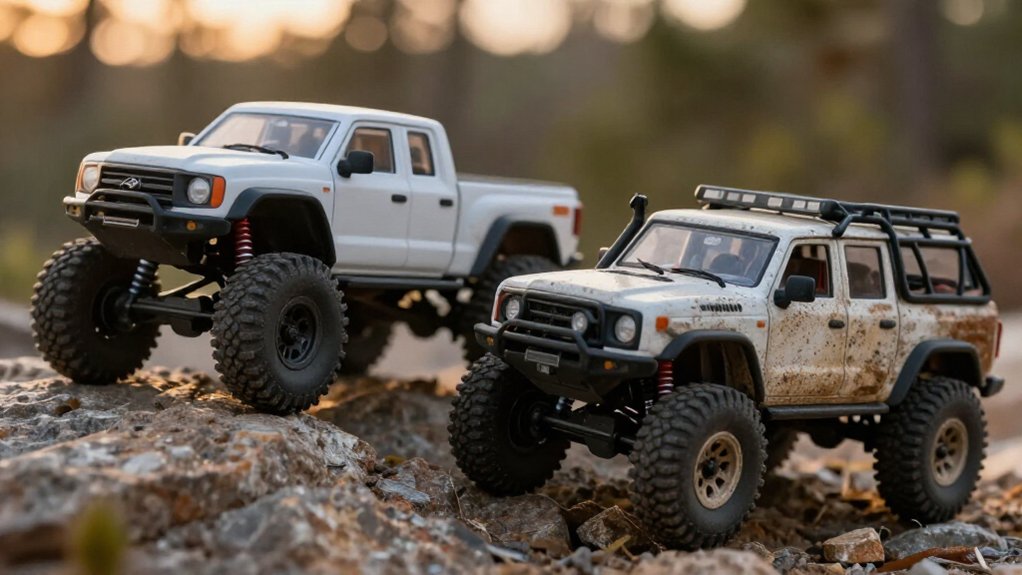
TRX4M vs FCX24: Two-Speed Power vs Scale Realism
Choose the FCX24 if you want selectable low and high ranges, metal transmission gears, portal-axle clearance, and stronger scale detail. Low gear lets you place tires precisely on ledges, while high gear covers open ground faster.
Choose the TRX4M if you prefer a simpler single-speed drivetrain, lower conventional-axle chassis, and steadier 155 mm wheelbase behavior on broken trails. Its waterproof-rated electronics also help on damp routes. You’ll find setup and care differences, trail by trail, next.
Two-Speed Transmission vs Scale Detail
The FCX24 gives you more drivetrain flexibility with its two-speed gearbox: low range supports slow, controlled technical climbs, while high range adds useful speed for open terrain without a motor or gear swap. That ratio choice makes the FCX24 better suited to mixed routes, because you can prioritize wheel control on obstacles, then shift for trail sections. Its detailed bodywork and scale accessories also strengthen visual realism. That versatility helps when grip, grade, and trail distance often vary within one outing under real driving conditions.
| Model | Gearbox | Primary benefit |
|---|---|---|
| FCX24 | Two-speed | Selectable pace |
| TRX4M | Single-speed | Straightforward operation |
The TRX4M can’t change ratios, so you accept one operating range. Choose it when simple operation matters most; choose FCX24 when selectable gearing and scale detail matter.
TRX4M Chassis, FCX24 Portals
Where the FCX24’s portal axles lift its differentials above rocks and ledges, the TRX4M uses a lower conventional ladder-frame and solid-axle layout for more predictable off-camber behavior. That distinction changes how you approach terrain. The FCX24’s gear-reduction portals increase differential clearance, letting you drive over center-hanging rock edges that might contact a conventional axle housing.
But the portal assemblies also position the chassis higher, so you’ll notice weight transfer sooner when traversing side slopes. The TRX4M trades that clearance advantage for a lower, simpler architecture; its solid axles and ladder frame give you a more consistent off-camber response. Both accept modular upgrades, allowing you to tune suspension and add weight according to whether clearance or stability matters more for your chosen terrain conditions ahead.
TRX4M’s 155mm Wheelbase Stability
At 155 mm, the TRX4M’s wheelbase gives it a longer footprint than many short micro crawlers, helping it feel more planted on climbs and broken terrain. You benefit from greater axle separation when the truck moves onto ledges: the chassis pitches less abruptly, so you can maintain a controlled approach rather than reacting to rapid fore-aft weight transfer. On off-camber terrain, the extended stance distributes weight over a longer contact footprint and improves directional composure relative to shorter layouts.
It doesn’t eliminate rollover risk: tire compound, track width, center-of-gravity height, and your line choice still determine available sidehill grip. Therefore, you gain a steadier platform across rough sections while retaining the precise throttle and steering control that micro crawling demands on very slow technical lines.
FCX24 Battery Swap Procedure
Beyond chassis stability, the FCX24’s runtime depends on a clean battery swap. Switch the truck off first, then disconnect the pack from the receiver/ESC by gripping the connector, never the wires. Release the tray retainer and slide or lift the battery free without stressing its lead. Unlike a quick, rough field change that can damage wiring, this sequence protects the FCX24’s compact electronics.
Install a fully charged replacement pack squarely in the tray. Route its wires clear of the driveshafts, moving suspension links, and sharp body edges. Align the keyed plug correctly and press it together without force; reversed polarity can damage components. Re-secure the retainer and body. Turn on your transmitter before the truck, then verify centered steering and throttle response before operating.
Carpet Crawling Versus Backyard Trails
Indoor carpet emphasizes control and course design more than outright trail speed. You’ll appreciate the FCX24’s two-speed transmission: select low gear for precise ledges, then shift high to cross open sections.
The TRX4M’s single-speed drivetrain feels simpler indoors, where steady low-speed modulation matters more than velocity. Use short-pile carpet and firm, low obstacles; loose fibers can snag small tires and axles.
- Choose the FCX24 if you want the satisfying drama of selectable gearing across carpet and yard.
- Choose the TRX4M if you want uncomplicated indoor crawling and portal-axle clearance over roots.
- Build changes carefully: backyard unevenness rewards the TRX4M’s extra clearance, while open carpet rewards FCX24 high gear.
For mixed use, match your course to the truck’s strengths, and you’ll create tense, scale-feeling challenges.
Replacement Parts Pricing
Replacement-part cost comparisons only mean something when you match like for like: compare a TRX4M driveshaft, servo, or axle piece against the equivalent FCX24 component, not a bundled upgrade kit against a single stock replacement. Check the FCX24 listing carefully: parts labeled for the standard FCX24 or Power Wagon may not fit every version.
For TRX4M parts, compare Traxxas-branded stock replacements with third-party options, then verify fitment for your exact chassis and body configuration. Add shipping before deciding; a cheap driveshaft ordered alone can exceed a higher-priced local or combined-order alternative. Retailer pricing and inventory change quickly, so you should check current listings rather than assume either platform consistently costs less for spares when comparable components are actually in stock at the same retailer.
FCX24 Two-Speed Servo Vulnerability
Parts cost isn’t the FCX24’s only ownership consideration: its two-speed transmission adds a small shift servo and linkage that the single-speed TRX4M doesn’t use. That extra actuator gives you useful ratio choice, but it creates a failure point absent from the TRX4M’s simpler driveline. Impacts, linkage binding, and shifts forced while gears carry load can strain the servo.
- Briefly release throttle before shifting so drivetrain unloads and gears align.
- Inspect the servo horn, linkage, and mounting screws for looseness, bends, or damage.
- Never push the shift mechanism by hand; you can overload its gears or linkage.
A failed servo or link can leave your FCX24 trapped in high or low range, turning your trail run into frustration, although motor and drivetrain still work normally.
TRX4M Waterproof Electronics, FCX24 Tradeoffs
You’ll get better wet-trail tolerance from the TRX4M’s water-resistant electronics, but you shouldn’t treat them as fully waterproof or submerge the truck. The FCX24’s two-speed drivetrain adds useful crawling and travel-range flexibility, yet its added mechanical complexity can increase water-exposure concerns. Dry either model thoroughly after wet runs to protect its electronics and drivetrain.
TRX4M Waterproof Electronics
Where wet-trail capability matters, the TRX4M’s stock waterproof-rated electronics give it a practical advantage over the FCX24, whose water resistance can vary by model and should be verified before exposure.
You can tackle splashes and damp trail crossings with confidence, but waterproof-rated doesn’t make the truck submersible. Prolonged immersion can defeat seals and expose components that electronics ratings don’t cover.
After every wet run:
- Dry the chassis promptly to stop hidden moisture from lingering.
- Inspect connectors and bearings for moisture, grit, and early corrosion.
- Follow Traxxas care guidance; worn seals or modifications can reduce protection.
This advantage supports spontaneous, messy trail sessions, but it doesn’t eliminate maintenance. Clean mud, dry vulnerable hardware, and check every connection carefully before your next outing.
FCX24 Water Exposure Tradeoffs
The FCX24 demands more caution around water because its resistance can vary by version and installed electronics, unlike the TRX4M’s generally waterproof-rated stock system. Before running, you should check your FCX24 manual and identify the receiver, ESC, servo, and connector ratings rather than assuming all components resist water. Shield exposed connectors and electronics from spray, and skip puddles or saturated terrain unless the manufacturer confirms your configuration is water-resistant.
FCX24 Low-Gear Crawl Control
The FCX24’s two-speed transmission lets you select low gear for precise, walking-pace throttle control. Compared with high gear, it reduces wheel speed so you can place the tires more carefully over rocks and on steep climbs. On technical terrain, this advantage improves control, though tire grip, weight balance, and your throttle inputs still determine climbing performance.
Low Gear Precision
When technical terrain demands precise tire placement, the FCX24’s selectable low range gives you slower, more controlled crawl speed than the TRX4M can provide.
Its two-speed transmission lets you shift from high-range travel to a reduced-speed setup before rocks, ledges, and off-camber sections. That mechanical reduction creates a calmer chassis response, so you can approach a line deliberately and correct tire position before the vehicle commits. The TRX4M, without a selectable low-range mode, can’t match that gearing flexibility.
- You’ll feel more confident easing toward a sharp ledge.
- You’ll gain control on steep climbs and descents, although traction and weight distribution still decide the outcome.
- You’ll enjoy a more deliberate, technical driving experience when obstacles demand precision over outright travel speed alone.
Walking-Pace Throttle Control
By selecting low gear on the FCX24 before entering technical terrain, you can reduce wheel speed to a walking-pace crawl and make more precise throttle corrections than in its high range. This gearing advantage is most apparent at the transmitter: small trigger movements produce smaller changes in wheel rotation. You can meter power in short, repeatable increments rather than constantly correcting for high-range momentum.
On steep approaches, low range lets you ease into the throttle and limit abrupt surges. It doesn’t remove the need for disciplined input; a sharp trigger pull can still spin tires and break traction. Compared with high gear, which suits open ground and faster driving, low gear prioritizes resolution over speed. That slower response gives you more deliberate driving rhythm.
Technical Terrain Performance
Against the TRX4M’s single-speed setup, the FCX24’s low range gives you a more controlled approach to steep climbs, rock ledges, and uneven gaps. Low gear slows wheel speed, so you can meter throttle without the abrupt surges that may tip or bounce the chassis on rocks.
- You feel confidence placing each tire before committing to a ledge.
- You gain composure through tight gaps, where momentum punishes rushed inputs.
- You choose precision over speed when the line looks unforgiving.
Use high gear to travel quickly between sections, then shift low before a climb demands delicate input. Still, gearing doesn’t create traction: tire grip, weight balance, and your chosen line determine whether you clear it cleanly without a stalled wheel or rollover.
FCX24 for Metal Transmission Gears
The FCX24 stands out for metal gears in its two-speed transmission, giving its drivetrain greater strength under crawling loads than a comparable plastic-geared setup. You get a transmission better suited to repeated torque spikes when tires bind on rocks, ledges, or steep ascents. In low gear, reduction helps you apply controlled crawling torque and maintain precise throttle response. Shift to high gear, and you can cover smoother trail sections faster without sacrificing the low-range option.
Compared with a plastic-geared transmission, the FCX24’s metal gearset resists load-related damage more effectively, but it doesn’t turn every driveline part into metal or prevent wear in axles, shafts, bearings, and joints. Keep transmission clean, inspect after runs, and use proper lube. This limits contamination and protects gear meshes.
Conclusion
Choose the TRX4M if you prioritize a stable 155 mm wheelbase, waterproof electronics, and predictable carpet-to-backyard durability. You’ll give up the FCX24’s portal-axle scale stance and selectable two-speed range, but you avoid its exposed shift-servo and more involved battery access. Choose the FCX24 when low gear precision, high gear trail speed, and metal transmission gear upgrades matter most. For consistent crawling, TRX4M delivers the simpler, more resilient platform across varied real-world terrain and wet conditions.