RC Car Scale Size Chart: 1/8, 1/10, 1/16, 1/18 and 1/24 Compared
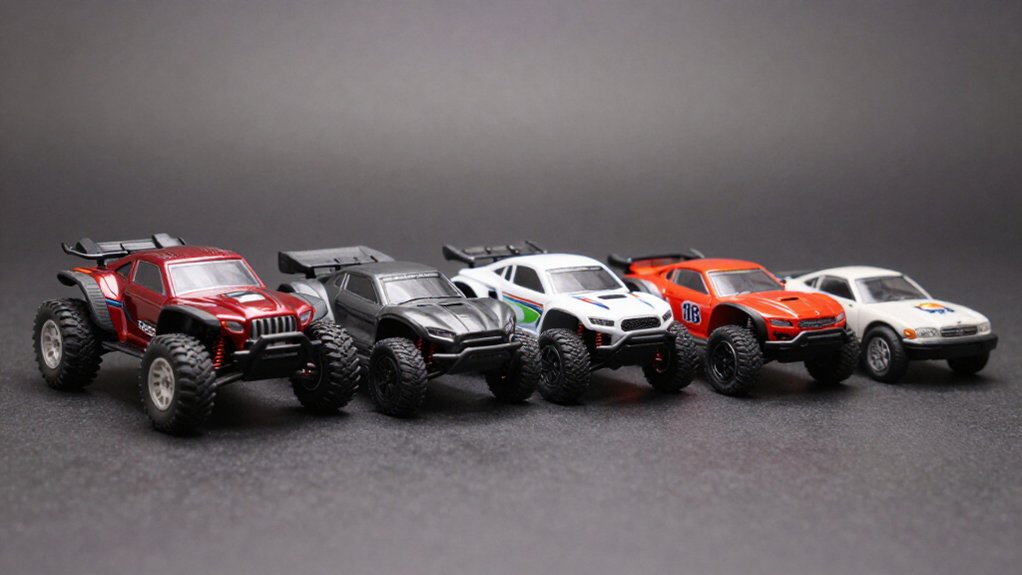
An RC scale tells you proportions, not exact dimensions, so compare the model’s listed measurements before choosing. Typical lengths are 19 to 24 inches at 1/8, 17 to 22 at 1/10, 9 to 13 at 1/16, 8 to 10 at 1/18, and 4 to 8 at 1/24.
Larger scales generally need more storage and suit rougher terrain; compact 1/18 and 1/24 cars travel and fit indoors more easily. Vehicle type changes width and height, too. The details below help you compare fit, shells, and handling.
Comparing 1/8 to 1/24
Although both are measured against full-size vehicles, 1/8-scale RC cars are much larger than 1/24-scale models: a typical 1/8 car measures about 19 to 24 inches (48 to 61 cm) long and weighs 5 to 20 lb (2.3 to 9 kg), while a 1/24 car is roughly 4 to 8 inches (10 to 20 cm) long and weighs 1 to 2 lb (0.2 to 0.9 kg). The scale ratio describes a model’s size relative to its full-size counterpart: at 1/8, you get a model one-eighth as large, whereas 1/24 reproduces the vehicle at one-twenty-fourth scale. Choose 1/8 if you want mass and capability for rough outdoor terrain and higher-speed runs.
A 1/24 model fits indoor driving and compact courses. Still, scale alone won’t determine dimensions: models representing different full-size vehicles can vary even when they share a scale.
Dimension Comparison Chart
RC car dimensions vary by scale and vehicle type, but these typical ranges give you a useful comparison: 1/8 models measure 19 to 24 inches long, 10 to 17 inches wide, and 4 to 10 inches high; 1/10 models, 17 to 22 by 8 to 14 by 5 to 9 inches; 1/16 models, 9 to 13 by 3 to 7 by 3 to 5 inches; 1/18 models, 8 to 10 by 3 to 5 by 2 to 4 inches; and 1/24 models, 4 to 8 by 2 to 4 by 2 to 3 inches.
| Scale | Length (in) | Width × height (in) |
|---|---|---|
| 1/8 | 19 to 24 | 10 to 17 × 4 to 10 |
| 1/10 | 17 to 22 | 8 to 14 × 5 to 9 |
| 1/16 | 9 to 13 | 3 to 7 × 3 to 5 |
| 1/18 | 8 to 10 | 3 to 5 × 2 to 4 |
| 1/24 | 4 to 8 | 2 to 4 × 2 to 3 |
Use length to compare footprint, then check width and height against your available space. Vehicle styles can shift these approximate dimensions slightly within each range.
Scale-Ratio Basics
An RC scale ratio compares a model’s dimensions with those of the full-size vehicle it represents. Written as 1:10 or 1:24, the ratio’s second number tells you how many times larger the real vehicle is than its model. At 1:10 scale, for example, the model measures one-tenth of its counterpart in length, width, and height; at 1:24, it measures one-twenty-fourth.
These ratios describe proportional relationships, not standard body sizes. You can’t infer a model’s exact length from scale alone, because full-size vehicles differ in their original dimensions. Two cars built at 1:10 scale may so have different lengths, widths, and heights while preserving the same relative scale. Compare each RC car with its represented vehicle, rather than treating the ratio as a fixed measurement.
Scale-by-Scale Dimensions
You’ll find that 1/8- and 1/10-scale cars occupy the largest footprint, though their length, width, and height ranges can overlap. At 1/16 and 1/18 scale, each dimension drops substantially, while 1/24 models are the most compact. Compare all three measurements—not scale ratio alone—to judge how a specific RC car will fit your space.
1/8 Scale Dimensions
At 1/8 scale, an RC car typically measures 19 to 24 inches (48 to 61 cm) long, 10 to 17 inches (25 to 43 cm) wide, and 4 to 10 inches (10 to 25 cm) tall. These dimensions make the class physically substantial, though body style and chassis layout change the proportions. A low-slung buggy may sit near the lower end of the height range, while a truck can stand taller and span more width.
At this scale, each inch represents eight inches on the full-size vehicle, so a 16-foot (4.9-meter) vehicle would translate to roughly 24 inches long. You’ll use that ratio to judge whether a model’s stated length matches its scale. Typical weights run from about 5 to 20 lb (2.3 to 9 kg), but heavier components or a different vehicle type can shift the figure. Check width and height alongside length; they reveal the model’s footprint better than scale alone, helping you compare shelf space, transport needs, and handling.
1/10 Scale Dimensions
Compared with a 1/8-scale model, a typical 1/10-scale RC car is smaller, measuring about 17 to 22 inches (43 to 56 cm) long, 8 to 14 inches (20 to 36 cm) wide, and 5 to 9 inches (13 to 23 cm) tall. Body style, chassis layout, and intended use affect dimensions, so check the model’s listed measurements before comparing storage, transport cases, or track fit. At this scale, each model represents one-tenth of its full-size counterpart: a 16-foot car scales to about 1.6 feet (49 cm) long.
For a quick estimate, think of a 1/10 car as roughly 20 inches (50 cm) long. Width and height vary by vehicle type, so length alone won’t tell you whether it’ll fit your setup. Typical weight ranges from about 3 to 12 lb (1.4 to 5.4 kg), giving you another comparison point when carrying models.
1/16 Scale Dimensions
A 1/16-scale RC car typically measures 9 to 13 inches (22 to 33 cm) long, 3 to 7 inches (8 to 18 cm) wide, and 3 to 5 inches (8 to 13 cm) tall. Because 1/16 means each model dimension equals one-sixteenth of its full-size counterpart, you can use the ratio to judge how closely a body follows its reference vehicle. Actual length, width, and height shift with vehicle type and manufacturer, so treat the ranges as typical rather than exact.
A model’s footprint remains compact, while its proportions can still make it feel substantial beside smaller hobby vehicles. Most weigh about 0.7 to 1.8 kg (1.5 to 4 lb), a range that affects how easily you carry and control the car. You can transport a 1/16 model without much effort, then drive it in a backyard or on light off-road terrain. Compare the stated dimensions with your storage space and driving area before choosing a model that fits your needs.
1/18 Scale Dimensions
Typically, a 1/18-scale RC car measures about 8 to 10 inches (20 to 25 cm) long, 3 to 5 inches (8 to 13 cm) wide, and 2 to 4 inches (5 to 10 cm) tall. At this scale, each model represents its full-size counterpart at one-eighteenth of its dimensions, so you can compare proportions directly. A compact sports car may sit near the lower end of the length and width ranges, while a truck’s taller body and larger tires can push its overall dimensions upward.
Typical weight falls between 1 and 2.5 pounds (0.5 to 1.1 kg), giving you a useful sense of mass and size. When you compare 1/18 models, check the stated length, width, and height: body style, wheel and tire setup, and ride height can change the fit on your shelf or in your carrying case.
1/24 Scale Dimensions
Stepping down from 1/18 scale, a 1/24 RC car is generally about 4 to 8 inches (10 to 20 cm) long, 2 to 4 inches (5 to 10 cm) wide, and 2 to 3 inches (5 to 8 cm) tall; some references put the length at 7 to 9 inches (18 to 23 cm). A 16-foot (4.9 m) full-size car scales down to about 8 inches (20 cm) at this ratio. Use that figure as a check, not a fixed target: your model’s length depends on the original vehicle’s size and shape.
A compact car may sit near the lower end of the typical range, while a longer body can approach the upper end. Compared with 1/18-scale RCs, 1/24 models take up less display space. Check listed dimensions before choosing storage, a track, or accessories for your specific model.
Choosing the Right Scale
Which RC car scale fits best depends on where you’ll drive, how much space you have, and your budget. For a versatile first car, choose 1/10 scale: at about 43 to 56 cm long, it stays manageable for beginners and offers broad parts and upgrade support. If portability, indoor driving, or limited storage matters, 1/16 and 1/18 models, typically 20 to 33 cm long, are easier to carry and store.
Choose 1/24, roughly 10 to 20 cm, for tight indoor spaces and maneuvering, but don’t expect it to handle rough terrain as well. For rough ground, 1/8 brings more power and stability, but its size and cost suit advancing hobbyists with room to transport it. Smaller scales cost less; compare your driving surface, storage, transport needs, and budget before you buy.
Body-Shell Measurement Differences
A body shell’s length, width, and height can differ from its chassis dimensions, so compare shell measurements separately.
At the same scale, shell size still depends on the vehicle you choose: a sports car and monster truck have different proportions. Typical overall lengths run about 48 to 61 cm for 1/8, 43 to 56 cm for 1/10, 22 to 33 cm for 1/16, 20 to 25 cm for 1/18, and 10 to 20 cm for 1/24 models, though vehicle type changes shell dimensions. A 1/10 buggy shell is generally smaller than a 1/10 monster-truck shell, despite their matching scale labels.
For a replacement shell, compare its wheelbase and body width with your chassis and mounting points; the scale label alone won’t confirm fit. Check shell length and height; chassis proportions don’t define them.
Fitting RC Cars in Backpacks
Will your RC car fit in a backpack?
A 1/24-scale car is typically 10 to 20 cm (4 to 8 in) long, making it the easiest size to carry. A 1/18-scale model measures about 20 to 25 cm (8 to 10 in) and may fit a larger backpack, depending on its width and interior. At 22 to 33 cm (9 to 13 in), a 1/16-scale car requires you to check usable bag length before packing.
A 1/10-scale car usually spans 43 to 56 cm (17 to 22 in), while a 1/8-scale model reaches about 48 to 61 cm (19 to 24 in); both generally exceed standard backpack capacity. Measure your car at its widest point, then compare it with the backpack’s internal dimensions. Leave extra room for the transmitter, battery, and protective padding so you can carry the complete setup securely, without undue strain.
Avoiding Scale-Measurement Mistakes
Because scale is a proportion, a 1/10 model represents one-tenth of its full-size counterpart’s dimensions, not a fixed length. Its actual size depends on the original vehicle. Compare same-scale models cautiously: a 1/10 monster truck can exceed a 1/10 sports car because their full-size counterparts differ in overall size.
- Check the model’s listed dimensions rather than treating its ratio as a measurement.
- A typical 1/10 RC car measures about 43 to 56 cm (17 to 22 in) long, though individual models vary.
- Separate scale from vehicle type: a 1/10 buggy may be smaller than a 1/10 monster truck despite sharing the same ratio.
Use published dimensions to compare 1/8, 1/10, 1/16, 1/18 and 1/24 models; scale labels don’t guarantee standard lengths. Treat chart figures as approximate, too.
Wheelbase and Track Width
Scale labels don’t specify a car’s proportions: wheelbase measures the distance between the front and rear axles, while track width measures the distance between the left and right wheels. Scale alone doesn’t set either dimension; the full-size vehicle and model type shape both, so compare specifications rather than assuming same-scale cars match.
- A 1/8 model commonly spans 10–17 inches in overall width; a 1/10 typically measures 8–14 inches.
- At 1/16, expect about 3–5 inches; 1/18 models run roughly 3–4 inches.
- A 1/24 car is usually 2–4 inches wide.
For fit, check the listed wheelbase and track width of your exact model. A longer wheelbase changes its footprint, while wider track needs more clearance; scale ratios won’t tell you those dimensions before you choose accessories.
Conclusion
Choose your RC scale by matching size to space, speed, and terrain. A 1/8 model delivers the largest footprint, while 1/24 fits tight storage and smaller play areas; 1/10 and 1/16 balance portability with presence. Remember, scale ratios compare a model with its full-size counterpart, but body shells, wheelbase, and track width vary by design. Check the manufacturer’s dimensions before buying or packing your car. That way, you’ll choose a model that truly fits your needs.