How to Choose a Basher RC Truck: Scale, Power and Durability
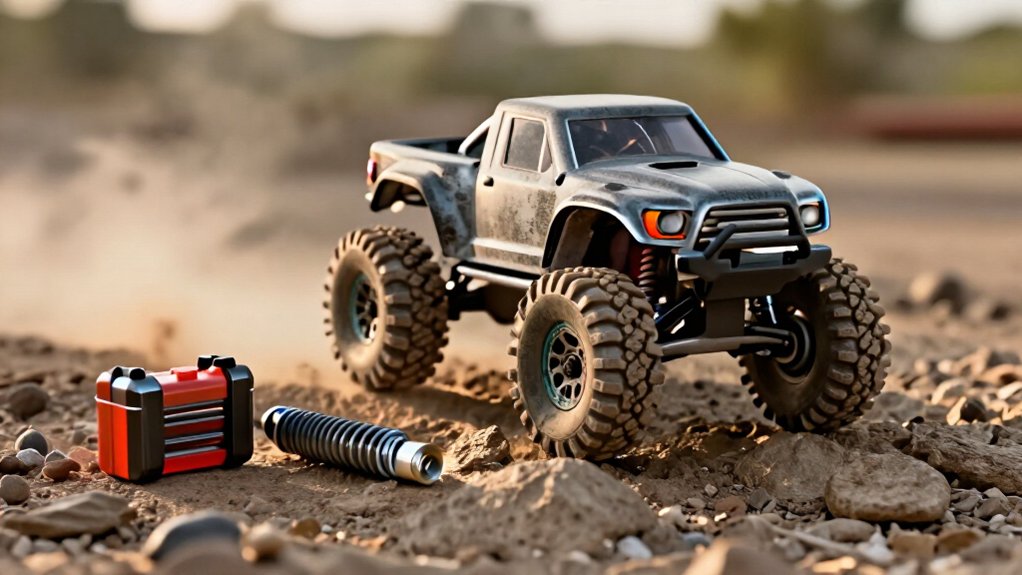
Choose a basher RC truck by matching its scale to your terrain: compact 1/16- or 1/18-scale models suit smooth, tight spaces, while 1/10 scale or larger handles loose dirt and rough ground better.
Choose 4WD and suitable tires for grass, mud, or snow; brushless power delivers more speed, while brushed setups cost less. Check clearance, drivetrain durability, parts support, and battery costs before buying.
Keep your budget and running space in mind; the comparisons ahead can help narrow your options.
Choosing Your Basher’s Scale
Choose your basher’s scale based on where you’ll drive it most. For portable fun, indoor use, or compact tracks, a 1/16- or 1/18-scale model is easier to store and maneuver. Many ready-to-run options cost about $80 to $200.
A 1/10-scale truck offers a versatile middle ground, with more room for upgrades and greater capability than micro models. If you need more clearance and suspension travel, consider 1/8 scale or larger; bigger tires and wider wheelbases support demanding setups. Large 1/5- and 1/6-scale trucks can measure 30 inches or more and cost hundreds to over $1,000.
Before buying, check your storage space, budget, and available running area. Small models turn tightly, while larger trucks need more room to control their speed, weight, and momentum. Plan ahead carefully.
Basher Terrain and Driving Style
Match your basher to the terrain and the way you drive. For thick grass, gravel, sand, or rutted trails, choose a larger truck with wide wheels, generous ground clearance, and long-travel suspension; compact, low models can bog down or snag. Compact trucks suit smooth driveways, packed asphalt, indoor tracks, and engineered rock gardens, where a tight turning radius helps you pick lines.
Match power and setup to your space. Brushless trucks can exceed 50 mph, so give them open ground and room to stop; slower crawlers reward precise inputs. For jumps and aggressive bashing, favor a wide stance, stable chassis, and impact-ready suspension to manage landings. On grass, mud, or snow, 4WD and suitable all-terrain tires improve traction. Choose 2WD for firm, predictable surfaces.
Battery Runtime and Charging
Battery Runtime and Charging
Your terrain and driving style affect battery use: large, fast brushless bashers can drain packs quickly, so expect shorter sessions and bring charged spares.
Match the pack to your truck’s required voltage and capacity; the Arrma Kraton 8S BLX EXB and Traxxas X-Maxx, for example, use 8S systems. High-capacity packs extend usable energy but raise purchase and replacement costs, especially in large-scale trucks.
Electric runs generally end sooner than gas sessions, though gas models can refuel quickly and return to the track. Check connectors regularly, follow the battery maker’s care instructions, and charge with a compatible charger; never leave charging packs unattended. Compare likely runtime, spare-pack expense, and charging access before choosing your setup.
| Situation | Practical choice |
|---|---|
| Short sessions | Charged spares |
| High capacity | Higher cost |
Brushless Versus Brushed Motors
When choosing a basher, you’ll get stronger speed and performance from brushless motors, while brushed setups usually cost less and keep things simple. Compare runtime and heat under your driving conditions, since high output can increase battery and cooling demands. Match the motor to your terrain and pace: choose brushless for demanding, fast runs or brushed for an accessible start.
Brushless Motor Benefits
Brushless motors deliver stronger, more efficient power than brushed motors, so they’re a practical choice when speed and performance matter. In a fast basher, that output helps you accelerate hard and sustain higher speeds. The brushless Traxxas Hoss 4X4 VXL, for example, is specified to reach 60+ mph; large brushless trucks commonly exceed 50 mph.
You can choose brushless power at nearly any scale, from the 1/16 HBX 16889a Pro to the 1/5 Traxxas X-Maxx. Match the motor to your battery and vehicle, rather than choosing by KV alone: a 1/10 Surpass Hobby 3650 3900KV is described as an all-purpose option for common 2S packs. If you want greater power and performance, brushless makes sense; for a more modest RTR, weigh your needs and budget.
Brushed Motor Basics
Unlike brushless motors, brushed motors use physical brushes to transfer electricity to the rotating part, making their design simpler. They offer an uncomplicated option for casual bashing. Arrma’s Granite 4X2 BOOST uses a MEGA 550 12T motor.
Brushless motors replace brushes with electronic switching and generally deliver stronger performance. Traxxas’s 3S Hoss 4X4 VXL, for example, is rated above 60 mph. Brushless choices span basher sizes, from 1/16-scale models to 8S trucks such as the Traxxas X-Maxx.
When choosing, weigh performance advantage against budget and driving needs. A brushed system suits you when you value a simpler entry point over stronger output. Brushless power isn’t confined to large trucks; you can find it in compact models too. Let budget and intended use guide your choice.
Speed, Runtime, And Heat
A brushless setup can make a 1/10- or 1/8-scale basher exceed 50 mph out of the box, while high-voltage builds can top 70 mph; brushed setups generally trade speed for lower cost and less aggressive power.
Your actual result depends on gearing, battery quality, tires, and terrain, so treat advertised figures as a reference rather than a guarantee. A brushless Traxxas Hoss VXL, for example, is rated above 60 mph. That output can raise motor and ESC temperatures and stress drivetrain components during hard runs. Check temperatures after each session and let the electronics cool before driving again.
Runtime depends on battery capacity and how aggressively you drive. Electric trucks deliver consistent power, but you’ll typically get shorter sessions than with gas; gas models can run longer and refuel quickly. Brushed power may feel easier to manage, while brushless speed demands closer attention to heat and run time, especially during sustained hard driving.
Matching Motors To Bashing
How hard do you plan to bash? Brushless motors suit fast, demanding runs. A 3S Traxxas Hoss VXL can exceed 60 mph, while 6S- and 8S-capable trucks bring power to larger rigs and open terrain. But that output can strain gears and shafts, so choose reinforced drivetrains, like the Hoss, or impact-ready construction, like the X-Maxx.
For moderate setups, brushed power can be simpler and adequate. The 1/10-scale Arrma Granite 4X2 BOOST pairs a brushed MEGA 550 12T motor with a 2-in-1 40A ESC. Match motor output to truck size and terrain: brushless options span the compact 1/16 Traxxas E-Revo to the 8S X-Maxx. Check motor and ESC battery limits; the 1/8-scale Team Associated Rival MT8 accepts one 6S or 4S LiPo battery.
Terrain-Specific Truck Recommendations
Match your truck to the surface: the Rival MT8 suits asphalt and lawns, while the DBXL-E 2.0 handles fast runs across dirt and hardpack. For grass, ruts, and rough trails, choose large tires, a wide wheelbase, and long-travel suspension; the Kraton 8S EXB adds impact-resistant chassis reinforcement. For rocks, sand, or other loose ground, prioritize clearance and stability, and consider the Hoss 4X4 VXL for mud, snow, and mixed terrain.
Pavement and Hardpack
On pavement and packed hardpack, prioritize a low center of gravity and a stable stance for predictable handling. The Traxxas XRT’s wide stance and low profile suit controlled high-speed runs, while the 1/8-scale Team Associated Rival MT8 targets tough asphalt use with a 2100kV brushless motor and 4S or 6S LiPo support.
The 1/8-scale HPI Savage X 4.6 GT-6 adds 4WD and nitro power, giving you another asphalt-capable option when you want a drivetrain suited to varied conditions. Small-scale trucks feel agile on smooth pavement, but low clearance and lightweight parts limit their tolerance for impacts.
Match power to available space: brushless models can exceed 50 mph, so you’ll use controlled throttle to reduce crash risk in a clear, open area during early runs.
Grass and Dirt
Tall grass and loose dirt call for a 1/10- or 1/8-scale truck, whose larger tires, higher ground clearance, and more capable suspension handle uneven ground better than a lightweight micro. A brushless 4WD option such as the Traxxas Hoss 4X4 VXL adds traction for grass, mud, and snow; its Sledgehammer tires and speeds above 60 mph suit open runs, though you’ll need room to use that pace. A 1/8-scale Team Associated Rival MT8 gives you 6S-capable brushless power for rough lawns and asphalt, making it a more substantial choice when you want one truck for mixed surfaces. For dirt and gravel, consider the 1/5-scale Losi DBXL-E 2.0: its long-travel suspension and stable, low stance favor fast, flowing runs over repeated huge jumps on fields.
Rocks and Rough Terrain
Rocks and rutted trails favor large trucks with wide wheelbases, big tires, and long-travel suspension; low-clearance micros can snag or bottom out.
For fast runs across uneven ground, you’ll benefit from the 1/5-scale Losi DBXL-E 2.0’s long suspension travel and stable handling. The 1/5-scale Traxxas X-Maxx 8S takes a different approach: its reinforced drivetrain and impact-ready suspension help it withstand hard hits. Choose the 1/5-scale Arrma Kraton 8S EXB when chassis strength matters; its 5 mm 7075-T6 aluminum chassis and reinforced bracing suit aggressive off-road driving.
If you want a smaller, more affordable option, consider the 1/8-scale Team Associated Rival MT8. It’s built for tough surfaces such as lawns and asphalt, though its smaller size won’t match the large trucks’ footprint on rocky trails.
Compare suspension travel, chassis protection, and repair costs before choosing. Check parts availability and confirm your driving area can accommodate a full-size model.
Sand and Loose Surfaces
Sand and loose dirt demand more flotation and ground clearance than rocky trails do, so choose a truck at least 1/10 scale with wide tires; small, lightweight models tend to bog down. A 1/5- or 1/6-scale model adds tire volume, suspension travel, and mass, helping you stay planted and cross uneven patches; its size demands room.
For fast open runs, compare the Arrma Kraton 8S with the Losi DBXL-E 2.0. The Kraton’s wide stance and long wheelbase steady it, but its 8S power suits experienced drivers. The DBXL-E favors flowing dirt and gravel runs; its long-travel suspension and low, stable stance help control.
For use, choose a brushless 4WD basher with a reinforced drivetrain, and run in open areas where you can manage speed and momentum.
Body and Tire Clearance
Check tire clearance at full steering lock and through suspension compression, not just with the truck at rest. A tire that fits while parked may rub the body or wheel arch when you steer or land from a jump. Basher suspension travels deeply over jumps and ruts, so compress it during inspection and check both front and rear.
Larger tires can improve clearance, but check that their diameter and width fit the body and wheel arches. Fit varies by model: the WL Toys 144001 uses 72 mm tires, 30 mm wide at the rear and 26 mm at the front. Before buying replacements, verify dimensions and 12 mm hex compatibility where applicable. Steer and compress the suspension to confirm the tires won’t rub.
Spare Parts Availability
Parts availability can determine whether a basher gets back on the track quickly or sits idle while you wait for repairs. Before buying, check whether you can readily source arms, hubs, driveline parts, and body components. Traxxas, Arrma, and Losi offer solid parts support, and authorized hobby retailers can help you identify the correct item, source it, and provide knowledgeable service or setup advice.
For high-impact use, the Arrma Kraton 8S EXB and Traxxas X-Maxx benefit from accessible replacement parts. Smaller models can offer useful cross-compatibility: the SG 1601, SG 1602, and HBX 16889 share parts, while over 95% of CEN Reeper parts match the Colossus XT. You can also compare related platforms: the WL Toys 124018 and 124019 share modifications with the 144001.
Waterproofing and Electronics Protection
Before driving through wet conditions, verify the ESC, receiver, and servo’s waterproofing claims separately; protection for one component doesn’t make the entire truck waterproof. Compare claims with the conditions you expect; don’t treat “waterproof” as permission for prolonged submersion when no protection level is specified.
- For example, the Surpass Hobby 3650 60A ESC is rated waterproof and has a cooling fan, but inspect the fan and connections after wet runs.
- Secure battery connectors and keep them dry; inspect wiring for damage before driving to reduce short-circuit risk.
- After mud or water runs, clean and dry the truck, then check connectors and exposed electronics for moisture or debris.
- Compare the receiver and servo claims too; exposed plugs and trapped moisture can undermine otherwise protected electronics.
Budget and Upgrade Potential
A basher’s price depends on scale, durability, and what you’ll need to run and maintain it.
Budget for the setup, not the truck alone: 1/10 and 1/8 models start at $300 to $600, while durable 1/5-scale rigs cost $700 to $1,500 or more, before batteries and a charger. Lower-cost RTR trucks offer an entry point; small-scale models cost $80 to $200, and the 1/16-scale SG 1602 was listed under $90, sometimes $70. Compare the trade-offs:
- Estimate battery and charger costs before choosing.
- Reserve money for replacement parts and upkeep; heavier, powerful trucks strain suspension and drivetrains.
- Larger platforms support upgrades like programmable ESCs, high-torque servos, tuned sway bars, and belted tires.
- Check parts availability. Traxxas, Arrma, and Losi offer parts support; authorized hobby retailers can help with spares, upgrades, and setup.
Conclusion
Choose your basher by matching scale and power to the terrain you actually drive, not by chasing the biggest motor. A brushed truck can lower your entry cost, while brushless power rewards you with speed and room to grow. Check runtime, charging needs, tire clearance, waterproofing, and local parts support before you buy. Then compare total cost, including batteries and likely repairs. The best choice is the truck you’ll maintain, upgrade, and confidently run well.