How to Choose an RC Car for a Child: Speed, Size and Toughness
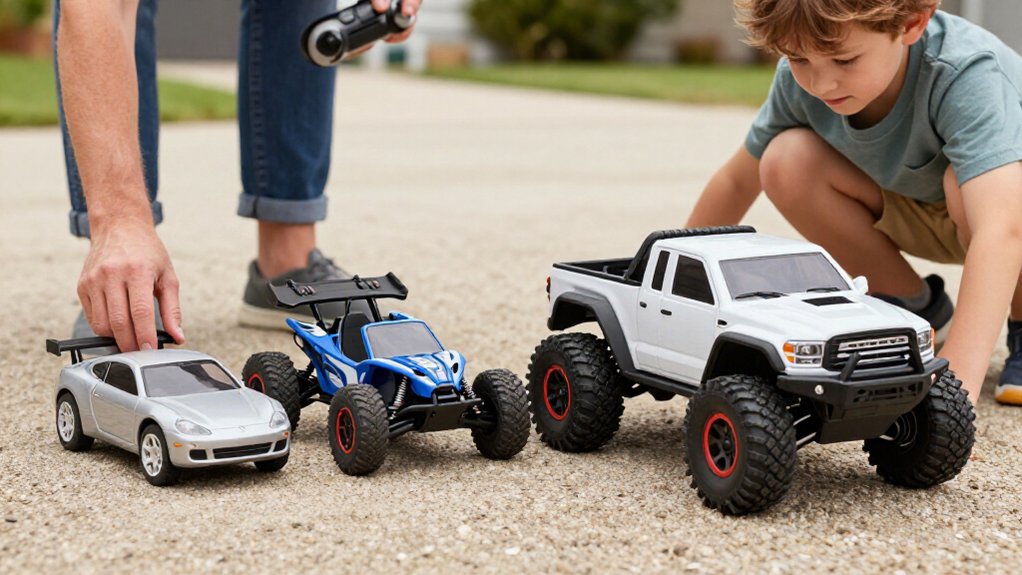
Choose a speed your child can control and stop reliably, matching age and experience. Preschoolers may prefer slower cars, while teens can handle faster models with practice.
Measure your space and set a budget, including batteries and chargers. Match tires and clearance to the surface; 4WD helps on rough ground, while drift tires suit smooth floors.
Check runtime, radio compatibility, a tough chassis, spare parts and steering before use. More checks can help you choose confidently.
Match Speed to Age
Match speed to age and experience, since a car that’s easy to control is more fun than one that’s simply fast.
For preschoolers, choose two-button controls and a modest-speed model; the 1.5-mph Nintendo Super Mario Kart Mini offers a manageable start. For ages four to seven, a reasonably paced 4×4 can help your child practise steering without overwhelming them. Around eight or nine, consider a beginner-friendly monster truck with 4×4 drive and speed your child can manage.
From nine or ten, a drift car suits a child with the patience and coordination to practise control. For teens, faster brushless models add acceleration, but match the car to your teen’s experience and play area. Start cautiously, then move up only when your child can steer and stop reliably.
Set a Budget and Space Limits
Once you’ve matched the car’s speed to your child’s skills, set a firm budget and check what the price includes: hobby-grade models may need a separate battery and charger. Under £50, you can find compact 1/18 off-road cars or pocket-sized 1/43 drift cars. From £50 to £100, ready-to-run models often include both, making costs easier to predict. Still, reserve money for transmitter batteries, spare packs, replacement parts, or another charger, since these may be extra.
Measure the play area before you buy. Small cars and track sets fit indoor rooms, while buggies and monster trucks need more room in a yard, path, or park. Check the car’s dimensions and stated terrain limits: the five-inch MotorDayz Polaris RZR PRO XP suits smooth floors and low-pile carpet, but not tall grass or deep gravel. Give your child clear space to steer and stop without hitting people or furniture, and keep play away from stairs and busy roads.
Surface Grip and Tire Type
Choose tires for the ground your child will drive on: oversized, high-traction tires grip grass, dirt, and gravel, while hard drift tires work best on smooth indoor floors.
| Surface | Better fit |
|---|---|
| Grass, dirt, gravel | Oversized high-traction tires |
| Smooth floors | Hard drift tires |
| Bumpy terrain | 4WD, clearance, suspension |
| Low-pile carpet | Check model rating |
On uneven ground, choose 4WD, high clearance, and responsive suspension; they help tires stay in contact over bumps. Crawlers trade speed for grip on garden obstacles. Check the stated terrain before buying: a compact car may not handle tall grass or deep gravel.
Hard-patterned drift cars can slide predictably on smooth floors, but they may struggle when the surface gets loose or tall. For control, start on an area suited to the model and keep your child away from roads, stairs, and people. A 1:43 Polaris RZR suits smooth floors and low-pile carpet, not outdoor ground.
Ready-to-Run vs. Build Kits
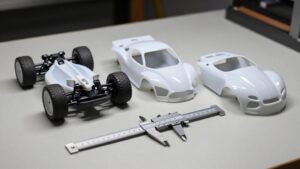
If your child wants to drive right away, choose an RTR car that needs no assembly. A build kit suits a patient, curious child who’s ready to learn basic tools, assembly, and tuning with your supervision. Compare what each kit includes, especially electronics, battery, and charger, before choosing the safer fit for your child’s skills and interests.
Ready-To-Run Convenience
For a child who wants to drive straight away, a ready-to-run (RTR) car avoids assembly, but “ready to run” doesn’t always include the batteries or charger, so check the box contents and allow for transmitter batteries too. That quick start can make an RTR a better fit when your child would rather practise driving than spend time preparing the model. Before you buy, confirm whether the car arrives with a usable power pack and charger, and budget for any missing items.
You’ll also need a safe place to charge batteries and supervise charging according to the manufacturer’s instructions. By contrast, a kit suits a patient, curious child or teen who wants to assemble and understand a car before driving. Choose RTR for convenience. Even with an RTR, read the age guidance and test controls at low speed in an open area before handing over full control.
Build Kit Basics
RTR models save you assembly time, while a build kit lets a child learn how the car works before driving it.
Choose RTR if your child wants to drive right away; it arrives assembled and keeps the first session simple. A kit is a better match for a patient, curious child or teen who wants to assemble, understand, tune, and then drive the car. For example, building a Tamiya TT-02 Porsche 911 GT3 (992) introduces the drivetrain, steering, shock absorbers, and basic adjustments.
Consider the time commitment, too: a family can build the 722-piece LEGO Technic Transformation Vehicle over a few light evenings, while a tween or teen working a few hours daily may need about a week. Before buying, check the box contents. Batteries, chargers, and other electronics may be sold separately, so confirm what you’ll need for a complete, safe, supervised first run.
Tools And Skills
How much hands-on work suits your child? A ready-to-run (RTR) car needs no assembly, so your child can focus on driving right away. You’ll need to charge its battery and follow the safety instructions before use.
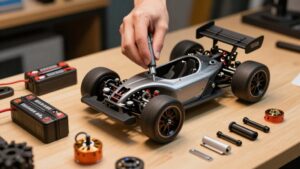
A build kit asks for patience, careful handling, and time with small parts and tools. The Tamiya TT-02 Porsche 911 GT3 (992), for example, teaches you about the drivetrain, steering, shock absorbers, and adjustments as you assemble it. You’ll set up the electronics afterward; the on-road model leaves room for upgrades.
A family can spend evenings building the 722-piece LEGO Technic Transformation Vehicle; a tween or teen working independently may need about a week. Keep tools controlled and supervise younger builders, especially around tiny components.
Choosing The Right Option
If your child wants to drive right away, choose a ready-to-run (RTR) car; check whether the package includes a battery and charger, since requirements vary. RTRs need no assembly, and simple controls help beginners focus on safe driving. Choose a sturdy chassis with replaceable parts for easier crash repairs.
A build kit suits a curious teen who enjoys assembly and tuning. The Tamiya TT-02 Porsche 911 GT3 (992) introduces the drivetrain, steering, shock absorbers, and adjustments; you’ll need to set up electronics after assembly. Allow time: a family may take a few evenings to build the 722-piece LEGO Technic Transformation Vehicle, while a tween or teen may need a week of hours’ work daily. Check requirements: LEGO uses the Technic Control+ app and six AA batteries.
Battery Runtime and Charging
About 10 minutes of runtime may suit a younger child, while an older kid or teen may prefer longer sessions or a spare battery. Check whether the car uses disposable or rechargeable batteries, and whether the battery and charger come included or require separate purchases. Compare charging time and setup, some rechargeable models have short attached cords, before choosing a quick-recharging option or spare to limit interruptions.
Battery Runtime Expectations
Runtime varies by model: some small RC cars run for about 10 minutes per charge, while select off-road models last up to 25 to 30 minutes. Compare runtimes with your child’s planned play sessions to avoid frequent pauses. Check whether the car includes a rechargeable battery and charger; some require separate purchases. An included battery may need charging before your child can play.
For extended play, a spare battery or a model that recharges quickly can reduce waiting. Check remote power separately: Mario Kart RC needs six AA batteries for the car and two for its remote, and doesn’t include them.
Also inspect how charging works. The Monster Jam Mega Megalodon has a short attached USB cable that can be awkward when the truck is dirty. Check the instructions before charging, and keep the connection clean.
Battery Type and Capacity
Start by checking whether the car uses a rechargeable pack or disposable batteries, and whether the car’s batteries and charger are included. Then check whether the remote needs separate batteries; ready-to-run doesn’t always mean everything is in the box. Compare capacity and expected play time rather than voltage alone. For example, a 7.4V, 1,500mAh pack may run up to 25 minutes, while a 7.4V, 2,000mAh pack may last up to 30 minutes, depending on the model and use.
A larger capacity can extend play, but check the listing for the battery and USB charger; some cars require you to buy both separately. Disposable AA batteries avoid recharging a pack but add ongoing replacements: the LEGO Technic Transformation Vehicle needs six, not included. Consider a compatible spare pack for older children and teens to reduce interruptions, and store batteries safely between sessions, away from heat.
Charging Time and Method
Before buying, check how long the car runs per charge and how it charges.
Check the product listing to confirm a battery and charger come in the box; some cars need both purchased separately. Runtime differs by model: the RCG Racing 1/18 off-road car runs for up to 25 minutes, while drift cars can offer up to 30 minutes.
Ready-to-run packages may include a USB or wall charger, but the included battery may arrive at storage charge, so charge it before first use. Compare charging methods and check cable length and access. For example, the Monster Jam Mega Megalodon’s short, attached USB cable can make charging awkward. Choose a setup that’s straightforward, follow the manufacturer’s charging instructions, and keep charging equipment away from heat and water.
Spare Batteries for Longer Play
If your child wants longer play sessions, check the stated runtime and battery type: some ready-to-run cars run for up to 25 minutes per charge, while others last up to 30. A compatible spare battery can reduce waiting between sessions, especially if your child wants to keep driving at home. Before buying, confirm the car supports battery swaps and check whether the battery and charger come in the box.
Some toy cars use rechargeable packs; others run on replaceable AA batteries, so you can skip charging but must keep spares handy. Many hobby-grade models sell batteries and chargers separately, adding to your cost. Follow the manufacturer’s charging instructions. A new pack may arrive at storage charge, so charge it before first use.
Check Radio Frequency Compatibility
Check that the car and controller use the same radio system: a 2.4GHz transmitter needs a compatible receiver, and a replacement controller may require an exact model or protocol match.
For racing two or more cars, 2.4GHz systems are usually more convenient than older channel-based radios: they can let several vehicles run at once with fewer channel conflicts. Still, check the maker’s instructions and supervise children; compatible controls don’t prevent collisions, so choose an open area and agree on turns before driving. Confirm the controller comes with the car and is already paired.
Even ready-to-run models may need separate AA batteries for the transmitter, so check before play. If you’re replacing a controller or receiver, don’t rely on the frequency label alone; verify the exact model and protocol. For app-controlled cars, check that you have the required app and a compatible phone or tablet before buying to avoid frustrating delays at home.
Spare Parts Availability
Since crashes and rough ground can wear out parts, choose a car with spares that are easy to find so you can get it running again. Check availability before buying: compare local shops and online listings for common items such as tires, body pieces, and suspension components. If replacements are scarce, a small repair may keep your child off the track for weeks.
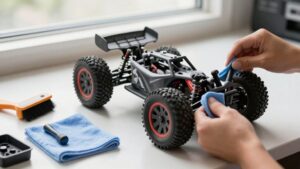
Traxxas Slash 4X4 VXL HD parts and upgrades are widely available, making repairs and tuning easier. ARRMA Granite 4X4 spares and upgrades are accessible too. GoolRC XKS 144001 replacement parts are affordable and widely available, but routine checks and thread-locker can support reliability. A hobby-grade model such as the Arrma Grom can help your child learn maintenance, while replaceable parts make crash repairs manageable. Switch off and disconnect the battery before repairs, and keep parts away from children.
Avoid Fragile Toy-Grade Chassis
An energetic child needs a chassis built to handle bumps, crashes, and rough ground, not a flimsy toy-grade frame.
Match construction to how your child drives. For energetic play, choose sturdy materials, effective bumpers, and replaceable parts; a cracked frame shouldn’t end the fun. Before buying, compare these checks:
- For loose terrain and hard jumps, consider the ARRMA Granite 4×4, designed for demanding outdoor use.
- The Traxxas Slash 4X4 VXL HD offers a durable chassis for rough landings, plus widely available replacement parts and upgrades.
- If you’re watching costs, the GoolRC XKS 144001 has affordable, easy-to-find replacements, but it’s less robust than higher-end cars.
- Look for durability checks or drop tests; Good Housekeeping assesses cars by driving them off a countertop and down stairs.
Inspect Steering Linkage
A sturdy chassis can take a hit, but damaged steering linkage may still make the car pull to one side.
Before choosing a model, inspect the rods and joints linking the servo to the front wheels. Use this quick check:
- With the car switched off, gently move the front wheels by hand; they should turn together smoothly, without binding.
- Look for bent rods, loose joints, cracked parts, or excess play; these can make steering imprecise.
- After a short drive, check for loosened fasteners or new damage, especially after obstacle impacts.
- Compare hobby-grade models by checking whether replacement links and joints are easy to find.
Reliable steering helps your child control the car and avoid veering near people or hazards. Replaceable parts can make repairs simpler after a rough outing.
Conclusion
Choose an RC car that fits your child’s age, your budget, and the space where they’ll drive. A slower, sturdier model often beats a fast, fragile one, especially on rough surfaces; match its tires to the terrain. For an easier start, pick ready-to-run, then compare runtime, charging needs, and parts availability. Check frequency compatibility, steering links, and chassis strength before buying.
Supervise driving, use batteries as directed, and prioritize control over top speed every time.
For practical guidance on this related topic, see our guide to drift cars.