How to Choose an RC Steering Servo: Torque, Speed and Size
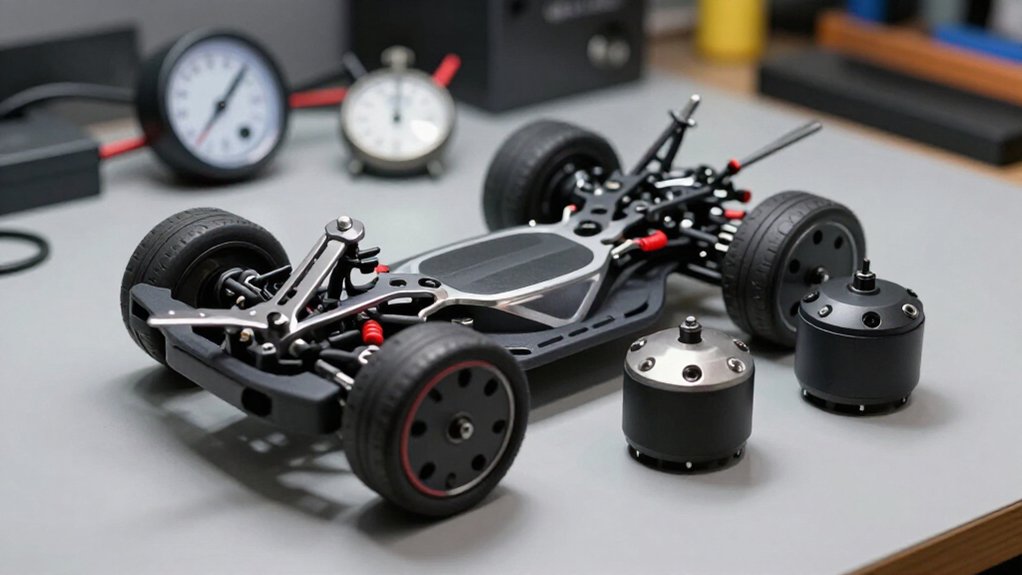
Choose an RC steering servo by matching its size and mounting footprint to your chassis, then estimate torque from vehicle weight, tire diameter, width, and steering effort. Larger tires and high-grip surfaces raise scrub load, so leave torque margin.
Compare speed in seconds per 60°; lower figures respond faster, while crawlers often favor slower, controlled steering. Confirm BEC voltage and current, spline and horn fit, and gear durability. Check seals; further fit checks can prevent failures.
Quick Steering Servo Picks
Start with the vehicle class: the low-profile PowerHD GTS-2 suits 1/10 on-road and drift cars, delivering 15 to 18 kg·cm of torque and 0.073 to 0.080 sec/60° speed for responsive steering in tight chassis. You can use the GTS-2 when your 1/10 touring or drift chassis limits servo height; its speed and torque suit quick steering response. For short-course trucks, choose the standard-size GTS-3, rated at 20 to 26 kg·cm and 0.067 to 0.083 sec/60° across 7.4 to 6.0 V.
If you’re building a 1/8 buggy, truggy, or heavy crawler, the brushless T60-BHV supplies 45 to 60 kg·cm at 0.080 to 0.098 sec/60°, depending on voltage. For a lower-cost high-torque choice in a monster truck or crawler, the B2S offers about 50 kg·cm and titanium-and-steel gears. For 1/16 to 1/18 mini cars, consider the compact R12S at 12 kg·cm; the 1025PH fits 1/24 models as a micro-servo option. Match servo size to your vehicle class, then compare the specs with your system requirements before selecting a model and confirm voltage compatibility with your setup.
Estimate Tire Scrub Load
Estimate tire scrub load from tire diameter and width, vehicle weight, and the steering effort required while the vehicle is stationary. Use those factors to judge how much resistance your servo must overcome before the vehicle rolls. High-grip surfaces and oversized tires increase scrub; larger, heavier tires generally demand more torque than small tires on loose ground.
For a baseline, consider about 15 to 20 kg·cm for 1/10 on-road steering, 30 to 45 kg·cm for 1/8 buggies, and 45 to 60 kg·cm for heavy trucks or crawlers. A 1/8 monster truck with oversized tires may need around 60 kg·cm, while a 1/24 micro car may steer with about 10 kg·cm. Choose a servo with torque margin above the estimate; insufficient torque can stall it or cause loss of steering control.
Servo Response and Precision
After confirming adequate torque for tire scrub, compare servo speed and precision. Speed is rated in seconds per 60° of output-shaft movement; lower figures mean faster response. Choose a range that matches your driving: racing often favors 0.06 to 0.10 sec/60°, while crawlers typically use 0.12 to 0.20 sec/60°.
| Servo | Speed at 7.4 V | Precision feature |
|---|---|---|
| GTS-2 | 0.073 sec/60° | Fast response |
| GTS-3 | 0.067 sec/60° | i-BUS 2 endpoints |
The GTS-2 suits touring and drift cars; the GTS-3 responds faster and lets you adjust endpoints with compatible FlySky i-BUS 2 transmitters. You can refine steering by programming endpoints, center, deadband, and response curves.
Match these settings to your chassis and driving style; excessive speed alone won’t guarantee accurate control. Check response under load, since voltage and setup affect delivered speed.
Metal Versus Composite Gears
Composite gears keep weight and cost low for many 1/10-scale applications, while metal gears generally resist higher loads and wear better. Your choice should match steering torque and impact exposure: steel and titanium offer durability, while brass can suffer under shock loads. Don’t exceed the servo’s torque capacity, and use a servo saver in high-impact vehicles to help protect either gear type.
Gear Strength Under Load
When steering loads and repeated wear are high, metal gears generally outlast plastic or composite gears, making them a sensible choice for heavier vehicles and high-torque setups.
Composite gears can suit many 1/10-scale applications when loads and impacts stay moderate. Still, material alone doesn’t determine gear strength: a shock load or steering demand beyond the servo’s torque capacity can strip any gear set. Match torque to your vehicle’s weight, tire grip, and conditions.
Steel handles demanding use; titanium or titanium-alloy gears offer higher-end alternatives, while brass exceeds plastic strength but may suffer under shocks. If impacts are likely, adjust the servo saver to absorb them and protect the gear train. Don’t set it so loose that steering response becomes sloppy.
Durability and Wear
Metal gears generally resist wear and higher steering loads better than plastic or composite gears, making them a durable choice for heavy vehicles and demanding use. For repeated operation, steel gears retain service life under sustained cycling, while brass offers greater strength than plastic but can deform or break after sharp shock loads. Titanium gears serve high-end applications; some GDW DS190X servos combine steel gears with a titanium surface treatment.
You can still use composite gears in many 1/10-scale models when steering loads and impacts remain modest. Their suitability depends on your vehicle’s mass, tire grip, and driving conditions, not scale alone. Inspect gear teeth periodically; pitting, backlash growth, or chipped edges indicate wear and warrant replacement before steering accuracy deteriorates. In high-impact use, fit a servo saver to absorb sudden loads, and choose adequate servo torque without oversizing it. That combination helps prevent gear stripping and extends reliable operation.
Weight and Cost
If weight and cost matter, composite gears offer a lighter, less expensive option than metal gears and can work well in low-impact applications, including many 1/10-scale vehicles. That difference can affect your vehicle’s balance and the servo’s overall mass, especially when you’re limiting weight across the chassis. Metal gears add strength and wear resistance, but they typically raise the servo’s price as well as its weight.
Compare complete servo specifications rather than gear material alone: the case, motor, and electronics also contribute to mass and cost. In a low-impact setup, composite gears may meet steering demands without paying for capacity you’re unlikely to use. If impacts or steering loads are higher, added gear durability may justify the premium. A servo saver can also reduce shock-related damage, helping protect the gear train. Weigh these trade-offs against your budget and the effect of servo mass on your build and its impact on handling dynamics.
Choosing the Right Material
Gear material affects how well a steering servo withstands load and impact.
Composite (plastic) gears are lightweight and suit low-impact 1/10-scale applications where you prioritize weight or price. Metal gears provide greater strength and longer wear, so they’re better for high-torque steering and demanding use. But metal type matters: brass exceeds plastic in strength yet can suffer under shock loads, while steel offers durability and titanium serves as a premium option.
Match gear material to steering loads and impacts. If you exceed the servo’s torque capacity, you can strip gears, regardless of material. A servo saver can reduce impact loads and help protect the train. Check the gear material and torque rating together; metal gears won’t prevent damage when steering load exceeds the servo’s limits.
Rock Crawler Steering Picks
For rock crawling, match servo torque to tire size and rig weight; the PowerHD T60-BHV delivers 50 kg·cm at 7.4 V or 60 kg·cm at 8.4 V for demanding setups. Assess low-speed steering control, waterproofing, durability, and physical fit before choosing a servo, and verify that your BEC supports its voltage and stall current. If you choose the lower-cost PowerHD B2S, add a servo saver to reduce gear damage from trail impacts.
Torque for Tire Size
As crawler tires grow larger, heavier, or grippier, they increase steering load, so size the servo for tire demands and vehicle weight—not scale alone. For a 1/10-scale crawler with oversized tires or added mass, target roughly 35 to 60 kg·cm; choose 45 to 60 kg·cm for demanding builds. A 1/8-scale monster truck with oversized tires may need about 60 kg·cm, and a heavy crawler can benefit from a comparable high-torque range.
The brushless PowerHD T60-BHV offers 45 kg·cm at 6.0 V, 50 at 7.4 V, and 60 at 8.4 V, making it a candidate for heavy crawlers. Allow a safety margin, then verify your BEC supports the servo’s voltage and current; the T60-BHV can draw over 2.5 A at stall under your vehicle’s actual electrical supply conditions, safely.
Low-Speed Steering Control
On a rock crawler, prioritize steering torque and control over outright speed: aim for 35–60 kg·cm and a measured response that won’t make low-speed steering twitchy. Heavy tires or beadlocks make that torque range useful, but speed still matters: a crawler-oriented target is about 0.12–0.20 sec/60°. The PowerHD T60-BHV exceeds that speed range, so use radio-rate or endpoint adjustments if its response feels abrupt; it delivers 50 kg·cm at 7.4 V and 60 kg·cm at 8.4 V.
Confirm your BEC supports the selected 6.0 to 8.4 V supply and can handle current above 2.5 A at stall, or the receiver may brown out. Set the servo saver to absorb impacts without adding play: excessive tension can strip gears, while a loose setting reduces steering precision carefully.
Waterproofing and Durability
When wet trails are routine, don’t treat “water-resistant” as waterproof: the T60-BHV has a metal case and gears and delivers 50 kg·cm at 7.4 V or 60 kg·cm at 8.4 V, but it has no IP rating.
For dedicated wet runs, add a waterproof servo cover or choose the fully sealed WT35; GTS-2 and GTS-3 use gasket-sealed aluminum cases. Heavy tires and beadlocks increase steering loads, so durable torque matters. A crawler servo may draw over 2.5 A at stall; provide adequate BEC current to limit brownouts and erratic steering. Set your servo saver to absorb impacts while holding position under moderate hand pressure. Too tight risks stripped gears, while too loose a setting can make steering sloppy on trail.
Servo Fit and Mounting
Before choosing a crawler steering servo, check its mounting footprint, height, and depth against the chassis and steering tray; a low-profile unit may provide needed clearance.
Match servo size to your crawler: most standard RC vehicles take standard servos, while 1/16-scale models need micro units. X-Maxx and Maxx require large-scale servos. For a 1/10 crawler, target roughly 35–60 kg·cm of steering torque. The PowerHD T60-BHV measures 40.7 × 20.5 × 38.7 mm and delivers 50 kg·cm at 7.4 V.
Before installation, confirm its 25T output spline matches your horn; you’ll need a compatible steering arm for secure engagement. Set the servo saver to absorb impacts without looseness. Move the horn and linkage through their steering travel. They should move freely without binding, preserving steering response.
Spline and Horn Fit
A steering horn must match the servo’s output spline in both tooth count and diameter; many servos use a 25-tooth spline, but size alone doesn’t guarantee compatibility. Before buying, check your servo’s specification and compare the horn’s tooth count and spline diameter. The PowerHD T60-BHV, GTS-2, and GTS-3 use a 25T, 5.80 mm output spline.
Don’t assume another servo with similar dimensions accepts the same horn: a mismatch can seat poorly or damage the output.
Then match horn length to your steering geometry. A longer arm increases linkage travel but reduces available steering force; a shorter arm increases force while reducing travel. Confirm that the horn’s mounting style suits your linkage, and check clearance throughout its movement before installation. Check clearance throughout steering travel.
Waterproofing and Environmental Sealing
How well a steering servo handles wet conditions depends on its actual sealing, not just the “waterproof” label; some models resist splashes but aren’t fully sealed.
Check for gasket seals and circuit-board protection, such as a silicone-modified coating; these features help limit water ingress. The T60-BHV is described as water-resistant, yet it has no IP rating. GTS-2 and GTS-3 use gasket-sealed aluminum cases, so compare their construction rather than relying on marketing terms.
If you drive frequently in wet conditions, consider a waterproof servo cover or a fully sealed model such as the WT35. GDW’s IPX896 carries an IPX8 waterproof rating, offering an ingress classification. Match the servo’s sealing to your exposure, and inspect seals for damage that could compromise protection.
Ignoring Receiver Voltage Limits
Sealing protects a servo from moisture, but electrical compatibility depends on the receiver or ESC BEC. Before installation, check voltage ratings; an 8.4 V-capable servo can fail if your BEC exceeds its specified range. Use these checks:
- Match your BEC output to the servo’s rated range: T60-BHV, GTS-2, and GTS-3 accept 6.0 to 8.4 V.
- Treat 7.4 V as a performance sweet spot only when your BEC supports it.
- At 8.4 V, T60-BHV delivers 60 kg·cm, versus 45 kg·cm at 6.0 V; higher voltage can raise speed too.
- A 6.0 V supply works, but expect roughly 15 to 20% less torque and speed than at 7.4 V.
- Verify current capacity: T60-BHV stall loads can exceed 2.5 A, and an undersized BEC may trigger receiver brownouts or erratic steering.
Verify Mounting Tab Spacing
Before installing the servo, measure the center-to-center spacing of the chassis mounting holes and compare it with the servo’s tab spacing. Use the manufacturer’s dimensions when available, and measure the actual mounting points rather than relying on a visual estimate. Small offsets can preload the case, distort alignment, or bind the linkage under steering load during full steering travel, too.
Check overall width, height, and depth too; matching holes don’t guarantee clearance.
- Confirm tabs sit flat against the chassis.
- Align screw holes without forcing or bending the tabs.
- If spacing differs, choose a compatible adapter or mount; don’t enlarge holes or stress the case.
- Test fit in the vehicle before tightening screws.
- Verify the servo moves freely without touching the chassis or nearby components.
Conclusion
Choose your steering servo by matching torque to tire scrub load, then balance speed against the control precision your vehicle needs. For crawlers, prioritize holding torque and durable gears; for fast models, favor crisp response without oversizing. Confirm spline and horn fit, mounting tab spacing, receiver voltage limits, and sealing for your conditions. A servo that fits electrically and mechanically will deliver predictable steering and last longer. Check specifications before purchase and test under load.