Brushed vs Brushless RC Car: Speed, Runtime and Cost Compared
Choose brushless if you want harder acceleration, 40 to 50+ mph potential, and roughly 30% longer runtime from the same battery. Its ESC electronically switches three phases, eliminating brush wear, but matched electronics typically cost $100–$400. Choose brushed for $20–$150 setups, simple two-wire repairs, and predictable low-speed throttle control.
Brushless needs compatible gearing, battery, and ESC tuning; sensored systems improve crawling precision. Your terrain, budget, and maintenance tolerance determine the better system, as the comparisons below further clarify.
Brush Wear vs ESC Switching
Brushed motors switch current through carbon brushes that rub against a rotating commutator, so friction, heat, and sparking gradually wear those contact surfaces. You’ll inspect brushes regularly because active RC use can require replacement after 10 to 20 running hours, depending on motor loading, cleanliness, and driving conditions. As contact material shortens, resistance and heat can rise, reducing consistent performance.
| System | Wear source | Service focus |
|---|---|---|
| Brushed | Brushes | Inspect, replace |
| Brushless | Bearings | Inspect, lubricate |
Brushless motors eliminate brush and commutator contact, removing wear and sparking. Their ESC switches current electronically; you must pair compatible components and program settings correctly. You still monitor bearings, but you’ll generally perform less routine maintenance. Frequent running shifts attention from brush replacement to bearing condition and electronic setup under typical running conditions.
Mechanical Commutation Versus Three-Phase Drive
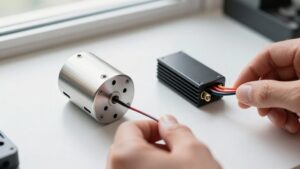
A brushed motor mechanically commutates: two carbon brushes contact segmented commutator bars to reverse current through the rotating armature at the required points. You connect it to an ESC through two motor wires, and swapping those wires usually reverses rotation. Its timing function occurs physically at the commutator.
A brushless motor instead places permanent magnets on the rotor and coils on the stator. Its ESC energizes three phases, commonly labeled A, B, and C, in sequence, creating a rotating magnetic field. Swap any two phase wires to reverse direction. With a sensorless setup, the ESC infers rotor position from back EMF after rotation begins. A sensored system uses Hall sensors and a separate harness, giving the ESC direct rotor-position feedback during startup and operation.
Acceleration, Top Speed, and Runtime
For similarly sized RC power systems, brushless setups typically accelerate harder, respond to throttle more quickly, and can push vehicles beyond 40 to 50 mph, whereas brushed models commonly top out near 20 to 30 mph. That performance gap comes from efficient electronic commutation, which lets you access stronger high-rpm output and sharper throttle shifts. Yet if you crawl over technical terrain, a brushed motor’s useful low-end torque can give you smoother, more precise control at walking speeds.
Runtime usually favors brushless: its higher efficiency can extend your run by roughly 30 percent on the same pack. However, if you choose a high-power system and drive at full throttle, you’ll consume energy faster, reducing that advantage. Choose power levels that closely match your terrain, gearing, and driving style.
ESC Calibration and Soldering
ESC compatibility comes first: a brushed motor needs a two-wire ESC, while a brushless motor requires a three-phase ESC that electronically commutates its A, B, and C motor leads. You must calibrate either ESC to your transmitter’s neutral, full-throttle, and full-brake or reverse endpoints, ensuring proportional response throughout its control range.
Before operation, confirm that programmed settings suit the installed motor and battery; on brushless systems, also check timing and sensor-wire seating where applicable. Solder brushless phase leads cleanly and securely to terminals A, B, and C. Unlike a brushed connection, phase order determines rotation: swapping any two leads reverses direction. Inspect every joint for bridges, cold solder, or looseness. Then lift the wheels, test throttle response, and confirm correct rotation before driving it.
Battery Voltage and Gearing
With the electronics connected and calibrated, battery voltage and gearing determine how effectively the motor’s output reaches the wheels. A brushless motor’s no-load speed is roughly KV multiplied by voltage: a 2,200KV motor on 3S, or 11.1V, reaches about 24,420 RPM. More voltage can deliver more speed, but only if your motor and ESC support it.
- Use taller gearing for higher top speed, accepting greater load and heat.
- Use shorter gearing to strengthen acceleration and reduce drivetrain strain.
- Match the ratio to vehicle weight and motor KV; heavy, high-KV setups dislike tall gears.
After each voltage or gearing change, run a brief test and check motor and ESC temperatures. If either runs too hot, lower voltage or shorten the gearing before driving again safely.
Commutator Wear and Bearing Service
Brushed motors require regular attention because their carbon brushes continuously rub against the commutator, creating friction that wears both components. As you run your RC car, brush contact erodes the commutator surface and shortens motor service life. Depending on load and driving conditions, you may need to replace brushes every 10 to 20 running hours; eventually, you’ll replace the motor itself. Typical brushed-motor life is roughly 50 to 100 hours.
A brushless motor removes the brushes and commutator, so you avoid this recurring electrical-contact wear and its associated service schedule. Instead, inspect its bearings for roughness, play, or noise, then replace them when worn. This concentrates maintenance on a serviceable mechanical component rather than a consumable contact system. With proper bearing care, you can expect 500 to 1,000 hours, making brushless systems durable.
Waterproofing and Thermal Shutdown
Water resistance depends on the design and rating of each motor-system component, not on whether the car uses a brushed or brushless setup. You shouldn’t assume a brushless car survives wet running: inspect the motor, ESC, connectors, bearings, and sensor wiring for their specific ratings. Brushed motors add exposed brush-to-commutator contacts, so trapped water or grit can accelerate corrosion and wear. Brushless motors eliminate those contacts, but they don’t protect vulnerable electronics or bearings.
- Check every component’s waterproof rating before puddle running.
- Keep airflow clear; aggressive gearing and heavy loads raise motor and ESC temperatures.
- Stop when thermal protection reduces or cuts power, then let the system cool.
An ESC’s thermal shutdown prevents damage, not the cause of overheating. Compare temperatures after hard runs.
Upfront Cost and Parts Availability
You’ll typically spend $20 to $50 on a brushed setup versus $100 to $150 or more for a brushless motor and compatible ESC. Brushed systems use simpler, widely available replacement parts, while brushless components cost more and require matched electronics. However, you’ll need to replace brushed motor brushes roughly every 10 to 20 running hours, adding recurring maintenance costs.
Initial Purchase Price
For most buyers, a brushed RC power system offers the lower entry price: basic setups often cost $20 to $50, while broader brushed motor-and-ESC packages typically fall around $50 to $150. That price advantage reflects simpler control electronics: you can pair a brushed motor with a less complex ESC and keep the conversion budget contained.
- Brushed baseline: choose it when you’re prioritizing minimum initial outlay.
- Brushless entry: expect roughly $100 to $150 to start, with quality motor-and-ESC combinations reaching $150 to $400.
- Upgrade overhead: budget for compatible batteries, motor mounts, and gearing; these requirements can widen the real gap.
If you already own suitable electronics and a chassis designed for the system, brushless pricing becomes easier to justify. Otherwise, you’ll spend more before realizing its performance potential during your first complete build.
Replacement Parts Availability
Replacement-part availability favors brushed systems in the short term: $20 to $50 motors, replacement brushes, and related components remain widely stocked because the design is simple and long established. You can usually source a brushed replacement quickly and cheaply, which limits downtime after a motor failure. However, brushes commonly require replacement every 10 to 20 running hours, so your low initial parts price creates recurring maintenance expense.
Brushless systems cost more when you replace major electronics: motor-and-ESC packages typically start around $100 to $150, while quality combinations reach $150 to $400. Yet you won’t buy brushes, and bearings are the primary wear item. Before ordering either system, verify ESC, battery, shaft, and mounting compatibility. A mismatched motor can force additional electronics or hardware upgrades, erasing the apparent savings in your vehicle’s configuration.
Crawlers, Racers, and Beginners
For crawling, you’ll value a brushed motor’s low-speed torque and linear control, though sensored brushless systems can match that precision. For racing, brushless power delivers harder acceleration, 40 to 50+ mph potential, and roughly 30% longer runtime than a comparable brushed setup. As a beginner, you can start with a simple $20 to $50 brushed system, while brushless costs more upfront but reduces long-term maintenance.
Crawler Torque And Control
Although brushless systems dominate when speed and acceleration matter, brushed motors remain highly effective for scale crawlers because they deliver strong low-speed torque and smooth, predictable throttle response. You’ll feel this controllability when climbing ledges, where incremental input limits wheelspin and helps the chassis maintain traction.
- Brushed two-wire motors reverse simply when you swap positive and negative leads, which keeps troubleshooting direct.
- Sensored brushless systems use rotor-position feedback and a compatible ESC to improve low-speed smoothness and throttle resolution.
- Avoid sensorless brushless setups for demanding crawling; startup back-EMF detection can cause cogging or stutter before rotation stabilizes.
If you’re learning precise throttle control or limiting initial cost, brushed power offers a simpler baseline; a sensored system is the higher-control upgrade for technical terrain today.
Racer Speed And Efficiency
Racers prioritize motor efficiency, acceleration, and top speed differently than crawlers, so brushless power usually becomes the better fit. For a 1/10-scale racer, you’ll commonly see a 3,500 to 4,500KV brushless motor because it balances punch, controllable gearing, and usable runtime. If you build a lighter, speed-oriented chassis, 5,000 to 6,500KV can raise wheel speed substantially, provided your ESC, battery, gearing, and cooling can handle the load.
Compared with similarly sized brushed systems, brushless motors can push beyond 40 to 50 mph rather than roughly 20 to 30 mph and deliver sharper acceleration. Their electronic commutation also wastes less energy, often extending runtime by about 30% on the same battery. However, you won’t automatically gain endurance: aggressive gearing, high KV, repeated full-throttle runs, and excess heat can drain packs quickly. Match it carefully.
Beginner Cost And Simplicity
Cost and system complexity usually make brushed power the more practical entry point: a basic motor-and-ESC setup costs roughly $20 to $50, uses simple two-wire connections, and accepts inexpensive, widely available replacement parts. For backyard driving, you’ll learn throttle control more easily because a brushed motor delivers power gradually.
It also favors crawlers: smooth, low-speed modulation helps you negotiate technical lines, and you can handle basic repairs at home. That tradeoff lets you focus on driving technique before managing advanced electronics and performance settings.
- Choose brushed if your budget is tight and simplicity outweighs maximum speed.
- Choose brushless when racing acceleration, higher speed, and long motor life justify its $100 to $150 entry cost and compatible ESC.
- Expect more tuning flexibility from brushless, but greater initial system cost.
Sensored Low-Speed Control
Sensored brushless systems deliver the most controlled low-speed behavior because Hall-effect sensors continuously report rotor position to the ESC. This closed-loop feedback lets you start smoothly and meter throttle precisely when wheel speed is minimal. For crawling or technical rock sections, you can maintain steady tire movement instead of fighting abrupt pulses.
A sensored installation uses three motor phase wires and a separate six-pin sensor harness connected to a compatible ESC. By comparison, sensorless ESCs infer position from back EMF, which is weak before rotation begins. That limitation can produce startup cogging or stutter. For best results, pair a sensored motor with a sensored ESC, then verify the harness is secure and configure ESC settings correctly for your terrain, gearing, and battery voltage needs.
Conclusion
Choose brushed if you want low upfront cost, simple wiring, and predictable beginner maintenance, but expect brush wear, lower efficiency, and reduced sustained speed. Choose brushless if you need stronger acceleration, higher top speed, longer runtime, and cooler operation under equivalent gearing and voltage.
You’ll pay more for the motor, ESC, and setup, yet gain durability and tuning range. For crawling, sensored brushless gives you the smoothest low-speed control; for casual use, brushed remains practical.