What Does kV Mean on a Brushless Motor? RPM, Torque and Gearing
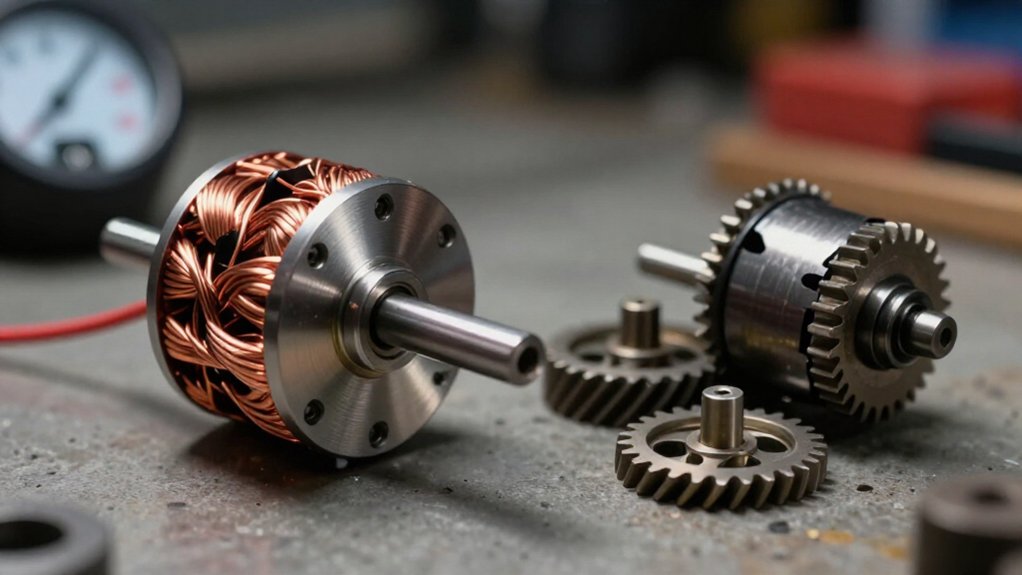
A brushless motor’s kV rating tells you its theoretical no-load speed in revolutions per minute per volt; it doesn’t indicate torque or battery voltage.
Multiply kV by battery voltage to estimate RPM, though load and losses reduce actual speed.
Your gearing trades wheel speed for torque: a higher reduction ratio slows the wheels while multiplying torque.
Battery cell count sets voltage, while motor load and setup affect current and heat. More factors can guide your setup.
kV Means RPM/Volt
A brushless motor’s kV rating tells you its theoretical no-load speed in revolutions per minute per volt applied. Here, kV is a speed constant, not a measure of torque: each volt corresponds to a theoretical increase of kV revolutions per minute when the motor runs without a load. To estimate that speed, multiply the motor’s kV rating by the battery voltage.
For example, a 2,300 kV motor supplied by a 14.8 V battery has an estimated no-load speed of 34,040 RPM (2,300 × 14.8). A 1,000 kV motor on 10 V yields 10,000 RPM by the same calculation. Treat either result as a reference, not a guaranteed operating speed: air resistance, motor efficiency, and the load reduce the RPM you’ll observe in actual operation.
Why kV Affects Runtime and Heat
That theoretical RPM also affects runtime and heat because a higher-kV motor can draw more current when gearing is too tall, the load is excessive, or the propeller is poorly matched.
A motor’s no-load speed is roughly kV multiplied by battery voltage: a 2,300 kV motor on 14.8 V reaches 34,040 RPM before load. Under demanding conditions, excess current wastes energy and heats the windings, shortening runtime and risking damage. Lower kV doesn’t automatically run cooler; voltage, load, current limits, and gearing matter too.
Match kV to your battery and vehicle load, and select a setup that reaches your target speed without overworking the motor. Monitor its temperature during use, and revise the setup if it gets too hot to confirm it stays safe.
Gearing and Wheel Speed
How fast the wheels turn depends on gearing as well as motor kV: no-load motor RPM is approximately kV multiplied by battery voltage, while the final drive ratio determines how that speed translates to wheel speed and torque.
When you increase the numerical reduction ratio, you lower wheel speed but multiply torque at the wheels. For a 150 km/h target, the 1257 kV example uses a 2.72 final drive ratio, while the 2200 kV example uses 4.77. Both motors produce about 319 mNm at the shaft, yet the latter setup delivers roughly 74% more wheel torque because its gearing provides greater reduction. That trade-off shows why you should choose gearing alongside kV and battery voltage: kV alone can’t specify wheel speed or wheel torque.
Motor Pole Count Differences
When you compare 2-pole and 4-pole motors, you’ll find that 2-pole designs generally favor higher RPM and lower weight, while 4-pole designs deliver more torque and smoother power. Pole count describes the motor’s magnetic configuration; it’s separate from KV, which indicates RPM per volt. For controlled power in crawlers or heavy trucks, you’ll often find a 4-pole motor suits the application better.
2-Pole vs. 4-Pole
Pole count affects how a brushless motor delivers power. A 2-pole motor uses two magnetic poles and typically favors a lighter, simpler design. A 4-pole motor uses four poles and generally produces more torque with smoother power delivery at low speeds. That difference can help you choose a motor for your vehicle and driving style.
If you run a crawler, heavy truck, or another setup that needs controlled power, a 4-pole design is often a practical choice. The additional poles support steadier, more manageable output when you need careful throttle control and consistent traction. Still, pole count doesn’t decide performance on its own. KV, battery voltage, gearing, and vehicle weight also shape how the motor behaves under load in your specific driving conditions.
Poles and RPM
Why doesn’t a motor with more poles automatically spin faster? A brushless motor’s pole count describes the number of magnetic poles on its rotor. At the same kV and voltage, a two-pole and four-pole motor have the same theoretical no-load RPM: roughly kV multiplied by voltage.
Pole count alone doesn’t directly change that estimate. Two-pole designs generally suit speed-focused setups because they’re often lighter and favor higher operating speeds. Four-pole motors can deliver smoother power, a trait useful in crawlers and heavier trucks.
But don’t use pole count alone to predict speed on the track. Your actual loaded RPM also depends on gearing, the vehicle’s load, and motor efficiency. A poor gear choice or heavy load can reduce wheel speed, regardless of pole configuration.
Pole Count and Torque
Beyond RPM, pole count affects how a brushless motor delivers power. A 2-pole design generally spins faster and weighs less, while a 4-pole design typically produces more torque and smoother power delivery. Use this comparison to match motor behavior to your rig:
| Poles | Typical strength | Common fit |
|---|---|---|
| 2 | Higher RPM, lighter | Speed-focused builds |
| 4 | More torque, smooth output | Crawlers, heavy trucks |
| Any | Torque depends on more than poles | KV, current, gearing |
Don’t treat pole count as a torque rating: it changes delivery, but doesn’t set torque alone. Consider KV, current capacity, and gearing too. For controlled low-speed response under load, a 4-pole motor often suits crawlers and heavy trucks; choose 2-pole when low mass and higher RPM matter more for your particular application and setup.
Battery Voltage and Cell Count
Your motor’s theoretical no-load RPM is its kV rating multiplied by battery voltage; for example, a 2,300 kV motor on a 14.8 V 4S LiPo calculates to about 34,040 RPM. Because each added LiPo cell raises voltage, you’ll increase RPM at the same kV, though load and motor losses reduce actual speed. Match cell count to your motor and gearing, and check the motor and ESC voltage limits before increasing it.
Voltage Sets RPM
Because a brushless motor’s theoretical no-load RPM is approximately its kV rating multiplied by the applied voltage, battery voltage directly affects its speed. For example, a 2,300 kV motor supplied by a 14.8 V nominal 4S battery has a theoretical no-load speed of 34,040 RPM.
The relationship is linear: if you increase the applied voltage, you increase the motor’s theoretical no-load RPM in the same proportion. However, you must keep the motor and electronic speed controller (ESC) within their voltage ratings; exceeding either limit can cause damage.
Don’t treat that estimate as the speed you’ll see in operation. Under load, your motor turns more slowly because the propeller or drivetrain demands torque, and electrical and mechanical losses reduce its speed from its no-load value.
Cell Count Basics
The “S” rating tells you how many cells a LiPo battery contains, which determines its voltage and helps estimate motor speed. Each LiPo cell has a nominal voltage of about 3.7 V and reaches 4.2 V when fully charged. Use one voltage convention consistently when estimating RPM.
| Pack | Nominal / full voltage |
|---|---|
| One cell | 3.7 V / 4.2 V |
| 2S | 7.4 V / 8.4 V |
| 3S | 11.1 V / 12.6 V |
| 4S | 14.8 V / 16.8 V |
Because motor RPM is approximately KV × voltage, more cells raise no-load speed. A 2,300 KV motor on nominal 4S estimates 34,040 RPM. Check your motor’s and ESC’s maximum supported cell count; exceeding voltage limits can damage them. Compare packs using nominal or fully charged voltage consistently for RPM estimates and compatibility checks.
Match Voltage to Motor
Match a brushless motor’s kV rating to your battery voltage to estimate its theoretical no-load speed: multiply kV by voltage to get RPM. For example, a 2,300 kV motor on a nominal 14.8 V 4S battery produces an estimated 34,040 RPM with no load. The 4S label identifies four cells in series; use the pack’s nominal voltage for this calculation, not its fully charged voltage.
If you increase cell count, voltage rises, so the same motor’s theoretical RPM rises proportionally. Before choosing a pack, verify that both your motor and electronic speed controller (ESC) can handle its voltage. Select kV and cell count together to suit your target speed, then adjust gearing to balance final speed and torque. Remember, the kV-times-voltage figure is an estimate, not a loaded running speed: motor RPM will drop under load. Losses prevent the motor from reaching theoretical speed under operating conditions.
Tire Diameter and Load
When you fit larger-diameter tires, your vehicle travels farther per wheel revolution, increasing speed at the same motor RPM and gearing. That speed gain comes with a mechanical cost: the tire’s rolling radius reduces the force available at the contact patch for a given motor torque. Your motor must deliver more torque to accelerate the vehicle and climb, so the motor and ESC carry a higher load.
Taller tires also act like a taller gear ratio, weakening acceleration and raising motor temperature. Shorter tires give you mechanical advantage at the contact patch, improving acceleration and reducing strain when the vehicle works hard. After changing tire diameter, check motor temperature. If it exceeds the motor’s safe operating range, adjust gearing, typically by choosing a lower gear ratio, then recheck temperature. Tire size changes effective gearing and load, even when you don’t change kV, voltage, or drivetrain settings overall.
Sensorless Startup Under Load
Changing tire size or gearing can increase the load a motor must overcome at startup, especially in a heavy vehicle or with a high-drag propeller. A sensorless ESC estimates rotor position from electrical signals, but at zero speed it has little back-EMF to read. When the load demands starting torque, the rotor may hesitate, twitch, or fail to turn because the ESC can’t track position reliably.
Excessive gearing or vehicle mass can worsen this; so can a propeller that resists rotation. Reduce the load or choose gearing that lets the motor accelerate more readily. Once it reaches sufficient speed, the ESC can track rotation more accurately. For reliable low-speed starts under load, use a sensored motor with a compatible ESC; its sensors report rotor position directly.
Confusing Motor kV With Battery Voltage
A motor’s kV rating isn’t its battery voltage; it indicates theoretical no-load RPM per volt. You can estimate a motor’s no-load speed by multiplying its kV rating by battery voltage. For example, a 2,300 kV motor on a 14.8-volt battery gives about 34,040 RPM.
- Treat kV as RPM per volt, not a voltage rating.
- Raising battery voltage makes the same motor spin faster.
- Check motor and ESC voltage limits before switching batteries.
- Under load, actual RPM falls below the estimate due to load, air resistance, and motor efficiency.
- Pair voltage with kV; gearing helps translate motor RPM into desired wheel speed.
Use the kV-times-voltage figure as a theoretical reference, not a guaranteed operating speed; real performance depends on the motor’s conditions and electrical limits.
Match kV to Vehicle Scale
Because vehicle scale affects motor load and available space, it helps narrow motor size, but it doesn’t determine kV.
For 1/18 to 1/16-scale vehicles, you typically use a 370–380-size motor; choose kV according to vehicle weight, battery voltage, and target speed. A 1/10-scale model commonly takes a 3650–3660-size motor, with kV matched to gearing and your ESC’s limits. For larger 1/8 to 1/7-scale rigs, 4074–4092-size motors handle greater loads, but you must balance kV, voltage, and gearing to control heat.
A 1/5-scale truck typically needs a 4274-or-larger motor; its weight and operating setup guide kV selection.
Treat scale as a starting point, not a kV rating. Before buying, check that the motor fits your chassis, then verify battery voltage, ESC capacity, and gearing suit your vehicle and driving needs.
Conclusion
Choose motor kV by balancing speed, torque, heat, and control, not by chasing the highest number. Remember, kV estimates unloaded RPM per volt; gearing, battery voltage, tire size, load, and motor design determine what your vehicle actually delivers. A lower-kV motor with suitable gearing can provide stronger, cooler operation, while excessive gearing or load can strain any setup. Match the motor to your vehicle’s scale, check startup behavior, and monitor temperatures during testing under load.