What Is an ESC on an RC Car? Speed Control Explained
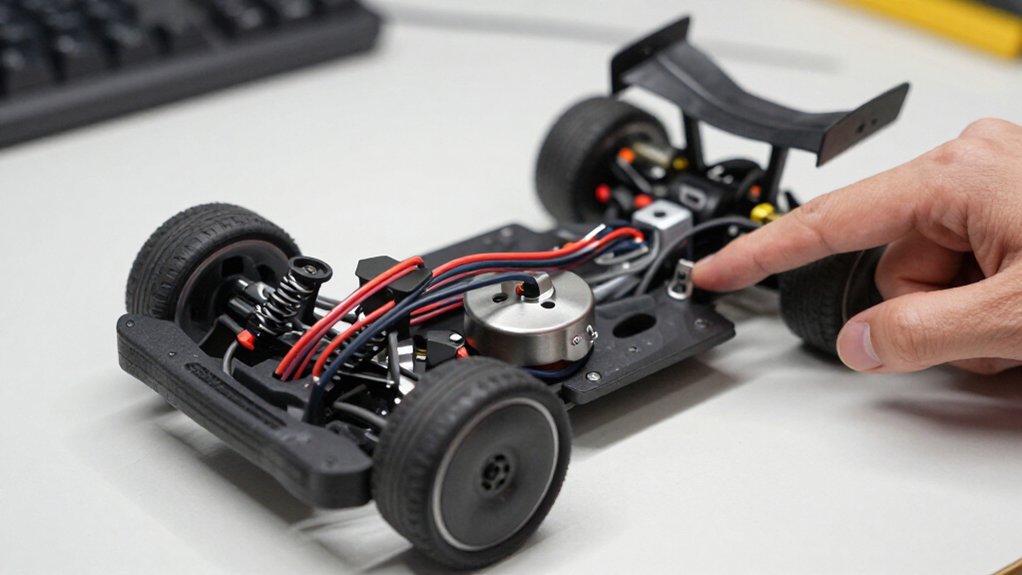
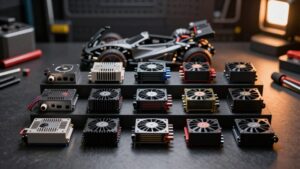
An electronic speed controller (ESC) on your RC car converts your transmitter’s throttle input into motor power for acceleration, braking, and sometimes reverse. It manages features such as low-voltage cutoff and motor direction. You must match it to your motor’s type, voltage, and current rating; brushed and brushless systems need compatible ESCs. Calibrate throttle and brake endpoints after setup. Proper battery settings and cooling help prevent damage. The guide ahead explains these choices in practice.
ESC Signal and Motor Pairing
A brushless ESC must pair with a brushless motor, while a brushed ESC is designed for a brushed motor; only a few ESCs support both. A brushless ESC connects to the motor’s three leads, usually labeled A, B, and C, and switches them in sequence to create the changing three-phase signal that turns the motor.
With a sensorless motor, you can connect the three wires in any order; swapping any two reverses rotation. For a sensored motor, match A, B, and C wires to corresponding ESC terminals; use ESC programming to change direction. Sensored systems use Hall sensors and an extra harness to report rotor position, while a sensorless ESC estimates position from voltage generated in the unpowered motor wire during normal motor operation.
Low-Voltage Battery Cutoff
When a battery’s voltage drops too low, an ESC’s low-voltage cutoff (LVC) reduces power or shuts down the motor to help prevent excessive discharge.
For LiPo batteries, your ESC typically sets cutoff voltage per cell. A 2S pack set to 3.2 volts per cell reaches cutoff at about 6.4 volts total. Your ESC measures total pack voltage, not each cell, so keep the cells well balanced for reliable protection. Many newer ESCs detect cell count automatically, but you can usually adjust the cutoff level to suit your battery.
Disable LVC with NiMH or NiCd batteries. Their voltage behavior differs from LiPo cells, so a LiPo-style threshold may trigger premature cutoff. Check your ESC manual and select the correct battery type if your ESC offers it.
Throttle Through a Hairpin
On a hairpin, ease off the throttle as you enter so the ESC reduces motor power and the car slows smoothly. If your ESC has drag brake, neutral throttle applies braking, helping you slow as you coast toward the apex. As you exit, apply throttle gently; the ESC uses partial-throttle PWM pulses to regulate motor power, and abrupt acceleration can break traction. Adjust punch and brake-force settings for your car and track: punch controls how smoothly power arrives, while brake force sets the braking limit.
During repeated hairpins, monitor ESC temperature. Partial-throttle running can produce more heat than full throttle, so maintain airflow and keep current demand within the ESC’s continuous-current rating. Check temperatures between runs and reduce load if the case becomes hot.
Brushed Versus Brushless ESCs
You must match your ESC to your motor: brushed systems use two motor leads, while brushless systems use three. A brushless ESC electronically switches power among those wires; a brushed ESC varies power to the motor’s leads. Brushless setups generally offer greater efficiency, performance, and service life, but you can’t use their ESCs interchangeably with brushed systems.
Motor Compatibility
A brushed ESC must match a brushed motor, while a brushless ESC is designed for a brushless motor, so check compatibility before connecting them.
Brushed motors use brushes that contact the armature, and you’ll find them in entry-level RC cars. A brushless ESC controls a brushless motor; most units support only one motor type, so don’t assume an ESC can run both.
Some hybrid ESCs support brushed and brushless motors, but confirm the manufacturer’s modes before choosing one. Also check sensor compatibility if you’re using a brushless system. A sensored brushless ESC can operate with either a sensored or sensorless brushless motor. A sensorless ESC, however, supports only sensorless motors. Match both motor type and sensor capability to the ESC to avoid incompatible setup.
Wiring Differences
Wiring Differences
Although both ESC types connect to the battery, they wire to the motor differently: a brushed ESC uses two power leads, while a brushless ESC connects to the motor’s three phase wires, usually labeled A, B, and C.
For a sensored brushless setup, match the motor’s A, B, and C wires to the corresponding ESC terminals, then connect the separate sensor harness. With a sensorless motor, you can connect its three wires in any order; swapping any two reverses rotation. To reverse a sensored motor, use ESC programming rather than swapping phase wires.
Keep battery wiring separate from motor wiring. Connect the red battery lead to positive and the black lead to negative. Check polarity before powering; reversing battery polarity can destroy your ESC.
Performance Trade-Offs
Choosing between brushed and brushless ESCs depends on your motor and performance needs: brushed systems are typically less expensive and easier to maintain, while brushless systems offer greater efficiency, speed, and service life.
Check the motor label before buying: a brushed ESC usually uses two motor wires; a brushless ESC switches power across three. They’re generally incompatible unless your ESC supports both. Match voltage and current ratings to your battery and motor to prevent overheating or damage.
| Choice | Trade-off |
|---|---|
| Cost | Brushed usually costs less |
| Care | Brushed maintenance is straightforward |
| Efficiency | Brushless uses power more efficiently |
| Use | Choose brushless for higher speeds and longer service life |
Choose the ESC that matches your motor first; then confirm its ratings suit your battery and motor under your expected driving loads consistently.
ESC Programming and Calibration
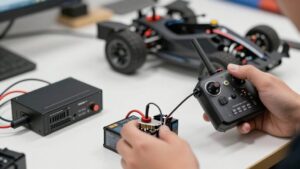
Calibrate a new ESC after installation or whenever you change the radio or receiver so it learns your transmitter’s full-throttle, full-brake, and neutral signals. Before calibration, set your radio’s throttle and brake endpoints to maximum, then follow the ESC’s prompts to apply each signal. You can adjust ESC settings with its button and LED or beeps, a programming card, or manufacturer software.
ESC Calibration
ESC Calibration
After installing an ESC or changing the radio or receiver, calibrate it so it recognizes the transmitter’s full-throttle, full-brake, and neutral signals. Before calibration, set throttle and brake endpoints (EPA or travel) to maximum; your radio may use 100%, 120%, 150%, or another value. Procedures vary by ESC, but you’ll usually enter calibration mode, then apply each input in sequence:
| Input | Action |
|---|---|
| Full throttle | Hold trigger forward |
| Full brake, then neutral | Follow prompts; release trigger |
Some radios require the throttle channel set to REV before calibration. If reverse becomes much faster than forward afterward, reverse the channel and recalibrate. Depending on your model, you’ll use the Set button with LED or beep prompts, a programming card, or a USB link to a computer directly.
Programming Options
Programming Options
Once calibration sets the ESC’s throttle range, you can use its programming options to adjust settings such as motor direction and low-voltage cutoff. Access these settings through the ESC’s Set button and its LED or beep prompts, a dedicated programming card, or USB connection to a computer; available methods depend on the model. Follow the manufacturer’s manual, since menu order and value ranges differ.
You may also install a manufacturer firmware update to fix bugs or add features, but confirm it matches your exact ESC before proceeding. If you change your radio or receiver, recalibrate the ESC so it recognizes full throttle, full brake, and neutral. Set throttle and brake endpoints to maximum first, and reverse the throttle channel if your radio requires it. Treat calibration as a distinct setup function, not a motor-direction or cutoff adjustment.
Throttle Range Setup
When you install a new ESC or change the radio or receiver, calibrate the throttle range so the ESC learns the transmitter’s full-throttle, full-brake, and neutral signals.
Before calibration, set your transmitter’s throttle and brake endpoints (EPA or travel) to their maximum values; the setting may be 100%, 120%, 150%, or another value. Then follow your ESC’s model-specific procedure. Most units require you to enter calibration mode and register full throttle, full brake, and neutral when prompted. Some radios require you to set the throttle channel to REV first. If reverse is much faster than forward after calibration, reverse the channel direction and repeat the procedure. Calibration matches the ESC’s response to your transmitter’s range, helping it recognize your correct intended maximum throttle and braking.
Battery Chemistry and Runtime
Set the ESC’s low-voltage cutoff for your battery chemistry: use a cutoff with LiPo packs, but generally turn it off for NiMH and NiCd packs to prevent premature shutdown.
For LiPo packs, set cutoff by cell voltage. A 2S pack set to 3.2 volts per cell reaches the 6.4-volt total cutoff at which your ESC stops the vehicle. The ESC reads total pack voltage, not individual cell voltage, so keep your cells well balanced; an imbalance can leave one cell under-protected even when the pack reaches its cutoff.
Runtime also depends on current draw. Choose gearing, tire size, and motor KV that suit your vehicle and avoid excessive current demand, which drains the battery faster. A higher ESC amp rating alone won’t make your car consume more power or extend runtime: the motor and vehicle load determine current draw. Check your pack’s capacity and condition when estimating how long each run will last.
Thermal Shutdown and Cooling
Because its MOSFETs generate heat as they switch current, an ESC can run hotter at partial throttle than at full throttle, where the FETs stay on longer.
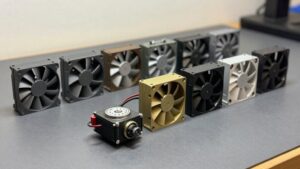
Higher PWM switching rates add FET heating, while poor airflow and high ambient temperatures limit heat rejection. Mount your ESC in a ventilated position; add a heatsink or forced-air cooling if temperatures remain too high. If your ESC supports thermal shutdown, it may cut output, but don’t treat that protection as operating control.
Prolonged overheating can trigger thermal runaway, melt solder, or loosen components. Test the system under driving conditions, since usable current capacity depends on cooling and temperature. A 10°C rise can halve component life, so monitor temperature on runs and improve airflow or reduce load if the ESC gets too hot.
ESC Reverse Settings
How your ESC handles reverse depends on its mode: forward/reverse with braking, forward and brake only (“race” mode), or forward and reverse without braking. Choose the mode that matches your track rules. Many ESCs let you cap reverse speed separately from maximum forward speed, limiting throttle output when backing up.
Before calibration, set your radio’s throttle and brake endpoints to maximum, then follow the procedure for your specific ESC. If reverse is much faster than forward after calibration, reverse the radio’s throttle channel and recalibrate. For motor direction, use the method that matches your system:
- On a sensorless brushless motor, swap any two of three motor wires.
- On a sensored setup, change direction through ESC programming.
- Recheck throttle response at speed before driving.
Verify ESC Waterproof Rating
Before running your RC car in wet conditions, check the ESC manufacturer’s stated waterproof rating; don’t assume every ESC can handle water. An IP67 rating, listed for the XC-BLDC E3 PRO, indicates defined protection against dust and water, but it doesn’t mean you can ignore the product documentation. Check the manual for test conditions, exposure limits, and any installation requirements before you drive through puddles or clean the car.
Descriptions such as “waterproof” or “water-resistant” on boat ESCs don’t prove that your car ESC has the same rating; verify its model. Also, waterproofing doesn’t protect the unit from heat. Maintain adequate airflow and monitor operating temperature, because both affect current capacity and service life. Follow the maker’s limits during every run, especially in demanding conditions.
Conclusion
Your ESC is more than a speed knob: it pairs with your motor, reads throttle input, and manages power delivery. Set its cutoff for your battery chemistry, calibrate throttle and reverse, and match it to brushed or brushless hardware. In a hairpin, smooth throttle helps preserve traction. Watch temperatures, provide cooling, and verify the waterproof rating before wet runs. Correct setup protects components and gives you predictable control.