What Is an RC Touring Car? On-Road Racing Explained

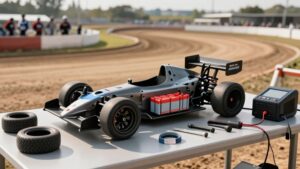
An RC touring car is a low-slung, 1/10-scale, four-wheel-drive electric sedan built for racing on smooth asphalt or carpet.
You tune its suspension, ride height, camber, and toe to balance grip, stability, and ground clearance.
Touring classes range from regulated 21.5- and 17.5-turn racing to open Modified and Rookie formats. Tyres, additives, battery voltage, and motor temperatures must meet race rules.
Club events let you test setups and discover how each choice shapes performance.
Touring Car Definition
An RC touring car is a low-slung, four-wheel-drive electric sedan built for precise racing on smooth surfaces such as asphalt and carpet. Most touring cars use the 1/10 scale, the hobby’s most common size, and grip-focused rubber or foam tires matched to the track. Their low ride height and responsive handling help you carry speed through corners, but they limit clearance over ground.
Competition rules may define the motor, speed controller, body, weight, and minimum ride height. For example, some classes require a 17.5T or 21.5T brushless motor, a regulated electronic speed controller, and a 190 mm four-door body. A 1/10 race setup must weigh at least 1,320 g and maintain 5 mm of ride height. These specifications distinguish on-road touring cars from off-road vehicles.
Low-Slung Touring Car Chassis
Built low to the ground, a 1/10 touring car uses a four-wheel-drive sedan chassis for precise handling on asphalt or carpet. That low stance helps you limit body roll on high-grip surfaces, but you’ll still need enough clearance to keep the chassis from scraping bumps. Touring-car rules commonly require a minimum ride height of 5 mm for 1/10 sedans, so measure it consistently before you run.
Many 1/10 classes also specify a 190 mm four-door body and a minimum vehicle weight of 1,320 g; check your class regulations before building. Then tune ride height, camber, toe, and droop to match track grip and refine the car’s cornering response. Change settings in measured increments and record each one to identify improvements without sacrificing clearance or compliance.
Carpet-Track Cornering
On high-grip carpet, your touring car can carry speed through corners, but too much grip can make it traction-roll. Black ETS carpet delivers high, consistent grip; your chassis can corner quickly, yet abrupt weight transfer may lift an inside wheel and roll the car. Grey Ozite carpet provides predictable bite, but it can accelerate foam-tyre wear. You’ll need rubber or foam tyres and compounds intended for carpet; soft high-grip foam compounds may wear rapidly on abrasive asphalt.
On smooth carpet, reduce suspension droop as needed to keep the chassis composed through tight turns. Set ride height low enough to limit body roll without compromising clearance. Add negative camber so the tyres’ contact patches remain effective as the car loads through each corner.
Touring Car Race Classes
You’ll commonly find 21.5, 17.5, and Modified Touring classes, which differ mainly in motor and ESC limits. The spec classes use ROAR-approved motors and Blinky ESC settings, while Modified allows an open motor and ESC. Choose your class based on its rules and the level of motor freedom you want.
Popular Touring Classes
Although touring-car rules vary by sanctioning body, common 1/10-scale electric classes include 21.5, 17.5, and Modified. Your choice sets the motor and ESC rules; the chassis baseline stays consistent.
| Class | Motor | ESC |
|---|---|---|
| 21.5 Touring | ROAR-approved 21.5 | Blinky |
| 17.5 Touring | ROAR-approved 17.5 | Blinky |
| Modified | Open | Open |
Across these 4WD sedans, you’ll use a 6-cell NiMH or 2S hard-case LiPo pack, Gravity Sedan Spec tires, and a 190 mm four-door body. Each car must weigh at least 1,320 g, stay at or below 8.44 V, and maintain 5 mm minimum ride height. Check your sanctioning body’s current rules before setup; terminology and permitted equipment can differ between events. Confirm class eligibility and voltage measurement procedures at registration, since officials enforce limits at technical inspection before you race today.
Stock Versus Modified
In stock touring, you’ll run a ROAR-approved 17.5T or 21.5T motor with a Blinky ESC that disables timing and ramping; Modified lets you choose an open motor and ESC.
That distinction controls how you deliver power: stock limits electronic adjustments, while Modified permits broader motor and speed-control choices. The chassis and race limits stay consistent across these classes.
You run a four-wheel-drive 1/10 electric sedan with a six-cell NiMH pack or a 2S hard-case LiPo battery. Rules require Gravity Sedan Spec tires and a 190 mm four-door body. Each class sets a minimum weight of 1,320 g, and the maximum voltage is 8.44 V. These shared specifications keep the platform and basic operating limits fixed, even as the permitted power system differs for all.
Choosing a Race Class
Choose a race class based on your experience and how much freedom you want in the power system.
Rookie gives you the broadest entry: use any 1/10 electric chassis with a brushless motor, on-road rubber tires, and a 1/10 body. For a regulated setup, choose 21.5 or 17.5 Touring. Each requires a 4WD 1/10 electric sedan, ROAR-approved spec motor, non-timing (“Blinky”) ESC, and either a six-cell NiMH or 2S hard-case LiPo battery. The motor rating distinguishes them: 21.5 uses a 21.5; 17.5 uses a 17.5. Both also require Gravity Sedan Spec tires, a 190 mm four-door body, and 1,320 g minimum weight. Modified Touring keeps those sedan, battery, tire, body, and weight rules, but lets you run an open motor and ESC for tuning freedom.
Tire Additive Rules
Before applying an additive, check your track and series rules for approved products and application limits. Choose a formula suited to the surface and tire compound, and confirm it’s permitted for the day’s conditions. Track officials enforce these rules, so ask them if anything’s unclear.
Approved Additives
Approved Additives
Tire-additive rules vary by track and racing series, so check the event regulations before applying any product. You may use MR33 additives on asphalt to soften rubber tires and build heat. On carpet, choose a product matched to the surface and its grip conditions. With spec tires, use only products the rules approve; a suitable additive can still be prohibited locally.
Ask track officials or local racers which options they permit and commonly use.
| Surface | Approved choice | Local check |
|---|---|---|
| Asphalt | MR33 or approved additive | Event rules |
| Carpet | Carpet-suitable additive | Track rules |
Don’t assume a product allowed at another venue is legal here. Confirm the brand or formulation with officials, especially when you race under a spec-tire rule. That check helps you select a compound treatment compatible with the surface, maintain tire response, and avoid a rule violation practice or qualifying begins.
Application Limits
Because additive rules vary by track and racing series, check the regulations before applying any product.
Your allowed application area may depend on surface and spec-tire class. On asphalt, a series may permit MR33 products to soften rubber and build heat. Carpet may require a surface-specific additive; an asphalt formula may not suit its tires or conditions.
Before treating tires, ask local racers or track officials which products and methods the venue approves for your surface and class. Apply additive only where permitted, and keep it off the tread or other restricted areas. Don’t assume approval for one tire class or application zone covers another. Match product and placement to the regulations; if guidance is unclear, confirm the allowed procedure before safely preparing your tires.
Rule Enforcement
Check the event regulations before applying an additive: tracks and racing series set different rules, and spec-tire classes may restrict both tire choice and preparation.
On asphalt, MR33 products can soften tires and help build heat, but use them only where permitted. Don’t assume asphalt approval applies on carpet; use only surface-appropriate additives allowed by the event. In spec-tire classes, confirm the permitted tire and preparation with race officials.
An unapproved product or treatment may violate the rules and jeopardize your result. Before race day, ask track staff or local racers about current enforcement and application procedures. Follow officials’ instructions, and verify the rules again at each event because policies vary by venue and series. Keep the product label available for inspection at the track.
Club-Level Touring Car Racing
At club level, touring-car races typically run weekly or bi-weekly, giving you time to practise, test setups, and meet other drivers in a relaxed setting.
Most touring classes use four-wheel-drive 1/10-scale electric sedans with 190 mm four-door bodies. In 17.5T and 21.5T specification classes, you’ll need a non-timing “Blinky” ESC. Tracks use asphalt or carpet; ask local racers which tyres and setup suit the surface. High-grip carpet can cause traction rolling, so choose settings carefully.
Bring your car, transmitter, charged batteries, basic hex and nut drivers, spare tyres, and a charger. Check whether the club requires a personal transponder for lap timing. Arrive early to claim a pit space and introduce yourself. Qualifying heats usually determine the starting grid for main races on race day.
Battery and Motor Temperature Limits
After choosing a club and class, check the electrical limits before running: 1/10 touring rules may cap battery voltage at 8.44 V, but your series regulations take precedence.
Spec-motor classes 17.5T and 21.5T require a Blinky ESC, prohibiting timing and ramping. Follow temperature limits from your motor, battery, ESC, and race rules.
| Check | What you control | Response |
|---|---|---|
| Pack voltage | Charge setting | Stay within rules |
| Motor temperature | Gearing, timing | Measure after runs |
| Battery temperature | Load, runtime | Cool before reuse |
During practice, monitor both temperatures, especially after changing gearing or timing. On long, flowing tracks, increased motor timing can raise RPM and heat. Recheck after each adjustment; if either component becomes unusually hot, stop and let it cool before resuming.
Overlooking Ride Height Checks
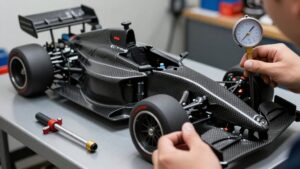
Small ride-height changes can affect cornering, chassis clearance, and consistency, so measure before each race on a flat setup surface with a ride-height gauge. Record settings at all four corners; this gives you a reliable baseline and reveals uneven clearance before it affects handling. For 1/10-scale touring classes, the stated minimum is 5 mm, but verify your class and event rules; requirements can differ. Recheck after tyre changes or suspension adjustments, since either can alter clearance.
- Lower ride height can reduce body roll on high-grip tracks, but maintain legal clearance.
- More clearance helps your car pass over bumps and can suit lower-grip surfaces.
- Measure consistently; don’t assume yesterday’s setting remains valid after maintenance.
Keep the car level and unloaded for accurate, repeatable gauge readings.
Compare Touring Car Setups
Once you’ve checked ride height, compare the rest of your setup against the track surface: sealed asphalt typically suits medium or hard belted rubber tyres, while lower-grip, unsealed asphalt may benefit from softer belted rubber. For carpet, choose rubber or foam tyres matched to the surface; soft foam can wear rapidly on abrasive asphalt.
Set ride height and droop for grip and smoothness: high-grip carpet needs a lower chassis and less droop, while bumpy, low-grip tracks often need more of both. Then tune alignment. Add toe-in when you need straight-line stability; use toe-out to sharpen turn-in. Apply negative camber to help the tyres maintain contact through corners. Make one change at a time, then compare lap consistency and tyre wear, not peak speed.
Conclusion
An RC touring car gives you a precise platform for learning on-road setup, tire management, and racecraft. Its low chassis rewards smooth inputs, while class rules and track conditions determine which motor, battery, and tires you can run. Before each heat, check ride height, temperatures, and additive regulations; small oversights can cost consistency or legality.
Compare setups methodically, change one variable at a time, and record results. You’ll build speed through repeatable preparation, not guesswork.