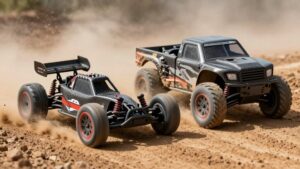
Short Course Truck vs Stadium Truck: Which RC Racer Suits You?
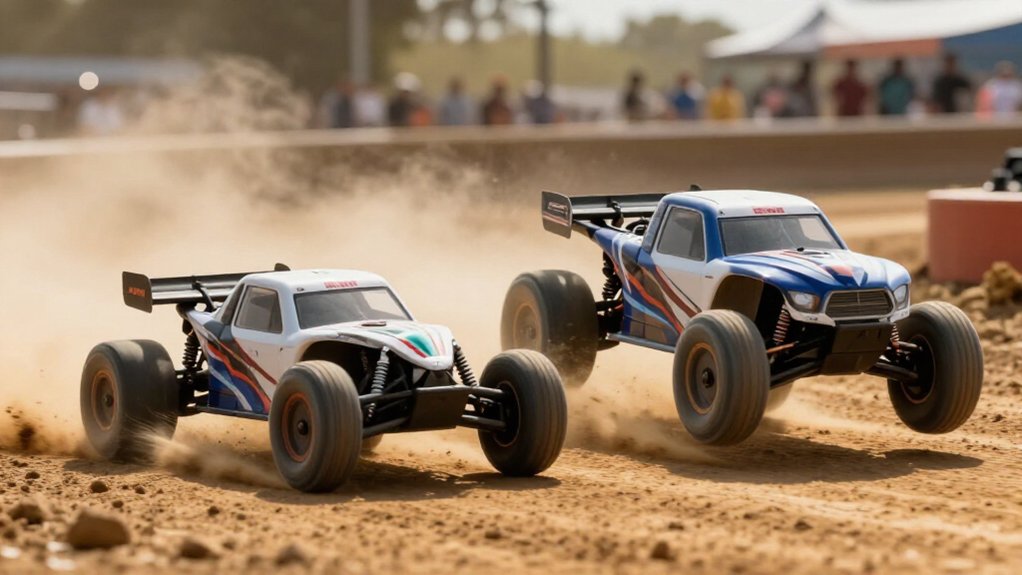
Choose a short course truck if you want a lower, wider, body-protected racer for rough, contact-heavy dirt tracks and stable sweepers.
Pick a stadium truck if you need faster rotation, tighter apex placement, more clearance, and longer travel over uneven surfaces.
Neither guarantees quicker laps; tire choice, setup, and throttle control matter. Check local ROAR class rules and battery fit before buying.
Continue for track-specific handling, durability, jump, and carpet comparisons that match your venue.
Wheelbase and Body Coverage
Short course trucks typically use a longer wheelbase and a wide, enclosed body that mirrors full-size desert racers, while stadium trucks favor a shorter wheelbase with open wheels extending beyond a narrower body. You’ll get a planted, scale-inspired profile from the short course layout, whereas the stadium design prioritizes compact proportions and fast visual access.
| Aspect | Short Course | Stadium |
|---|---|---|
| Wheelbase | Longer | Shorter |
| Body coverage | Enclosed; protects chassis/electronics | Open; exposes components |
Compare each manufacturer’s wheelbase and body dimensions rather than relying on category labels. A longer chassis can suit your preference for a broader desert-racer stance, while a shorter stadium platform delivers a more compact package. Choose enclosed coverage when you want added debris shielding; choose open architecture when you value immediate component inspection access.
Suspension Travel and Clearance
Stadium trucks generally pair longer suspension travel with higher ground clearance, so they absorb larger bumps, cross uneven dirt, and resist chassis strikes more effectively than short course trucks. That extra stroke lets your wheels follow rough terrain while preserving contact when the chassis would otherwise bottom out. The added ride height also gives you more margin over ruts, loose soil, and jump faces.
A short course truck’s lower ride height and shorter travel keep its chassis closer to the surface on groomed tracks, but you’ll risk bottoming on deep ruts or abrupt landings. Its lower stance can limit body roll, whereas a stadium truck’s taller profile may roll more. Compare published travel and ride-height measurements before choosing; setup can outweigh category labels alone.
Lap Times on Packed Dirt
On smooth, packed dirt, a short course truck’s lower, wider stance usually produces steadier cornering and more repeatable lap times, particularly through long sweepers. Its enclosed body and wider tires give you predictable grip when the surface stays consistent.
- Short course trucks favor stable arc speed.
- Stadium trucks change direction faster through tight turns.
- Chicanes can reward the stadium truck’s lighter, agile chassis.
- Sweepers often expose the short course truck’s planted balance.
- Equal motors, batteries, tires, and conditions reveal design differences.
Neither platform automatically sets faster laps. You’ll see results shift with layout, tire compound, suspension setup, and driving precision. On flowing packed-dirt layouts, choose a short course truck for consistent corner exits; in direction-change-heavy sections, a stadium truck can recover time more quickly.
Throttle Control and Marshalling Demands
Throttle control separates the two trucks as much as chassis geometry does: a short course truck’s low, wide platform lets you feed power in earlier and more smoothly through corners, while a stadium truck’s taller stance and larger tires respond more sharply to bumps and weight transfer. On loose dirt, use progressive inputs in either class; abrupt acceleration breaks traction and reduces steering authority. The stadium truck demands restraint after bumps and landings, where wheelspin can unload the chassis and trigger rollovers.
Its reactive behavior requires more marshal resets. Short course trucks stay planted on flatter layouts, reducing interruptions. When either truck overturns, stop or signal before a marshal intervenes. Marshals should wait for a safe gap because both trucks can regain speed once righted.
ROAR Class and Battery Compatibility
ROAR class rules separate short course and stadium trucks by more than 1/10-scale size: short course trucks commonly compete in dedicated 2WD or 4WD classes, while stadium trucks may enter separate truck divisions. Your chassis and electronics must match the entered class; shared scale doesn’t make either platform cross-legal. Check the current event rulebook, because permitted configurations and class labels can change.
- Confirm your battery tray accepts the pack’s dimensions securely.
- Match connector type to ESC leads without adapters.
- Verify approved chemistry and cell count before qualifying.
- Most 1/10 electric trucks use 2S LiPo, nominally 7.4 V.
- Prioritize manufacturer specifications and current ROAR limits; they override assumptions.
That verification keeps your setup legal, protects electronics, and maintains comparable acceleration across the grid for racing.
Tire Wear and Parts Pricing
Tire longevity depends far more on compound, surface grip, driving style, and alignment than on whether you run a short-course or stadium truck. On abrasive asphalt, either platform can consume rubber rapidly; dirt generally lowers wear rates. You’ll preserve tread by limiting wheelspin and setting toe and camber accurately, since excessive angles scrub tires and reduce cornering consistency.
Short-course tires are often wider, so replacements may cost more, while stadium-truck pricing changes with wheel diameter and tread pattern. Don’t assume either category is cheaper: price the exact tire-and-wheel fitment you’ll run. Then compare brand-specific availability and costs for suspension arms, drivetrain pieces, and wheels. For a useful ownership benchmark, total a matching pair of tires with common wear parts. It better predicts your costs.
Short Course Body Parachuting
Beyond running costs, short-course trucks introduce an aerodynamic tradeoff that stadium trucks usually avoid: body parachuting. Their tall, enclosed sides and broad noses trap air at speed, creating drag that can blunt straightaway pace. You may also notice less composure in gusts or over jumps than with a more open stadium-truck body.
- Keep the body low and aligned with the chassis to reduce lift.
- Use secure mounts so pressure can’t raise or shift it.
- Check that airflow openings match manufacturer guidance.
- Vent gradually; extra openings can invite dirt and debris.
- Test changes on long straights and jump approaches.
Compared with a stadium truck, you’ll trade some aerodynamic cleanliness for short-course realism, then tune fitment and venting carefully to preserve high-speed stability when winds rise.
Bumper-to-Bumper Racing
When you race bumper-to-bumper, a short course truck’s broad bumpers and enclosed body absorb contact while protecting critical components. Its wider, lower platform also stays more settled through bumps and corner exits than a stadium truck. A stadium truck changes direction faster, but its exposed wheels and rear wing require you to leave more room in close traffic.
Close-Quarter Contact
Short course trucks handle bumper-to-bumper racing more confidently because their broad, enclosed bodies, protective bumpers, and wider, lower stance absorb minor contact without upsetting the chassis as easily. That composure lets you hold a tighter line in traffic, where small side nudges can otherwise disrupt steering angle, traction, and corner exit.
- You can run door-to-door with reduced chassis reaction through tight, low-speed corners on entry.
- The wider track resists lateral deflection, helping you preserve rotation when rivals lean on you.
- A stadium truck’s narrower, more exposed layout reacts faster to side contact, demanding cleaner spacing.
- Its response can reward precision, but you’ll lose momentum sooner if a nudge misaligns.
- Keep steering inputs smooth and throttle measured; hard hits can damage either truck quickly regardless.
Bumpers And Body Protection
In bumper-to-bumper racing, a short course truck’s oversized front and rear bumpers distribute impacts across a broad area, limiting direct contact with the body and chassis. That coverage lets you trade paint with less risk of immediately exposing vulnerable hardware. Its full-length enclosed body also keeps dirt and debris away from the chassis and electronics, preserving reliability through crowded heats. A stadium truck’s open body and exposed wheels offer less shielding; side-to-side contact can load tires, arms, and suspension links directly.
However, you shouldn’t treat short course bumpers as indestructible. Repeated heavy strikes can crack plastic, loosen bumper mounts, and transfer force into suspension components. After crashes, inspect mounts and body posts, then replace cracked pieces promptly. Doing so preserves isolation and protects chassis.
Indoor Carpet Track Suitability
On high-grip carpet, you’ll typically get more settled cornering and controlled landings from a Short Course Truck, while a Stadium Truck’s taller tires and ride height can increase roll. You’ll need venue-approved tires, appropriate inserts, and softer throttle response to manage grip and wheelspin in either class. On tight layouts, check lane width carefully, because the Short Course Truck’s wider body can cost you clearance despite its stability advantage.
Carpet Grip And Tire Choice
How each truck uses carpet grip separates their handling: a short course truck can race indoors, but its heavier body and generally wider tires make it less responsive through tight direction changes than a stadium truck. On high-grip carpet, tune compound, tread, and insert together; the stadium truck exploits this surface more readily, while the SCT needs disciplined setup.
- Run softer compounds with shallow pins or carpet-specific tread for predictable repeatable traction.
- Avoid aggressive outdoor knobs; they’ll feel twitchy and scrub speed across the carpet.
- Match compound to carpet texture and temperature, since grip varies throughout race day.
- Use firmer inserts for sidewall support; softer inserts generate more mechanical grip available.
- Check club rules; approved compounds, tread patterns, and treatments can dictate your purchase.
Cornering In Tight Layouts
When the carpet layout packs corners tightly, a stadium truck’s lighter, narrower chassis changes direction faster and fits cleaner lines than a short course truck. Its reduced width lets you place the front tires nearer apexes without clipping barriers, while lower mass responds more sharply to quick steering movements.
A short course truck’s wider, enclosed body and typically longer wheelbase demand earlier turn-in and more deliberate rotation through chicanes and linked hairpins. On high-grip carpet, neither platform rewards abrupt inputs: enter too fast and either can traction-roll. You’ll carry consistent speed by braking straight, releasing steering progressively, and feeding throttle as the chassis settles. Choose the stadium truck for agility on compact layouts; choose the short course truck if you prefer stable scale-style handling.
Jumping And Landing Control
Small indoor jumps favor the short-course truck’s lower, wider stance, which holds a flatter attitude in the air and delivers more predictable four-wheel landings than a taller stadium truck. You can carry controlled speed, use smooth throttle, and aim for level touchdowns.
- Keep takeoffs low; carpet traction punishes over-rotation.
- Land with all four tires nearly square.
- Straighten steering before contact to prevent traction-induced rollovers.
- Use the stadium truck’s lighter chassis to adjust pitch.
- Expect its higher center of gravity to demand cleaner timing.
If you’re learning a tight carpet layout, the short-course platform gives you a larger landing margin. The stadium truck responds faster to throttle pitch inputs, yet its short body and elevated mass punish nose-first or sideways contact more severely on carpet.
Choose by Racing Format
Match the truck to the course you’ll race: an SCT suits closed dirt short-course layouts with jumps, berms, marked lanes, and frequent wheel-to-wheel contact, while a Stadium Truck excels on tighter stadium-style tracks where quick rotation and precise placement matter.
For rough surfaces and larger obstacles, its enclosed fendered body, bumpers, and typically broader stance help you absorb traffic without exposing the tires. Pick the Stadium Truck when compact technical sections demand rapid direction changes; its open-wheel body and narrower layout let you judge tire placement more easily. Before you buy, verify local classes: scale, two- or four-wheel-drive rules, and approved body styles can determine eligibility. A capable truck that doesn’t fit the format won’t reach the starting grid for your local class.
Conclusion
Choose a short course truck when you want covered wheels, realistic contact racing, and stable behavior on rough outdoor dirt. Its body can parachute, so you’ll need disciplined throttle and clean landings.
Pick a stadium truck when you prioritize lighter response, suspension clearance, and faster laps on packed surfaces. It’s less forgiving in wheel-to-wheel traffic but excels on carpet and layouts. Match your chassis, battery rules, and driving style to the class you’ll race most.
RC Truck Scale Size Converter
Convert a real truck's length, width and height to any RC scale from 1/6 to 1/24, or find the scale implied by a model's length.
Tire Swap Speed & Gearing Compensator
Enter motor KV, cells, gearing and old vs new tire diameter to see the theoretical no-load speed change and rollout from a tire swap.
Basher Motor, ESC & LiPo S-Count Matcher
Compare your motor kV, ESC max S and LiPo cell count from your own spec sheets and see the theoretical no-load RPM (kV × S × 3.7).