What Is a Short Course Truck? The Most Realistic RC Racer
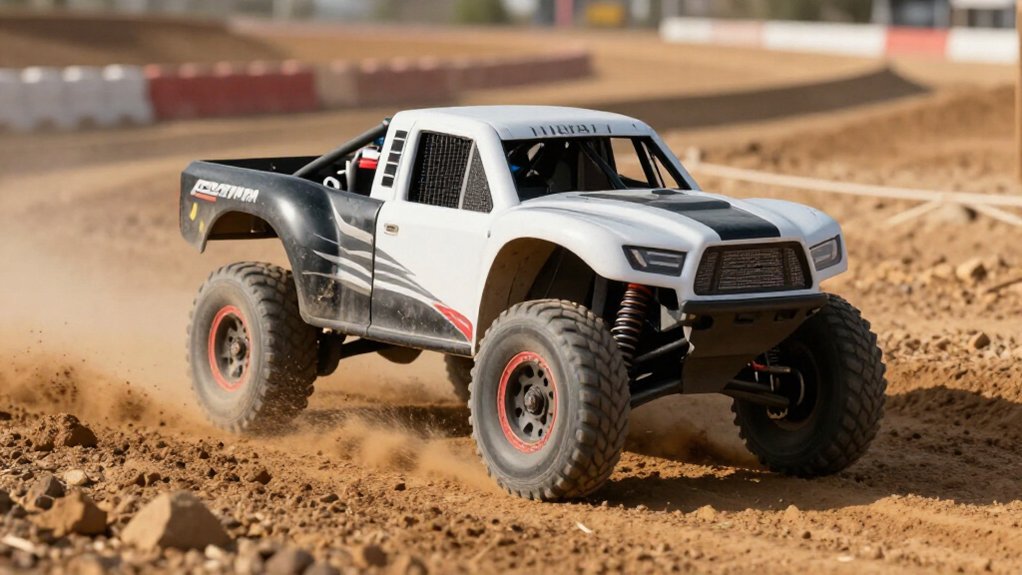
A short-course truck gives you a realistic version of a full-size off-road racer, with enclosed wheels, full fenders, and a low stance. Most are 1/10-scale RC models, but dimensions vary, so check body coverage and footprint.
Its wide chassis and low center of gravity support stable cornering, while independent suspension helps tires follow ruts. Electric or gas power, indoor tire choice, and battery compatibility shape performance. Explore how scale, setup, and care affect your choice.
Define Scale-Truck Design
A short course truck (SCT) is typically a 1/10-scale RC model designed to resemble a full-size, closed-wheel off-road race truck. Its enclosed wheels and full-fender body give you a recognizable scale-truck profile, while a strong polycarbonate shell absorbs impacts and helps shield internal components from debris. Extended wheel wells and a wide stance add clearance and protect the body during rough running, and they support predictable handling. The low-profile chassis places mass near the ground, reducing rollover risk in fast turns compared with taller monster trucks. Many 1/10-scale examples measure about 22–24 inches long, so you’ll need space for transport and storage; smaller models offer a more portable option. Check shell coverage, clearance, and dimensions against your terrain, storage space, and control preferences before choosing.
Full-Size Racing Inspiration
Inspired by full-size off-road short-course racers, 1/10-scale SCTs combine recognizable styling with practical protection and handling. Their full-fender, closed-wheel bodies reproduce race-truck proportions while shielding chassis, suspension, and electronics from impacts and debris.
| Feature | Full-size cue |
|---|---|
| Body | Enclosed wheels and fenders |
| Stance | Wide footprint, low center |
| Finish | Paint, grille, extended wells |
You can judge the scale influence by how these details serve appearance and function. A wide stance and low center of gravity echo competition layouts and help your truck remain composed in fast turns. Realistic paint, grille treatment, and extended wheel wells make the model read convincingly at trackside. Those proportions suit packed-dirt tracks, gravel, clay circuits, and asphalt, giving you a versatile platform whose design feels purposeful rather than merely decorative.
Suspension Over Uneven Dirt
That wide, low stance only pays off on rough dirt when the suspension keeps the tires tracking the surface.
Independent suspension lets each wheel respond to ruts independently. Four oil-filled shocks control that movement, while adjustable spring tension helps you balance support and compliance.
With two inches of travel, the truck can absorb patches and jump landings before the chassis bottoms out. Metal pivot balls support smooth movement, and deep-tread tires help maintain grip on dirt and gravel.
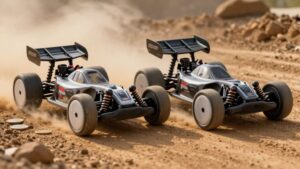
You can tune the shocks and suspension for the surface: firmer settings can steady landings, while softer settings help the wheels follow uneven ground. You can’t skip regular maintenance. After each dirt run, inspect shock seals and suspension parts for wear, then clean away debris to preserve handling.
Electric vs. Gas Power
When you choose an electric short-course truck, you get quiet, responsive power from a 7.4V or 11.1V LiPo, but typical 15 to 20-minute runtimes make battery capacity and charging time key constraints. Gas models trade that charging downtime for engine noise, fuel handling, and heavier hardware; a 32 cc Losi 5IVE-T 2.0, for example, exceeds 40 mph on VP Racing Powermix. Compare runtime, maintenance, and speed needs to select the powertrain that best fits your driving sessions.
Electric Power Advantages
How does electric power compare with gas? For your short-course truck, electric offers a convenient drivetrain with performance options suited to your skill level. A brushed motor delivers approachable entry-level control, while a brushless system provides stronger acceleration and higher racing speed. Well-equipped brushless trucks can exceed 40 mph; some 3S models reach 50 mph or more.
You’ll typically power the truck with a 7.4V or 11.1V LiPo battery, giving about 15 to 20 minutes of driving per charge. That runtime makes battery capacity important: a larger-capacity pack can extend runs, while charging time determines when you’re ready to drive again. Some ready-to-run packages include a battery and charger, simplifying setup.
You avoid fuel mixing and can recharge between sessions, making electric power straightforward to manage.
Gas Power Tradeoffs
If you want longer runs without waiting for a battery to recharge, gas power offers a different tradeoff: the fifth-scale Losi 5IVE-T 2.0 uses a 32 cc Zenoah engine, exceeds 40 mph, and can run longer with VP Racing Powermix fuel. That endurance comes with fuel preparation, rather than the battery charging that limits electric sessions.
Choosing Your Powertrain
Your powertrain choice determines a short-course truck’s scale, performance, and session routine. Electric power dominates the category and gives you the widest range of sizes and output. Choose a brushed motor for manageable beginner speeds, or brushless power for stronger acceleration. Stock trucks reach 25 to 30 mph; upgraded setups can exceed 40 mph.
You’ll usually run a 7.4-volt 2S or 11.1-volt 3S LiPo pack, with roughly 15 to 20 minutes per charge. Battery capacity and recharge time shape your downtime, so carry spares if you want longer sessions. Gas suits you if you prefer fuel-powered operation and a larger chassis. For example, the 1/5-scale Losi 5IVE-T 2.0 pairs a 32cc Zenoah engine with speeds above 40 mph. Its scale and extended runtime come with larger vehicle.
Wheelbase and Body Dimensions
Your truck’s wheelbase, the distance between its axles, shapes handling. Body dimensions vary: some 1/10-scale trucks are about 12 inches long and 8 inches wide, while other models measure roughly 22–24 inches long. Compare scale and proportions carefully; the Losi 5IVE-T 2.0, for example, is 38 inches long with a 24-inch wheelbase.
Wheelbase and Handling
A short course truck’s wheelbase, width, and body dimensions shape how it responds in fast turns and over rough ground.
With a wide stance and low center of gravity, you get cornering stability and less body roll when you carry speed through a turn. The wheelbase also sets the truck’s response: a longer span tracks steadily across ruts, while a shorter one can change direction more quickly but feel less composed on uneven ground. You’ll notice these trade-offs when you brake, turn, and accelerate on loose surfaces, where abrupt inputs can unsettle the chassis.
Choose setup and driving pace to match the terrain; stable geometry helps, but it won’t replace smooth steering or throttle control. Compare wheelbase figures across models rather than judging handling by length alone.
Body Dimensions and Scale
Beyond wheelbase and stance, scale determines a short-course truck’s overall footprint and where you can run it. Most short-course RC trucks use 1/10 scale, though that label doesn’t guarantee a standard body size. Typical descriptions range from about 12 inches long by 8 inches wide to models measuring 22 to 24 inches long, so check the manufacturer’s specifications before choosing storage or transport gear.
A larger 1/5-scale truck changes the demands substantially: the Losi 5IVE-T 2.0 measures 38 inches long, with a 24-inch wheelbase and 12-inch height. That footprint suits spacious outdoor running better than tight indoor layouts. Conversely, a 1/24-scale model travels easily and fits indoor courses, while a 1/10-scale truck needs more room. Compare body length, width, and height with your available course, vehicle space, and carrying capacity.
Realistic Truck Proportions
Because short-course trucks are modeled on full-size off-road racers, their enclosed-wheel bodies and proportions aim for realism, though dimensions vary by scale and model. Most short-course RC trucks use 1/10 scale, so you get a racer with enclosed wheels and bodywork that echoes its full-size counterpart.
Published dimensions differ: one typical estimate is about 12 inches long and 8 inches wide, while other listings put truck lengths at 22–24 inches. That spread means you should compare the specific model, not assume scale alone predicts its footprint. At 1/5 scale, the Losi 5IVE-T 2.0 measures 38 inches long, rides on a 24-inch wheelbase, and stands 12 inches tall. Longer wheelbases and bodies need more room; match proportions to your driving space and handling priorities.
Community and Hobby Uses
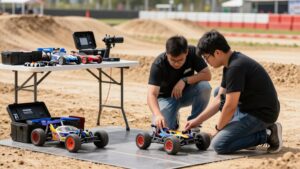
Whether you drive in a backyard or on a prepared track, short-course RC trucks support both casual running and organized racing on packed dirt, clay, gravel, and asphalt. You can run casually or enter competition; skill-based classes let you progress from beginner sessions to experienced heats without requiring equal pace.
Local tracks may host dozens of racers each week, while major events can bring hundreds together. Weekend races turn practice into a useful exchange: you can compare driving lines, maintenance methods, and setup choices with other hobbyists.
Your truck offers creative ways to connect: custom paint, scale details, build posts, videos, and how-to tips let you share ideas and learn from other drivers. That makes the hobby welcoming and technically rewarding.
Wet-Weather Electronics Risks
Splash-proof ESCs, receivers, and steering servos reduce water exposure risk, but they don’t make the entire short-course truck waterproof.
Treat that protection as limited: consult your model’s instructions and IP rating, if available, to identify which components tolerate wet conditions. Avoid deep water; immersion can bypass seals and reach exposed electronics, causing corrosion or immediate failure. A damp exterior doesn’t confirm a dry receiver box or connector.
After each wet-weather run, disconnect and remove the battery, then clean and dry the truck thoroughly. Pay particular attention to wiring plugs, receiver compartments, and crevices where moisture can remain. Before the next run, inspect connectors and electronics for water or condensation; don’t energize a damp system. Store the truck in a dry place. This routine lowers risk but can’t compensate for components whose seals or ratings don’t support your conditions.
Choosing Tires for Indoor Tracks
Choosing Tires for Indoor Tracks
On indoor tracks, choose tires for the surface rather than relying on an aggressive tread by default: smooth clay and other high-traction surfaces usually need less tread than loose dirt or gravel.
- For polished or smooth indoor tracks, choose a compound and tread that deliver grip without making your truck twitchy through corners.
- Standard short-course tires measure about 4.5 inches tall and 2.5 inches wide, but verify replacements match your wheels and body clearance.
- Internal foam helps keep each tire from buckling under cornering loads; inspect foam and tread wear regularly.
- Test your setup at moderate speed first, because traction and handling can change with the surface and tire combination.
If nervous, reassess tread and compound before pushing; predictable cornering often beats raw bite.
Check Battery Connector Compatibility
Before buying a battery for a short-course truck, check that its plug physically matches the truck’s connector; a suitable voltage and battery type won’t help if the plugs can’t connect. Short-course trucks commonly run 7.4V (2S) or 11.1V (3S) LiPo packs, but you must also confirm that the electronic speed controller (ESC) supports the pack’s cell count. A matching plug alone doesn’t make an incompatible battery safe.
Check whether your model includes a battery and charger; if not, inspect the connector before ordering. If you use an adapter, confirm its ends fit and its current rating suits the truck’s power demand. Extra connections can add resistance, making a match preferable. Disconnect the pack after use. Never force a plug or connect a damaged or reversed-polarity connector.
Conclusion
You get a remarkably realistic RC racer in a short course truck: its scale-like body, long wheelbase, and full-size-inspired proportions make it look convincing, while long-travel suspension helps you handle uneven dirt. Electric power suits convenient running; gas adds noise and complexity.
Match tires to indoor surfaces, and check battery connector compatibility before buying. Protect electronics from wet conditions, then use your truck for racing, tuning, and community events. You’ll enjoy realism without sacrificing control.