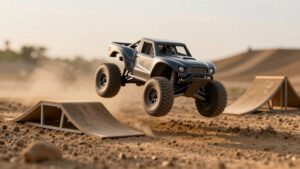
Hobby Grade vs Toy Grade RC Cars: Speed, Parts and Value Compared
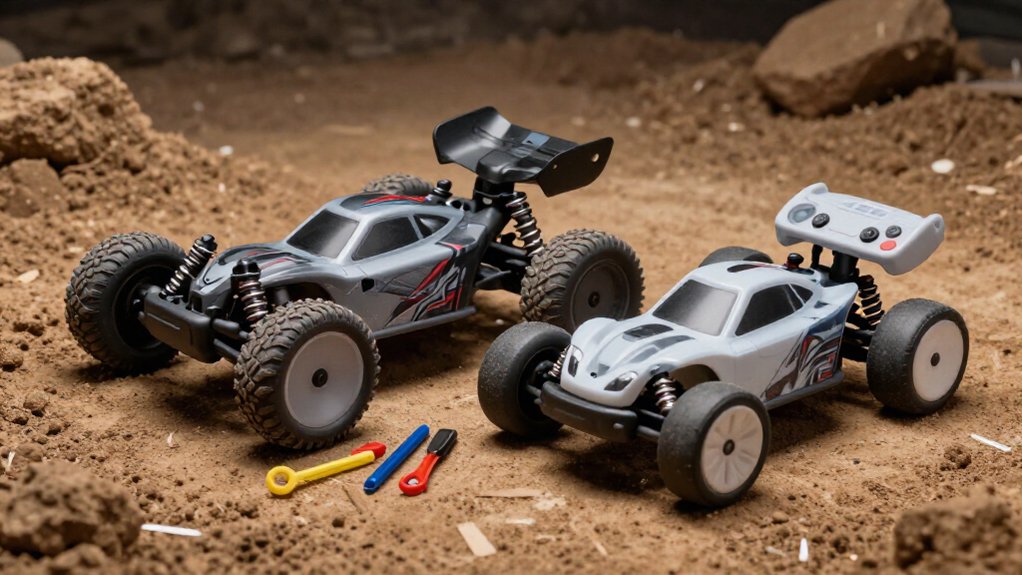
Choose toy-grade RC cars if you want inexpensive, simple fun in small spaces: they typically run 15 to 20 km/h, use basic on/off controls, and may be difficult to repair. Choose hobby-grade models for 30 to 40 km/h RTR performance, proportional throttle and steering, adjustable limits, and replaceable parts.
Hobby cars need more outdoor room, battery-care discipline, and adult supervision for children. Check waterproof limits, parts catalogs, warranties, and support before buying. The comparisons below clarify the trade-offs clearly.
Waterproofing Ratings Side-by-Side
Waterproofing claims differ sharply between toy-grade and hobby-grade RC cars. You shouldn’t treat a plastic body or USB charging port as water protection: toy-grade products rarely publish standardized ratings. Hobby-grade models may claim splash-resistant or waterproof electronics, yet you must check each manual’s limits. “Waterproof” electronics don’t protect every vulnerable part.
| Grade | Typical claim | Your practical limit |
|---|---|---|
| Toy-grade | Usually unrated | Avoid water exposure |
| Hobby-grade | Splash-resistant or waterproof electronics | Confirm model-specific limits |
| Either | See listing | Don’t assume submersion is safe |
Splash resistance can suit damp grass or light spray, not immersion. After wet running, disconnect the battery, remove grit, and dry steel hardware. Motors, bearings, connectors, and battery compartments can corrode or fail despite electronics claims still.
Sealed Electronics and Chassis Design
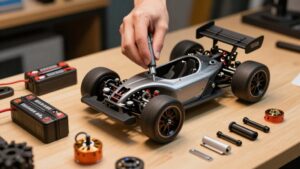
Beyond water-resistance claims, electronics packaging and chassis layout determine how well an RC car tolerates use and how easily you can service it. Toy-grade models often place the receiver, ESC, and steering-motor drive on one hardwired board inside a molded-plastic unibody. This compact arrangement limits access: if one circuit or a non-standard gearbox fails, you can’t readily substitute standard hobby components.
Hobby-grade designs separate these systems, so you can replace a receiver, ESC, servo, shock, or transmission part independently as needed. Before buying, verify:
- An exploded parts diagram and replacement-parts directory.
- Availability of suspension arms and steering knuckles.
- Flexible composite plastics, metal hardware, and sealed ball bearings.
These details indicate whether your car can endure wear and remain serviceable over time.
Top Speed and Acceleration
Speed separates toy-grade and hobby-grade RC cars quickly: toy models typically reach about 15 to 20 km/h, while many hobby-grade vehicles run 30 to 40 km/h straight out of the box. That gap affects both usable space and driver workload. Toy cars usually use simple forward-and-reverse controls, so you have limited authority over acceleration. Hobby models normally provide proportional throttle, allowing you to meter power precisely through corners and on loose surfaces.
Motor choice widens the difference. Brushed systems give you smoother, more controllable low-speed response; brushless systems produce stronger acceleration and substantially higher potential speed. Performance-oriented hobby cars can reach 70 km/h to more than 200 km/h, depending on model and setup. If you’re learning, use a transmitter’s 50% throttle limit and increase output gradually as needed.
Battery Charging Requirements
Charging needs often reveal another practical divide between toy-grade and hobby-grade RC cars. Toy-grade models commonly use small-capacity Li-ion or LiPo packs that charge through USB. Hobby-grade RTR vehicles may need a separate drive battery and a compatible balance charger, increasing setup cost and responsibility. Before buying, check the “Needed to Complete” list; the battery, charger, or AA transmitter cells may be excluded.
- Use an approved balance charger for rechargeable packs.
- Monitor charging and place packs on a fire-resistant surface.
- Disconnect batteries after driving; store them in a fire-resistant bag at the correct storage voltage.
You should isolate swollen or damaged packs immediately. Don’t place damaged or end-of-life batteries in household trash or curbside recycling; use a local approved battery-recycling facility instead.
Indoor vs Outdoor Driving
Where you plan to drive should guide your RC car choice: toy-grade models are typically smaller, lighter, and limited to about 15 to 20 km/h, which makes them easier to manage on smooth indoor floors.
You’ll need outdoor space for hobby-grade cars, which commonly reach 30 to 40 km/h out of the box. Match the chassis to the surface: on-road cars suit flat pavement, while buggies, monster trucks, and crawlers handle uneven terrain. Indoors, proportional steering and throttle let you meter turning angle and power through tight routes; basic toy-grade controls may respond less precisely. Consider speed and vehicle weight against the area, since heavier, faster models carry momentum. If children drive, supervise them, particularly with hobby-grade vehicles, and establish boundaries around people, furniture, walls, and breakable objects.
Gearbox Access and Parts Availability
Repairability separates hobby-grade RC cars from most toy-grade models. You can usually open a hobby-grade transmission and replace a worn gear, shaft, or drive cup individually because the drivetrain uses standalone, modular components. Toy-grade gearboxes commonly combine proprietary gearing with integrated electronics, so standard hobby parts often won’t fit.
Before you buy, verify:
- The exploded diagram identifies each gearbox part.
- The manufacturer lists components for your exact chassis revision and drive type.
- Common spares, including spur gears and drive cups, are in stock.
This check matters: a supported hobby-grade gearbox lets you restore operation after wear or damage. With limited toy-grade parts support, one stripped gear may leave the car impractical or impossible to repair without replacing an entire sealed drivetrain assembly at home.
Toy-Grade Range and Signal Limits
Toy-grade RC cars generally offer shorter control range and simpler radio systems than hobby-grade models, which can limit use in large or obstructed areas. You should check the manufacturer’s stated range, because it varies by model and can shrink around walls, trees, vehicles, or other radio interference. A shorter reliable link makes toy-grade cars better suited to driveways, small yards, and indoor spaces than open fields or long-distance running.
Many toy-grade vehicles use a combined receiver and speed-control board. This design reduces cost but often prevents pairing with standard hobby transmitters, receivers, or replacement electronics. Hobby-grade platforms usually separate these components and support broader radio compatibility, easier upgrades, and adjustment options. If you need dependable control beyond a compact area, compare range specifications.
Proportional Throttle and Steering
With a hobby-grade RC car, you can use proportional throttle and steering to make gradual speed and directional changes. This precision helps you maintain traction and place the tires accurately, while toy-grade controls often limit you to abrupt forward, reverse, left, and right inputs. Transmitter adjustments such as trim and dual rate can further refine how the car responds to your commands.
Smooth Speed Control
Control precision marks a major difference between hobby-grade and toy-grade RC cars. With a hobby-grade transmitter, you can feather the throttle: a slight trigger pull produces a gradual increase in motor output instead of an all-or-nothing burst. That control helps you match speed to traction and terrain in real time.
Toy-grade models commonly reduce inputs to forward and reverse commands, so you don’t get as many usable speed steps. Smooth delivery depends on more than advertised top speed:
- Radio resolution determines how finely the system reads your trigger movement.
- Suspension, tires, and weight distribution affect whether power reaches the ground predictably.
- On hobby systems, transmitter adjustments can help you set the vehicle up for consistent, repeatable operation across changing surfaces and conditions during runs.
Precise Steering Response
That same input precision extends to steering: hobby-grade RC cars use proportional throttle and steering, so small trigger pulls and wheel movements produce measured changes in speed and direction. You can ease onto a rock ledge, place each tire, preserve traction on loose dirt, and arc through corners without corrections. Radio resolution determines how many response steps the system recognizes, while steering trim lets you correct a car that tracks off-center. Dual-rate settings let you reduce or expand steering travel for surface and speed.
Toy-grade cars use on/off forward and reverse with full-lock left or right steering. You get simpler operation, but can’t meter speed or steering angle as accurately. A servo saver cushions impacts and helps wheels return toward center after a hit.
Driver Age Recommendations
For drivers aged 5 and up, you’ll typically find toy-grade RC cars easier to control and maintain. You can consider hobby-grade models from about age 7, but coordination, maturity, and safety awareness should guide your choice more than age alone. You should supervise children with either type, particularly when they charge batteries or operate faster, heavier hobby-grade vehicles.
Toy Grade Age Ranges
Toy-grade RC cars generally suit children age 5 and up, especially when the model uses a lightweight chassis and simple forward, reverse, and steering controls. You should still use the maker’s age label as the primary guide, because toy-grade vehicles vary in speed, mass, battery access, and control sensitivity. Match the car to the child’s coordination rather than relying on age alone.
- Choose lighter, slower models for new drivers who need room to develop steering control.
- Supervise battery handling and operation around people, pets, driveways, and traffic.
- Reassess capability as skills and maturity improve; a child seeking greater speed or repairability may eventually need a different class.
Compared with configurable RC vehicles, toy-grade models prioritize immediate operation and simpler controls overall.
Hobby Grade Starting Ages
Hobby-grade RC cars commonly suit drivers age 7 and up, but readiness depends more on coordination, maturity, and the vehicle’s speed than on age alone. Compared with toy-grade models, aimed at age 5 and up, hobby vehicles demand finer steering control, deliberate throttle use, and awareness of traction and stopping distance. You can reduce the learning curve by setting a hobby transmitter to a 50% or 75% throttle limit.
This preserves proportional steering and braking while limiting acceleration and top speed. A younger driver may be ready if they maintain control, follow operating rules, and show interest in the hobby. Their ability to handle basic tasks, such as checking fasteners, cleaning the chassis, and recognizing when a part needs attention, also supports hobby-grade ownership.
Adult Supervision Needs
Age recommendations provide a baseline, but adult supervision should reflect the driver’s experience and the RC car’s performance. Toy-grade cars commonly suit children age five and older, yet you should stay nearby when a younger or inexperienced child drives. Hobby-grade models may carry a 7+ recommendation, but coordination, maturity, and safety-rule compliance matter more than the label.
- Match vehicle speed and weight to your child’s skill. A fast, heavy hobby model can overwhelm a beginner and increase collision risk.
- Use transmitter throttle limits, such as 50% or 75%, to provide controlled progression while steering and braking skills develop.
- Directly supervise battery charging, battery handling, repairs, and setup changes on hobby-grade cars. These tasks require more judgment than operating a basic toy-grade model.
Prioritize Warranty and Support
Before you buy, compare warranty terms and support resources, because coverage for crash damage and individual components varies by manufacturer and model. Verify the policy excludes impact damage, electronics, wear items, or labor, and retain purchase documentation. For a hobby-grade car, prioritize brands that publish exploded diagrams, service manuals, and searchable parts catalogs.
These resources let you match part numbers and order components for your chassis revision and drivetrain. Confirm stock for high-failure items, including steering knuckles, suspension arms, and drive cups. Toy-grade models commonly integrate the receiver, ESC, and steering drive onto one board; if it fails, replacement may be unavailable or cost-prohibitive.
Finally, check whether a specialty hobby shop supports your chosen model. You’ll get setup, repair, and customization help, reducing downtime.
Conclusion
Hobby Grade vs Toy Grade RC Cars: Speed, Parts and Value Compared
When you compare hobby-grade and toy-grade RC cars, you’ll find hobby models deliver higher speed, proportional control, longer range, replaceable parts, and stronger outdoor capability. You’ll also manage more demanding battery charging and maintenance. Toy-grade cars cost less, suit younger drivers and indoor use, but offer limited performance, sealing, and repairability. Check waterproof ratings, chassis protection, age guidance, warranty, and parts support before buying. Your best value depends on where and how often you’ll drive.