3S vs 6S RC Truck: How Much Power Do You Really Need?
3S vs 6S RC Truck: How Much Power Do You Really Need?
Choose 3S if you run a typical 1/10 truck in backyards, grass, or tight dirt: its 11.1V nominal output gives controllable acceleration, lower heat, and less driveline stress.
Choose 6S only when your ESC, motor, gearing, tires, connectors, battery tray, and drivetrain are rated for 22.2V, and you have open space for its higher RPM potential. Proper setup, throttle control, temperatures, and differential maintenance determine whether extra voltage becomes usable speed. What follows clarifies tradeoffs.
11.1V vs 22.2V Snapshot
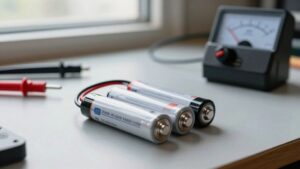
A 3S LiPo delivers 11.1V nominally and 12.6V when fully charged, while a 6S pack doubles those figures to 22.2V nominal and 25.2V at full charge. That voltage difference sets the electrical ceiling: with identical motor KV, you’ll see approximately twice the no-load RPM potential on 6S. Loaded speed still depends on gearing, tire diameter, drivetrain losses, and ESC limits.
| Metric | 3S | 6S |
|---|---|---|
| Nominal voltage | 11.1V | 22.2V |
| Full-charge voltage | 12.6V | 25.2V |
| Packaging | lighter, smaller | heavier, larger |
At equal power, the higher-voltage setup can use less current, reducing I²R loss and current-related stress. Verify every component’s voltage rating, then check battery dimensions and mass; a larger 6S pack can alter fitment and chassis balance. This comparison identifies critical system requirements before you select compatible hardware.
Three Cells Versus Six Cells
Three cells versus six cells changes far more than a truck’s top-speed potential. A 3S LiPo supplies 11.1V nominally and 12.6V fully charged; a 6S pack supplies 22.2V nominally and 25.2V charged. That voltage difference changes the electrical demands across your system.
For a comparable power requirement, a properly matched 6S setup can use less current, reducing current-related stress in some conductors. However, it requires a motor and ESC explicitly rated for 6S. You must also account for the pack’s larger size and mass, then verify battery clearance, connector capacity, gearing, drivetrain durability, tire integrity, and overall tuning. A 3S-designed truck isn’t automatically a 6S-compatible platform. Review manufacturer limits before installation, because voltage capability alone doesn’t confirm the complete vehicle can handle the conversion.
Top Speed, Torque, and Punch
Voltage capacity sets the ceiling, but motor RPM, gearing, traction, and drivetrain efficiency determine how much of that potential reaches the ground. A 6S pack doubles nominal voltage from 11.1V to 22.2V, raising available motor RPM and, with matched electronics, acceleration and terminal speed.
- You’ll see the clearest 6S advantage in heavy trucks on long, high-grip runs.
- Torque at the tires depends on KV, reduction ratio, tire diameter, current delivery, and losses.
- On loose surfaces, excess 6S punch can break traction, letting a sorted 3S truck accelerate more effectively.
- Verify motor and ESC 6S ratings; aggressive gearing can overheat components and load the drivetrain.
This comparison assumes identical vehicles; component limits determine whether higher voltage becomes productive performance rather than mechanical or thermal stress.
Throttle Discipline and Setup
Because 6S can overwhelm available traction almost instantly, throttle discipline and baseline setup matter as much as peak power. Use gradual trigger inputs, because the stronger pull can spin tires before a heavy truck transfers load and hooks up. Set throttle punch or acceleration rate conservatively, then raise it only when launches stay clean and temperatures remain safe.
Match motor KV, ESC rating, and gearing to the pack. A system that works on 3S can overspeed or overheat on 6S without proper configuration. Begin with conservative 6S gearing, run briefly, and measure motor and ESC temperatures before adding speed. Aggressive gearing raises heat and drivetrain stress. On loose dirt, grass, or casual bashing, you’ll often control a tuned 3S truck more easily; 6S demands compatible hardware, careful setup, and deliberate throttle.
ESC Voltage Ratings and Connectors
Start with the ESC’s published LiPo cell-count rating, not the truck’s name or battery tray size. A 3S LiPo supplies 11.1V nominal and 12.6V fully charged; 6S supplies 22.2V nominal and 25.2V charged. Applying 6S to a 3S-rated ESC can destroy its switching components. Confirm the exact rating before installing any pack.
- Match the battery voltage to the ESC’s stated cell limit.
- Verify that battery and ESC connectors mate directly and securely.
- If you use an adapter, confirm its current rating meets system demand.
- Inspect connectors for looseness, damage, or heat discoloration after hard runs.
High-voltage systems can pull current under load. Undersized connectors and high-resistance joints generate heat, increase voltage drop, and reduce reliability. Check voltage rating, connector type, and current capacity before upgrading.
Charger and Battery Replacement Costs
Once the ESC and connector match are confirmed, price a 3S-to-6S change as a battery-and-charger system rather than a pack swap. A 3S LiPo is nominally 11.1V, whereas a 6S pack is 22.2V, so verify that your charger supports six cells, balance charging, and the required output wattage.
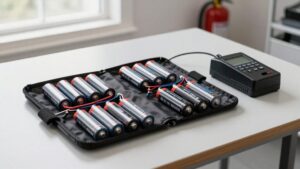
Compare replacement-pack costs by capacity, connector, physical dimensions, and discharge rating; voltage alone doesn’t establish price or runtime. If your existing charger lacks six-cell capability or sufficient wattage, include a higher-rated unit in the conversion budget. Also price compatible connectors or adapters, but don’t use an adapter to defeat charger voltage or current limits. Follow manufacturer charge limits and use a LiPo-safe bag; CNHL’s fireproof bag costs $12.99 to $25.98. That safety expense belongs in your replacement calculation.
Driveline Breakage and Tire Ballooning
Although 6S can transform acceleration and top speed, its 22.2V nominal voltage, 25.2V when fully charged, can impose sharp torque shocks on gears, driveshafts, and differentials designed around 3S power. That surge can exceed the safety margin of a 3S-spec driveline, particularly during hard launches on high-traction pavement.
- Ease into throttle; avoid abrupt full-power starts while establishing limits.
- Verify ESC, motor, gears, driveshafts, and differentials carry 6S ratings.
- Use sensible gearing and a 6S-matched motor KV to limit load and heat.
- Fit speed-rated tires and inspect glue bonds before each run.
At high RPM, 6S can balloon tires severely, loading the carcass and adhesive joint. A separating tire fails violently; if components lack 6S ratings, choose 3S for reliability instead of pushing it past intended limits.
Center Differential Wear
On 6S, repeated hard launches, wheelspin, and abrupt traction regain can shock-load your center differential and accelerate gear and outdrive wear. You’ll usually impose less stress on it with 3S, extending component life during casual bashing. Maintain the diff with clean, correctly weighted fluid, but remember that thicker oil increases drivetrain load and can’t compensate for damaged gears or bearings.
Torque Load And Wear
A 6S power system can send substantially higher torque through the center differential than a 3S setup, raising shock loads during hard launches, abrupt throttle inputs, and moments when the tires suddenly regain traction. That load doesn’t guarantee accelerated wear; motor characteristics, final drive ratio, tire traction, and your driving inputs determine how severely the gears and outdrives are stressed.
- Tall gearing or oversized tires increase torque demand, heat, and contact stress.
- Match gearing to the motor and truck’s intended operating load.
- Inspect gears and outdrives; replace worn components before collateral drivetrain damage occurs.
- If wear accelerates, moderate throttle use, reduce gearing, or choose 3S.
These changes lower peak torque and help keep loading safely within the differential’s mechanical capacity during sustained on-track use.
Differential Fluid Maintenance
Center-differential fluid controls how torque splits between the front and rear axles, so contaminated, depleted, or leaking silicone oil can make a 3S or 6S truck’s power delivery inconsistent. During drivetrain service, inspect the housing and outdrives for leaks, roughness, unusual play, chipped teeth, scoring, and metallic debris. Don’t merely add oil around a failed seal or worn gear; replace the damaged component first.
Refill with your manufacturer’s specified silicone weight, because viscosity determines how readily the differential transfers torque and biases drive between axles. Hard 6S running can accelerate fluid breakdown and gear wear, although conditions and truck design determine interval. After reassembly, rotate the unit to confirm smooth operation, then run truck and inspect again for seepage. Follow manufacturer’s maintenance schedule.
Backyards, Skateparks, Open Fields
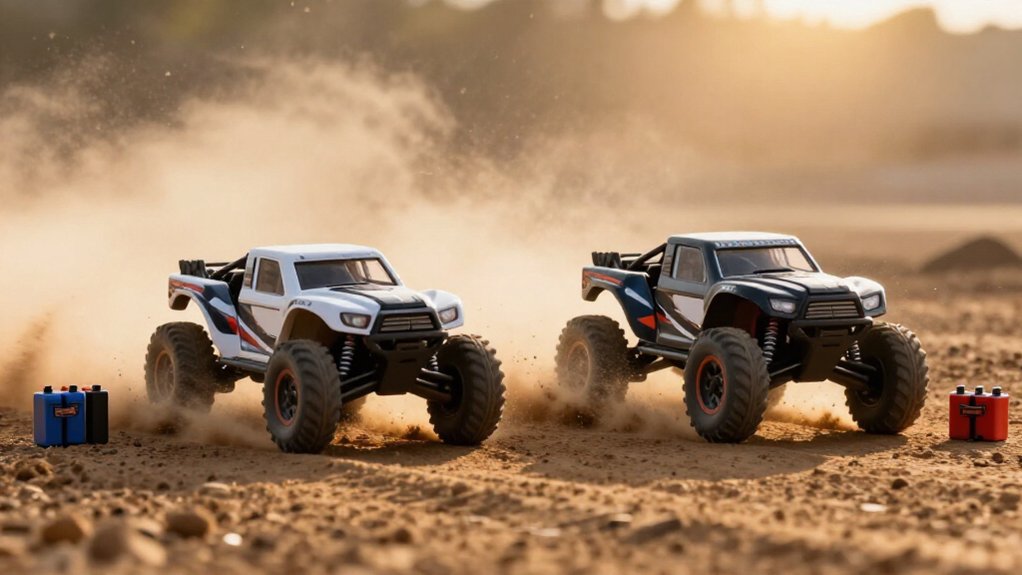
In a backyard, you’ll usually control a 3S truck more precisely because lower wheel speed reduces tire spin in tight turns. At a skatepark, 6S gives you stronger ramp acceleration if your motor, ESC, drivetrain, and tires can handle it. For long open-field runs, use 6S when traction and space support high speed; otherwise, a well-matched 3S setup remains more usable.
Backyard Control On 3S
When space is limited, a 3S truck gives you more usable control than 6S power: its smoother throttle response suits short backyard runs, obstacles, and frequent direction changes. You can modulate acceleration before the truck reaches a fence, curb, planter, or tight turn, so the chassis stays settled and tires retain traction. Instead of repeatedly braking from excessive speed, you use the available distance efficiently and place the truck accurately. This margin matters when your driving area includes landscaping or hard boundaries.
- Progressive throttle lets you correct line errors without destabilizing the rear tires.
- Lower peak speed reduces impacts when a run ends unexpectedly.
- Controlled wheelspin helps you maintain steering authority on uneven ground.
- Verify the specified voltage, pack dimensions, and connector before driving.
Skatepark Punch On 6S
6S power changes character once you leave confined backyard terrain: at a skatepark, it supplies the acceleration and top-end speed needed to clear gaps and carry momentum up ramps, but you must meter throttle carefully to avoid overshooting banks or upsetting the chassis on landing.
Begin with short, progressive trigger inputs and evaluate how the truck tracks across each section. Excess throttle can unload the tires at a lip, rotate the chassis unpredictably, or force braking before the next feature. Skatepark concrete generally offers better grip than loose terrain, yet suspension setup and tire condition still determine whether extra power becomes usable drive. Check motor and ESC temperatures after runs; aggressive 6S gearing raises current load quickly. Compared with 3S, 6S rewards disciplined throttle.
Open Field High-Speed Runs
Although 6S and 3S trucks can share the same terrain, open-field speed runs expose their biggest difference: 6S’s 22.2V supply gives a properly matched motor and drivetrain substantially more RPM potential and top-end speed than 3S at 11.1V. On a long, clear field, you can use that headroom to build speed, provided your ESC, motor KV, gearing, drivetrain, and tires are rated for 6S. Otherwise, heat, ballooning, or mechanical failure can end the run. You’ll gain speed only when the entire system remains controlled under load.
- Choose 3S for backyards with obstacles and limited braking room.
- Reserve 6S for clear acceleration zones and safe stopping distance.
- At skateparks, reduce throttle or gearing to control wheelspin.
- Check temperatures after passes; excessive load stresses drivetrain components.
3S 1/10, 6S 1/8
A 3S LiPo typically fits the lighter chassis, smaller battery trays, and manageable power demands of a 1/10 RC truck, while 6S systems more often serve larger 1/8 trucks built to handle their higher voltage and output. At 11.1V nominal, 3S gives you useful speed without imposing the mass, current load, or component stress associated with a 22.2V nominal 6S pack.
A purpose-built 1/8 platform generally has a stronger drivetrain, more room for batteries, and electronics selected for this power headroom. Don’t treat voltage as a simple upgrade. Before using 6S, verify your ESC and motor ratings, motor KV, gearing, drivetrain capacity, and pack dimensions. A correctly configured 3S 1/10 truck is more reliable and practical than a 6S conversion that overloads its chassis.
Conclusion
Choose 3S when you want controllable acceleration, longer component life, and practical speed in confined spaces. Move to 6S only if your chassis, ESC, gearing, tires, and driveline can manage the added voltage and heat. You’ll gain stronger punch and higher potential speed, but setup errors become expensive quickly. Match battery voltage to your terrain and driving skill: 3S suits most 1/10 use; 6S better fits reinforced 1/8 platforms and open ground under controlled conditions.