RC Car Terms Explained: A Beginner’s A-Z of Hobby Jargon
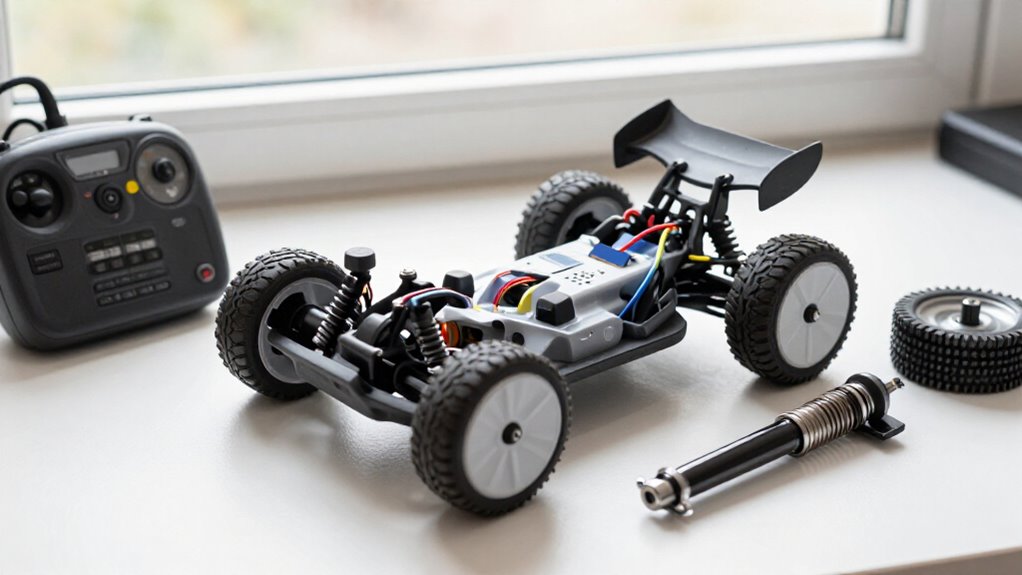
RC car jargon makes more sense when you connect terms to what you see on the track or bench. Your transmitter sends commands to a receiver, which directs the steering servo and ESC; the ESC controls motor speed, while battery voltage and capacity affect power and runtime differently.
You’ll encounter nitro break-in, LiPo safety, camber, caster, and droop. Knowing these basics helps you choose, maintain, and tune your model, and terms ahead build confidence.
Nitro-Specific Terms
Nitro RC cars use nitromethane fuel to power an engine, producing realistic engine sound and potentially high top speeds.
A glow plug heats the fuel-air mixture until it ignites; it doesn’t function like a spark plug. Break-in is the controlled, gentle running-in period. You keep loads and throttle modest at first to support long-term reliability.
The carburetor meters incoming fuel and air, so its adjustment affects engine operation. The clutch engages engine power and transfers it to the drivetrain.
After a run, after-run oil helps protect the engine during storage. Instructions may tell you to remove the glow plug, but don’t treat that step as a complete procedure: follow the manufacturer’s guidance for the remaining service steps. Learn these terms.
A-to-Z Term Index
Use this A-to-Z index to decode common RC terms: 2.4 GHz is the radio frequency used by most modern transmitters and receivers, while an A-arm links the chassis to the wheel hub through two inner pivots and one outer mount. Use the entries to interpret setup menus and chassis diagrams; each term identifies a distinct function.
| Term | Meaning | Where you’ll see it |
|---|---|---|
| Ackermann | Inside and outside wheels steer at different angles | Steering geometry |
| ATV | Adjustable Travel Volume limits servo movement either side of neutral | Transmitter settings |
| Trim rate | Servo movement per trim click, often percentage of travel | Fine adjustment |
When you compare these labels, distinguish steering geometry from servo limits: Ackermann changes wheel angles, whereas ATV caps travel and trim rate sets the correction step.
Electronics & Power
Your battery choice, LiPo for lightweight power or NiMH for beginner-friendly handling, sets the system’s voltage and runtime. The ESC controls motor speed and direction, while brushed motors favor lower cost and brushless motors deliver greater speed, efficiency, and durability; a servo actuates steering, throttle, or braking. Your 2.4 GHz transmitter sends commands through a paired receiver, with modern systems designed to resist interference from nearby cars.
Batteries And Voltage
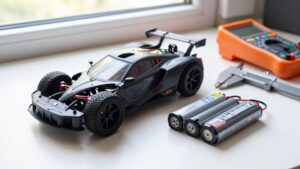
Before choosing a battery, check your RC car’s specifications: electric models need a charged pack to run, and the pack’s chemistry, voltage, and connector must match the car’s requirements.
LiPo means Lithium Polymer. These packs are lightweight and powerful, and manufacturers commonly house them in molded plastic cases. NiMH means Nickel-Metal Hydride; these packs weigh more than LiPo packs but are generally more beginner-friendly. Your choice affects weight and handling, so follow the model maker’s guidance rather than assuming either chemistry is universally suitable.
Voltage describes the electrical potential a battery supplies to your car’s electronics and motor. It isn’t simply a measure of capacity: choose the specified voltage, because an incompatible pack can cause problems. Check the connector, too; a physically mismatched plug won’t make a reliable connection. Unlike a nitro model, your electric car doesn’t use fuel. Charge its battery before driving, and use a compatible pack and charger for your model.
ESC Functions
An electronic speed controller (ESC) regulates an electric RC car’s motor, managing acceleration and, if supported, braking and reverse.
Your ESC must match your motor’s type—brushed or brushless—and handle your battery’s voltage and current demands. These compatibility limits matter before you adjust its features.
Drag brake applies braking when you release the throttle, helping your car slow down or hold position without a separate brake input. In blinky mode, the ESC disables adjustable motor timing, giving you a fixed, rules-compliant setting for racing.
Boost and turbo timing can raise motor speed at higher throttle levels. You can also shape power delivery with throttle profile and strength settings: these determine how quickly the ESC responds and how forcefully it applies power. Check your event’s rules.
Motors And Power
With the ESC regulating motor speed and direction, your motor and battery determine how the car delivers power. A brushed motor costs less and gives you an entry point; a brushless motor typically runs faster, converts energy more efficiently, and lasts longer. Compare torque—the motor’s twisting force—when you want stronger acceleration, but remember that gearing and traction affect how that force reaches the wheels.
Your battery choice shapes weight and runtime potential: LiPo packs are lightweight and powerful, while NiMH packs weigh more and are generally easier for beginners to manage. Match the battery’s voltage and connector to your electronics. Nitro cars use another power source: a glow plug heats to ignite the fuel in the engine. Know the terminology before choosing a setup.
Servo Basics
A servo converts receiver commands into mechanical motion, steering the car when you turn the transmitter’s wheel or move its stick. The receiver relays those commands to a motor that positions the steering linkage. Nitro models may use a separate servo for throttle and brake control.
Servo travel is the distance the servo arm moves. ATV, or Adjustable Travel Volume, limits travel on either side of neutral. Set it so the steering links reach lock without binding; binding strains the servo and can damage its gears.
Steering trim centers the wheels when you release the control. Trim rate determines how much the servo moves with each trim adjustment. Use trim for alignment corrections, not to compensate for a bent linkage or incorrectly centered servo.
Radio Transmitter
Your radio transmitter is the handheld controller that sends steering and throttle commands to the car’s receiver. Most modern VRX cars use a 2.4-GHz radio system designed for long range and to reduce interference near other cars. You pair, or “bind,” the transmitter to its specific receiver before driving.
The steering wheel commands the steering servo, and the trigger controls the electronic speed controller (ESC), which governs motor power. RTR models usually include a transmitter, but you may need to install its AA or AAA batteries first. Check the battery compartment and fit the specified cells before heading out. Keep the controller powered and use smooth wheel and trigger movements to steer and apply throttle precisely. Its handheld layout puts both controls within reach.
Receiver Signals
When you steer or apply throttle, the receiver captures the transmitter’s 2.4-GHz signal and converts each command into an electrical control signal. It typically routes one channel to your steering servo and another to the electronic speed controller (ESC), which governs motor speed and direction. Your receiver must match the transmitter’s protocol and be bound to it; otherwise, they can’t exchange commands.
Binding pairs the devices, while modern 2.4-GHz systems use distinct links designed to limit interference from nearby RC cars. The receiver also needs power to process incoming data and drive its outputs. In an electric car, the ESC’s built-in battery eliminator circuit (BEC) usually supplies that power, drawing from the main battery and regulating voltage for the receiver—for dependable control always.
Connectors And Plugs
Receiver signals control the car, but connectors carry the power that makes it move. Your battery connector links the pack to the electronic speed control (ESC), which distributes power to the motor and receiver. Common plugs include Deans/T-plugs, XT60, EC3, and Traxxas connectors. Their shapes, current ratings, and compatibility differ, so don’t assume one plug fits every car.
Check polarity before connecting: reversed positive and negative leads can damage electronics or create a short. If the plug doesn’t match your car’s socket, use a correctly wired adapter. Each adapter adds another connection that can loosen or heat under load. Keep plugs clean and fully seated to maintain reliable contact. Inspect them regularly; replace any connector that’s cracked, loose, or discolored from overheating without delay.
Charging And Safety
Safe charging starts with matching the charger to the battery’s chemistry and specifications. LiPo (lithium-polymer) packs deliver high power at low weight, but you must select LiPo mode and the correct cell-count setting. NiMH (nickel-metal hydride) packs are heavier and more beginner-friendly, yet you still need a compatible charger.
Never leave a pack charging unattended. Place it on a nonflammable surface, and stop charging immediately if it swells, overheats, or shows damage. The wrong chemistry mode or voltage can damage cells and create a fire risk, so verify the charger’s settings against the pack’s label before connecting it.
After driving, disconnect the battery and store it safely. For LiPo storage, set the manufacturer-recommended storage charge; don’t leave the pack fully charged for long periods.
Battery Capacity vs. Voltage
Capacity, measured in mAh, tells you how much charge your battery stores; voltage, measured in volts, is its electrical pressure and must suit your ESC and motor. At similar driving conditions, greater capacity generally extends runtime, while higher voltage can increase speed and power without necessarily adding stored energy. Choose a compatible voltage and compare watt-hours—nominal volts multiplied by capacity in amp-hours—to assess total energy.
What Capacity Measures
Although capacity and voltage both describe a battery, they measure different things. Capacity tells you how much electrical charge a pack can store, and manufacturers rate it in milliamp-hours (mAh) or amp-hours (Ah). Divide mAh by 1,000 to convert to Ah: a 5,000 mAh pack is 5 Ah. For your RC car, a higher-capacity battery can deliver longer runtime.
Capacity isn’t a direct measure of speed or guaranteed run time; driving style, motor load, and battery condition also matter.
Don’t choose a replacement by capacity alone. Packs with identical capacity can have different voltage, while packs with identical voltage can store different amounts of charge. Check your car’s required voltage and battery-bay dimensions before fitting a larger-capacity pack. More mAh won’t make an incompatible battery suitable.
What Voltage Measures
Voltage (V) measures the electrical potential that drives current through your RC car’s motor and electronics; it doesn’t tell you how long the battery will run.
Think of voltage as electrical pressure; capacity, usually listed in milliamp-hours (mAh) or amp-hours (Ah), tells you how much charge the pack stores. Since 1,000 mAh equals 1 Ah, a 5,000 mAh pack stores 5 Ah. A LiPo cell has about 3.7 V nominal; so a 2S pack is 7.4 V and a 3S pack is 11.1 V.
For equal-capacity packs, higher voltage can deliver power, but confirm your motor and ESC support the pack’s voltage. Capacity and voltage aren’t interchangeable: a 7.4 V, 5,000 mAh pack has the same voltage as a 7.4 V, 2,500 mAh pack, but stores twice the charge.
Runtime And Speed
Choosing a battery for runtime versus speed comes down mainly to capacity and voltage: a higher-capacity pack generally runs longer, while a higher-voltage pack can increase speed if your motor and ESC support it.
Capacity, measured in milliamp-hours (mAh), describes stored charge; under matching conditions, a 5,000 mAh pack typically outlasts a 3,000 mAh pack. It won’t automatically make your car faster. Voltage, measured in volts, sets the motor’s speed potential. LiPo cell count gives you nominal voltage: each cell supplies about 3.7 V, so 2S equals 7.4 V and 3S equals 11.1 V.
Don’t exceed your motor or ESC ratings, because extra voltage can damage electronics. Nor should you expect a higher-voltage pack to extend runtime. Your actual speed and run time also vary with driving style, motor load, gearing, terrain, and the car’s electronics. These are separate effects: capacity mainly governs duration, while voltage mainly governs speed potential; neither number alone predicts performance in every setup.
Choosing The Right Battery
For the right RC car battery, match voltage to your electronics and capacity to your runtime needs.
Voltage sets a pack’s nominal electrical pressure; it must stay within your motor’s and ESC’s supported range. A 2S LiPo is nominally 7.4 V, while a 3S pack is 11.1 V. Never exceed the vehicle’s specified limit.
Capacity, measured in milliamp-hours (mAh), tells you how much charge the pack stores. A 5,000 mAh battery generally runs longer than a 3,000 mAh pack under similar conditions. However, higher-capacity packs can be larger and heavier; check your tray dimensions and the car’s weight limit. Also verify the connector and chemistry match your vehicle. For LiPo, choose the required cell count and charge with a compatible balance charger before driving.
Chassis Geometry and Suspension
Chassis geometry and suspension settings determine how your RC car steers, grips, and responds to uneven terrain. Camber is the inward or outward tilt of a wheel when viewed from the front; it changes tire contact and cornering grip. Caster is the forward or backward tilt of the steering axis viewed from the side, shaping steering feel and straight-line stability. Set ride height—the chassis-to-ground distance—to shift your center of gravity and alter bump clearance and cornering behavior.
Droop measures how far suspension extends; downstops cap that travel and help you tune cornering response. Shock oil, pistons, and mounting positions control damping and leverage, changing how quickly your car reacts to bumps and weight shifts. Adjust these variables methodically: change one setting at a time, then test handling on consistent terrain. Small adjustments can transform balance without masking the cause.
LiPo Battery Fire Precautions
LiPo packs can deliver high current, but damage or improper charging can trigger a fire. Set your charger to the pack’s chemistry and cell count, and never exceed the manufacturer’s charge-rate limit. Charge and store packs in a fire-resistant LiPo bag or container, on a nonflammable surface, away from exits and combustible materials.
Don’t leave a pack unattended while charging. Stop immediately if it swells, smokes, smells unusual, or gets unusually hot.
Never charge or use a damaged, punctured, or swollen pack. Isolate it outdoors in a safe spot away from flammables.
Keep a suitable fire extinguisher nearby, and follow local disposal guidance; never put a damaged LiPo battery in household trash. If compromised, isolate it outdoors, away from flammable materials; don’t use it.
Hobby Culture (Explore & Support)
With battery safety covered, you can explore RC culture through the way people drive and build. Choose a style that fits your terrain, pace, and appetite for competition; each term signals a different setup and driving priority.
- Bashing is casual fun with jumps, stunts, and off-road runs.
- Racing is organized track competition; VRX buggies and truggies suit this use.
- Crawlers favor torque over speed for slow, technical climbs.
Nitro cars run on nitromethane, delivering engine sound and high top speeds, but reliable engines need careful break-in. After a run, use after-run oil for engine care; consult the manufacturer’s instructions, since guidance can vary. A club or track offers setup advice and practical support. Choose gear to suit your style and local terrain.
Conclusion
You’ve now got a working vocabulary for RC cars, from nitro tuning and chassis geometry to LiPo voltage and capacity. Use these terms to read manuals, compare setups, and describe what your car’s doing with precision. When you handle LiPos, follow safe charging and storage practices; never leave a charging pack unattended. Keep learning from experienced hobbyists, verify advice against your model’s documentation, and put your new knowledge to work at the track. Word count: 75.
RC Apps & Software Finder
Filter RC phone control apps, ESC/radio programming software and design tools by purpose, platform, price and brand, with official links.