RC Pinion Gear Chart: Tooth Counts for Speed vs Torque
RC Pinion Gear Chart: Tooth Counts for Speed vs Torque
Use a pinion-and-spur chart to compare tooth counts and external ratios: spur teeth ÷ pinion teeth. For example, an 86T spur with a 23T pinion gives 3.74:1; a 24T pinion gives 3.58:1.
A smaller pinion raises torque and acceleration but lowers top speed; a larger pinion favors speed and adds motor load. Match pitch, bore, and mesh, then check temperatures after changes. The chart also helps you identify compatible gearing and model-specific stock combinations.
Pinion Tooth Count Basics
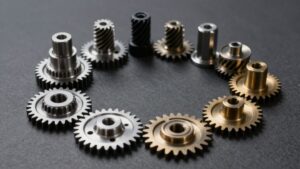
The pinion is the smaller gear mounted on the motor’s output shaft, where its teeth mesh with the larger spur gear. Count pinion teeth to identify its size: a 23-tooth pinion has 23 teeth. To calculate the pinion-and-spur gear ratio, divide the spur’s tooth count by the pinion’s.
For example, an 86-tooth spur paired with a 23-tooth pinion produces a ratio of about 3.74:1. Check the gear specifications before installation: the pinion and spur need matching tooth profiles and compatible pitch or module to mesh correctly. You can read the pinion size directly from its labeled tooth count, but verify the count when markings are absent. A correct mesh lets you inspect alignment without forcing the gears together or risking tooth damage during setup.
Pinion Teeth Versus Performance
A smaller pinion raises the spur-to-pinion ratio, generally improving torque and acceleration at the expense of top speed. You calculate the external ratio by dividing spur teeth by pinion teeth. With an 86-tooth spur and 23-tooth pinion, the ratio is about 3.74:1. Changing to a 24-tooth pinion lowers it to 3.58:1, shifting emphasis toward speed while reducing low-speed torque and increasing motor load.
| Pinion teeth | Ratio | Typical effect |
|---|---|---|
| 23 | 3.74:1 | Higher torque, acceleration |
| 24 | 3.58:1 | More speed, motor load |
| Smaller | Higher | Torque-biased |
| Larger | Lower | Speed-biased |
Treat each change as a gearing trade-off, not a guaranteed performance gain. A larger pinion can raise speed, but taller gearing asks more from the motor. After each adjustment, monitor motor and speed-control temperatures under comparable running conditions; excessive heat signals that the setup may be too tall for your vehicle, motor, and driving load, and ambient conditions.
Pinion Bore and Mounting Fit
Pinion fit depends on more than tooth count: match the bore diameter to the motor shaft, since an undersized bore won’t fit and an oversized one can wobble or slip. Check the pinion’s retention method before installation. If it uses a set screw, align the screw with the shaft’s flat, when present, to improve its grip and reduce movement.
Also verify that the pinion’s tooth pitch or module matches the spur gear; incompatible profiles won’t mesh correctly and can strip teeth. Slide the pinion into position so its teeth engage the spur gear fully, without forcing them together. Then adjust the gear mesh according to your vehicle manufacturer’s guidance. Correct bore, secure mounting, compatible teeth, and engagement help preserve power transfer and limit wear.
Motor and Battery Compatibility
Match motor Kv to your battery’s fully charged voltage: a 3,500 Kv motor on 2S (8.4 V) yields about 29,400 RPM, while a 2,200 Kv motor on 4S (16.8 V) yields about 36,960 RPM before gearing. Similar RPM doesn’t guarantee compatibility, so confirm your motor and ESC voltage and current limits and your battery’s discharge rating. Higher RPM can raise temperatures and reduce runtime, so monitor motor and ESC heat and adjust gearing if needed.
Motor KV Compatibility
Motor Kv and battery voltage jointly determine speed: approximate motor RPM as Kv multiplied by voltage, then account for gearing by dividing by the spur-to-pinion tooth ratio. Use this estimate to compare setups: estimated RPM reaching the transmission equals (Kv × battery voltage) ÷ (spur teeth ÷ pinion teeth). A charged 2S LiPo is 8.4 V; a charged 4S LiPo is 16.8 V. Doubling voltage while nearly halving Kv can produce similar RPM with unchanged gearing. For example, a 3500 Kv motor on 2S with 56T/13T gearing yields about 6,825 RPM, while a 2200 Kv motor on 4S with that gearing yields about 8,580 RPM. Higher RPM can increase heat, so check motor and ESC temperatures after changing Kv, battery voltage, or gearing.
Battery Voltage Limits
Although higher voltage can increase motor RPM and heat, you must first confirm that both the motor and ESC support the battery’s voltage.
A fully charged 2S LiPo reaches 8.4 V, while a fully charged 4S pack reaches 16.8 V. Estimate unloaded motor speed by multiplying its Kv rating by battery voltage. In the Slash 4×4 example, a 3500Kv motor on 2S turns about 29,400 RPM.
A 2200Kv motor on 4S reaches about 36,960 RPM. Halving Kv while doubling voltage roughly offsets the RPM change, but it doesn’t remove voltage or heat limits. Check the motor and speed-control manufacturer’s ratings before pairing components. Then monitor motor and ESC temperatures during testing, because higher voltage can increase heat even when the estimated RPM seems suitable.
ESC Current Capacity
When selecting an ESC, check that its continuous and burst current ratings meet or exceed the motor’s expected draw, including the higher current it may demand under heavy load. Match the ESC’s output type to your motor: brushed ESCs suit brushed motors, while brushless systems require compatible sensorless or sensored operation. Confirm its voltage range supports your battery’s cell count and chemistry; exceeding that limit can damage the ESC.
Higher-Kv motors, heavier vehicles, aggressive driving, and taller gearing can raise current demand. Changing pinion tooth count may consequently alter ESC temperature and compatibility. During testing, monitor both ESC and motor temperatures. If either overheats, reduce load or improve cooling; a current rating alone can’t guarantee safe operation. Recheck temperatures after each gearing change; a taller pinion can increase speed and load, pushing the system beyond practical thermal limits even when the ESC’s current rating appears adequate in actual use.
Battery Discharge Rating
Pinion changes can raise current demand, so check that the battery can safely supply the motor’s expected draw. Your battery’s discharge rating, or C rating, indicates how quickly it can deliver current safely. Estimate its continuous capacity by multiplying capacity in amp-hours by the C rating: a 5 Ah, 30C battery can provide up to 150 A continuously.
Compare that figure with the motor’s expected current draw; the battery’s continuous rating should meet or exceed it. Also confirm that your speed controller’s current rating is adequate. High-load motors and aggressive gearing can increase demand, so monitor battery and motor temperatures and stay within the battery’s discharge limits. Don’t judge compatibility by C rating alone: verify that voltage, capacity, connector, and controller limits suit your motor and setup.
Heat and Runtime
A larger pinion raises gearing and motor RPM, which can increase motor and ESC temperatures; a smaller pinion can reduce gearing and help lower heat. After changing pinion or spur gears, check motor and speed-control temperatures under your driving conditions. A safe setup depends on your vehicle and throttle use, so don’t assume a tooth count suits every run.
Match gearing to motor Kv and battery voltage: motor RPM is approximately Kv multiplied by voltage. A charged 2S LiPo reaches 8.4 V; a 4S reaches 16.8 V. Doubling voltage while roughly halving Kv can keep RPM similar, but it doesn’t guarantee equal temperatures or runtime. If heat rises excessively, your motor, battery, and gearing may be mismatched. Change gearing gradually, then monitor temperatures before pushing harder.
Reading Tooth-Count Chart Rows
To read an RC pinion gear chart, treat each row as one pinion-and-spur combination and note both tooth counts before comparing setups. A row identifies pinion and spur sizes; calculate the external gear ratio by dividing spur teeth by pinion teeth. For example, an 86T spur paired with a 23T pinion gives 86 ÷ 23, or about 3.74:1.
With the spur unchanged, a larger pinion lowers the ratio and shifts the setup toward speed; a smaller pinion raises it and favors torque. With the pinion unchanged, a larger spur raises the ratio and favors torque, while a smaller spur lowers it and favors speed. Compare ratios.
Gear Pitch and Mesh Limits
Before comparing gear ratios, verify that the pinion and spur have compatible tooth profiles and the same pitch or module; otherwise, they won’t mesh correctly.
Common imperial pitches include 32P, 48P, and 64P, while metric modules include 1.0, 0.8, and 0.6. The pitch number describes teeth per inch; a higher number means finer teeth and smaller tooth spacing. Coarser teeth generally contain more material and tolerate greater loads, so they’re often more durable.
Don’t assume similar labels guarantee exact interchangeability. 32P and 0.8-module gears are nearly interchangeable, but 48P and 0.6-module gears aren’t identical. Use matching standards rather than forcing a fit. Inspect tooth contact and backlash; don’t force incompatible gears together, because poor engagement can accelerate wear and strip fine teeth under load.
Indoor Carpet Speed Setup
For indoor carpet, start with the manufacturer’s recommended pinion-and-spur combination, since the right ratio depends on your motor, battery, and drivetrain. To raise straight-line speed, fit a pinion with more teeth or a spur with fewer teeth; either change lowers the spur-to-pinion ratio. For stronger acceleration and reduced motor load, choose a smaller pinion or larger spur, which raises the ratio.
Change pinion size incrementally, often one tooth at a time, and check motor and ESC temperatures after short carpet runs. Record each combination, temperatures, and handling. Carpet grip and track layout affect which gearing delivers usable speed and predictable response, so compare results under consistent conditions before settling on a setup. Repeat tests as needed to confirm the best balance for your course.
Overheated Motor Symptoms
How can you tell if an RC motor is overheating? Check its temperature after a run; touch alone can’t provide a reliable reading. A hot case deserves attention, but slowing, power loss, or cutouts may signal overheating and can also have other causes.
- Sudden power loss can turn a lap frustrating.
- A cutout mid-run can threaten control.
- Higher RPM from taller gearing, a larger pinion, or higher-voltage battery can raise motor heat.
- After a gear change, unchecked heat can put your motor at risk.
During testing, monitor temperature, especially after changing pinion or spur gears. Stop if it exceeds the manufacturer’s limit. If heat rises, gear down with a smaller pinion or larger spur; retest and check speed-control temperature after each run.
Stock Spur Gear Tooth Count
A pinion gear chart depends on the vehicle’s stock spur gear tooth count, which varies by model. Before you change gearing, confirm the exact model and drivetrain; the spur count sets the baseline for interpreting pinion choices. For a Slash VXL 2WD, the stock 86-tooth spur pairs with a 23-tooth pinion, producing an external ratio of about 3.74:1. The Slash 4×4 instead uses a 56-tooth spur and 13-tooth pinion.
- Check manufacturer specifications before applying chart values; assumptions can distort your setup.
- Match the listed spur count to your model, not merely its family name.
- Treat the 2WD ratio as specific to that stock pairing, not universal.
- Verify before buying; the wrong baseline can cost speed, torque, and confidence.
Check first, then tune with confidence.
Conclusion
Use the chart to choose a pinion that matches your speed, torque, and run-time goals. Before changing tooth count, verify pitch, bore, mounting fit, spur compatibility, and motor limits. A smaller pinion generally improves acceleration and reduces heat; a larger one raises potential speed but increases load. Check motor temperature after each adjustment, especially on carpet, and change gearing in small steps. Your best setup depends on the vehicle, battery, track, and driving conditions, not tooth count alone.