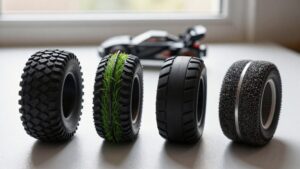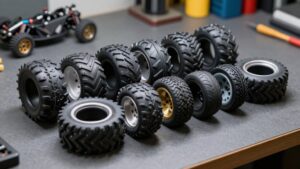
RC Crawler Tire Size Chart: 1.0, 1.9, 2.2 and 2.6 Inch Wheels
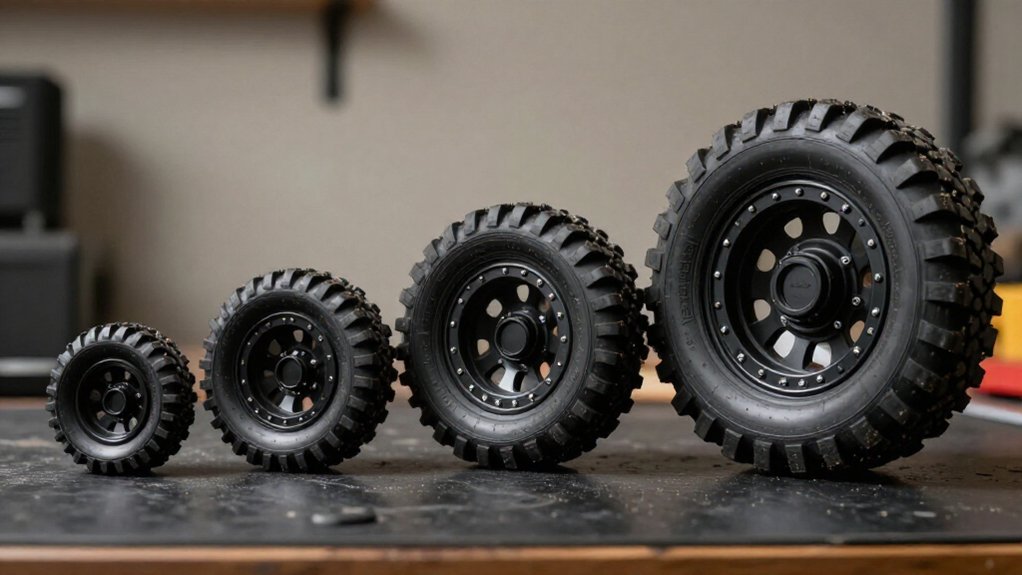
You can’t determine an RC crawler tire’s height or width from its 1.0-, 1.9-, 2.2-, or 2.6-inch wheel label alone; labels identify wheel diameter and matching tire bead size.
Measure outside diameter and casing width, then compare published specs. Typical 1.9-inch tires are roughly 4.2 to 4.8 inches tall. Listed 2.2-inch examples range from 4.1 to 5.5 inches.
For 1.0- and 2.6-inch wheels, check bead fit and clearance; the guide below covers key checks.
Portal Axle Clearance
Portal axles raise the differential above the wheel center, giving your crawler more under-axle clearance, while a taller tire can lift the axle and chassis further. That height helps you clear obstacles without making the differential the lowest contact point. Tire diameter still matters: a taller tire raises the axle and chassis, but a 2.2-inch wheel doesn’t automatically carry a taller tire than a 1.9-inch wheel.
Compare stated outside diameters when you estimate clearance, not wheel labels alone. For example, listed Axial 1.9 Ripsaws are 4.3 inches tall; 2.2 Ripsaws are 5.5 inches. Before upsizing, check body and suspension clearance through full steering and articulation; rubbing can limit movement or damage parts. Bigger, heavier tires also load your motor, battery, steering, and drivetrain, so confirm fit and gearing first.
Wheel-and-Tire Size Chart
For a quick wheel-and-tire size comparison, note that a tire’s 1.9- or 2.2-inch label refers to its inner diameter, which must match the wheel—not its overall height. Use this chart to compare common sizes and checks:
| Wheel size | Practical reference | Check before fitting |
|---|---|---|
| 1.0 in | Match tire inner diameter | Confirm wheel fit |
| 1.9 in | Common scale-truck size | Check overall height |
| 2.2 in | Generally larger tires | Check vehicle clearance |
| 2.6 in | Match tire inner diameter | Verify fitment |
Axial’s Ripsaw measures 4.3 inches tall in 1.9-inch size and 5.5 inches in 2.2-inch size. So wheel diameter doesn’t determine tire height. Before upsizing, check clearance; larger tires may need suspension or body adjustments. Some tires also require a specific wheel type, so confirm the tire’s stated fitment before choosing a wheel.
Beadlock Ring Compatibility
Beadlock ring compatibility depends on the wheel’s exact model and diameter, so don’t assume a ring will fit just because its size is labeled 1.0, 1.9, or 2.2 inches. Check the wheel maker’s specifications to confirm the ring matches your wheel and intended tire combination; nominal diameter alone isn’t enough. Before installation, verify that the tire bead seats correctly against the wheel and that the hardware clamps it evenly.
Tighten fasteners gradually in a cross pattern, following the manufacturer’s guidance, to avoid uneven pressure. Because hardware secures the tire mechanically, you can reuse beadlock wheels without glue when changing tires. Account for their added weight, which may aid low-speed crawling but can burden suspension and drivetrain parts. Also confirm the tire clears your crawler’s body and suspension before fitting it.
Tire Diameter and Width Ranges
Measure tire diameter from tread to tread and width across the casing at its widest point. You’ll find typical 1.0 to 1.9-inch tire ranges, but those labels describe wheel fit, not tire height; for example, Axial’s 1.9-inch Ripsaw is 4.3 inches tall, while its Maxxis Trepadore is 4.6 inches. Compare 2.2 to 2.6-inch tires by their listed dimensions, since tire height and width vary by model and affect ground clearance and contact patch.
Measuring Tire Diameter
Although 1.0-, 1.9-, 2.2-, and 2.6-inch labels identify the wheel diameter and matching tire inner diameter, they don’t indicate the tire’s outside size. To find that dimension, measure from one tread edge to the opposite tread edge through the tire’s center, with the tire mounted and inflated as intended. Use the manufacturer’s listed outside diameter when comparing models; the wheel designation alone can’t predict overall height.
Published examples show the range: a 1.9-inch Axial Ripsaw measures 4.3 inches in diameter, while several 2.2-inch Axial tires measure 5.5 inches. That difference affects fit and trail performance. A taller tire can raise ground clearance, but it may also alter gearing and steering clearance. Check the exact tire specification before buying, then compare its measured diameter with your current setup and available body clearance. Don’t assume tires sharing a wheel size will often have the same outside diameter across brands.
Measuring Tire Width
Tire width is a separate measurement from wheel size and outside diameter. Labels such as 1.0, 1.9, and 2.2 inches identify the wheel diameter and matching tire inner diameter; they don’t state the tire’s overall size. Measure width across the tire’s widest point, and measure outside diameter from one outer tread edge to the opposite edge. Record both dimensions when checking clearance, because either can affect fit.
Check manufacturer specifications; matching wheel labels don’t guarantee matching tire dimensions. A taller tire can increase ground clearance, and a wider tire can enlarge the contact patch, but either may affect fit. Axial’s 1.9-inch Ripsaw is 4.3 inches tall; its 2.2-inch Ripsaw is 5.5 inches tall. Compare listed width and diameter directly with available space before buying.
Typical 1.0-Inch Ranges
A 1.0-inch designation identifies the wheel diameter the tire fits, not its outside diameter or width. Treat it as a bead-fit measurement, not a tire-size range. The listed 1.0-inch options include the Propson Baja Pro X, Interco IROK Super Swamper, Rock Creeper, Scrambler Offroad, and several RC4WD scale replicas.
Before comparing options, check each manufacturer’s specifications for measured dimensions. For fitment, match the tire’s 1.0-inch inner diameter to a 1.0-inch wheel. Then verify that the tire’s actual height clears your body and suspension, and that its width fits the vehicle without rubbing during steering or suspension travel.
Typical 1.9-Inch Ranges
For 1.9-inch crawler tires, the designation refers to the wheel diameter, not the tire’s outside diameter.
Typical 1.9-inch tires measure roughly 4.2 to 4.8 inches tall, with examples including 4.19-inch and 4.75-inch Goodyear Wrangler MT/R tires. Treat those figures as a practical range, not a guarantee: tread design and carcass shape affect the mounted tire’s actual height. Width varies by model, and these examples don’t establish a standard range.
Check the manufacturer’s listed width and diameter before you buy, then confirm the dimensions against your body and suspension clearances. A taller tire can raise ground clearance, but it may rub at full steering lock or suspension compression. You might need to adjust suspension setup or body clearance. Larger or heavier tires can also strain your motor, battery, steering, and drivetrain, so consider those loads when selecting a size for your crawler.
Comparing 2.2 And 2.6-Inch Tires
The 2.2- and 2.6-inch labels describe wheel diameter and the tire’s matching inner diameter—not its overall height or width. To compare fit, check each tire’s published outside diameter and section width, then confirm wheel compatibility.
Listed 2.2-inch examples show why the label alone can’t predict height: Axial Ripsaw and Maxxis Trepador tires measure 5.5 inches tall, while the Hankook Dynapro MT measures 4.1 inches. Goodyear Wrangler MT/R and BFGoodrich Mud Terrain KM3 2.2-inch models each list for $31.99.
For 2.6-inch wheels, the Michelin MEGAXBIB is $37.99 but out of stock; the Genius Ignorante costs $31.99. Before choosing, compare manufacturers’ measurements with 2.2-inch candidates and check clearance on your crawler; don’t infer size from wheel diameter.
Body and Fender Clearance
Check a tire’s listed outside diameter—not its 1.0-, 1.9-, or 2.2-inch wheel size—to judge body clearance. Wheel diameter identifies the rim; outside diameter sets the tire’s overall height. Moving from 1.9-inch to 2.2-inch tires generally increases tire size, so you may need to adjust body mounts or suspension to prevent fender rubbing.
A taller tire can improve ground clearance, but it may hit the body when suspension compresses or you turn. On an SCX10, adjustable body posts and shocks can help accommodate larger tires.
Fitting smaller tires on Ridgecrest or Wraith models may demand more substantial modifications. Before driving, check clearance at full steering lock and with the suspension fully compressed. Check clearance through steering and suspension travel; labels alone can’t confirm fit.
Foam Insert Fitment
When choosing foam inserts, match their dimensions to the tire’s internal size and shape; wheel diameter alone won’t confirm fit. Check the tire’s inner diameter and width, then compare the insert’s profile with the cavity, including its sidewall contour. An insert that’s too wide can bunch or distort the carcass; one that’s too narrow may leave the tread unsupported.
Standard foam gives you durable, consistent support on dirt, rocks, sand, and pavement, making it a practical all-terrain choice. Denser, heavier memory foam conforms more closely to rocks, so choose it for rock-only crawling or competition rather than general use. Hybrid inserts combine standard foam’s predictable support with memory foam’s rock-conforming flexibility. If your tire has interior sidewall ribbing, it adds support while preserving flexibility.
SCX24 Stock Tire Upgrade
If you’re upgrading an SCX24’s stock tires, choose replacements made for its 1.0-inch wheels, then compare their outside diameter with the stock size. Most SCX24 models use 1.0-inch wheels, so skip 1.9- and 2.2-inch crawler tires; their beads won’t match. For stock-size options, the Propson Baja Pro X 1.0, listed at $9.99, and RC4WD Milestar Patagonia M/T 1.0, listed at $8.99, are shown in stock. Choose tread for your terrain: open lugs can clear loose dirt and mud, while tighter patterns suit harder surfaces.
Softer rubber can grip rocks better, but it wears faster; firmer compounds generally last longer. Taller tires may increase ground clearance, but check body clearance through steering and suspension travel. If they rub, you may need suspension or body-mount adjustments. Verify the maker’s published measurements before you buy.
Hex Hub Offset Compatibility
Wheel diameter doesn’t determine hex size or offset, so verify both before buying. Measure hex size flat-to-flat; many 1/10-scale crawlers use 12-mm hexes, but check your vehicle’s hub dimensions before ordering. Match the wheel’s opening to that hub, then confirm offset clears suspension and body.
- Compare the replacement wheel’s offset with your stock wheel; offset sets how far the wheel sits inward or outward.
- A different offset can change track width and tire clearance, so inspect the full steering and suspension sweep.
Before installation, test-fit the wheel and rotate the axle through its travel. Check for contact at full steering lock and compression under load.
Crawler Tire Size Reference
Crawler tire sizes such as 1.0, 1.9, and 2.2 inches describe the wheel diameter and matching tire inner diameter, not the tire’s overall height. Use the outside diameter to judge clearance and fit; wheel size alone won’t tell you how tall the mounted tire will be.
- 1.0-inch tires suit micro crawlers; 1.9-inch tires commonly equip trail rigs.
- 1.9-inch tires may measure 4.3 to 4.75 inches tall, while 2.2-inch tires reach about 5.5 inches.
- Many SCX10s run 1.9-inch tires and often accept 2.2-inch tires with few changes; Ridgecrest and Wraith models use 2.2-inch tires.
Larger tires raise clearance but may need body or suspension changes and strain your motor, battery, steering, and drivetrain. Check clearances through travel and at steering lock carefully before upgrading.
Conclusion
Use this RC crawler tire size chart to match tire diameter, width, wheel size, beadlock rings, foams, and hex offset before you buy. Check portal axle clearance and body travel at full steering lock and suspension compression; static clearance alone can mislead you. For an SCX24 upgrade, confirm the tire fits its wheel and clears the fenders. Compare actual manufacturer dimensions, since nominal 1.0-, 1.9-, 2.2-, and 2.6-inch labels don’t guarantee identical fitment. Recheck clearance after installation.