Can You Use a Brushless ESC With a Brushed Motor? Compatibility Explained
You can’t run a brushed motor from a standard brushless ESC: its three-phase outputs don’t provide the reversible DC supply the motor needs. Use a brushed-rated ESC matched to battery voltage and the motor’s stall current.
A specialized AM32 conversion exists for supported ESCs, but it requires compatible hardware and custom firmware; pole-count settings won’t make an ESC compatible.
Secure the motor and limit bench-supply current before powering up. The wiring details matter.
Brushed ESC Conversion Feasibility
Because a standard brushless ESC switches three-phase power across three motor leads, it can’t directly drive a brushed motor, which needs reversible DC power through two leads. You can use a brushed motor with an ESC only when its specifications explicitly support brushed operation; don’t infer compatibility from appearance. A brushless-only model isn’t a safe conversion by connecting the motor.
Choose a compatible brushed ESC unless you’re following a documented modification that matches both the hardware and firmware. One demonstrated AM32-compatible ESC project repurposes its hardware to control two brushed motors, but it requires the project’s custom firmware and a supported ESC. Install AM32 firmware first as the project directs, then apply its conversion. Without that specific support and firmware, don’t treat conversion as feasible or safe.
Three-Wire Motor Phases
A three-phase brushless ESC switches power across three motor leads in timed sequences, but a custom AM32 setup can use those phase outputs to control two brushed motors independently. In this arrangement, you connect each brushed motor between a side phase and the shared middle phase. The ESC configures that middle output to provide half the supply voltage, allowing its three half-bridges to regulate the two motor paths independently.
Current can pass through the middle half-bridge and either side bridge, helping prevent one motor’s torque from influencing the other. You need compatible AM32 hardware and custom firmware; this is a specialized dual-motor configuration, not evidence that brushless ESCs generally drive brushed motors directly in standard use without custom firmware or phase configuration alone.
Bench-Test Wiring Example
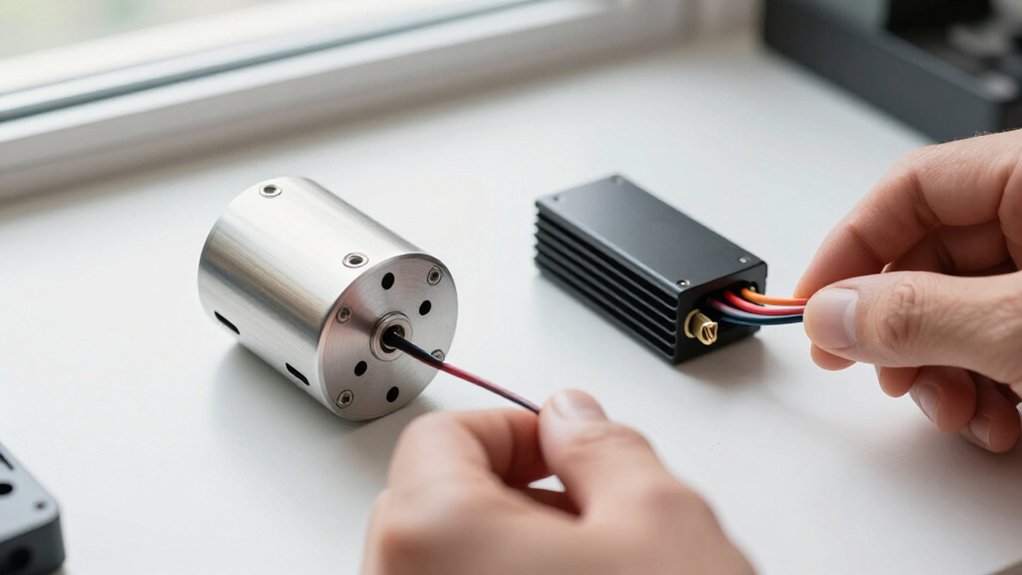
For a bench test, don’t connect a two-lead brushed motor directly to a brushless ESC’s three phase wires: its timed commutation isn’t designed for that hookup. Instead, connect the motor’s two leads to the output terminals of a brushed ESC rated for the motor and battery. Connect the battery to that ESC’s input with polarity observed, and keep the motor secured before applying power.
If you’re using a bench supply, connect its output to the motor only after setting the voltage within the motor’s rating and enabling a current limit. Increase the setting while monitoring current, temperature, and rotation. A brushless ESC is suitable only if its manufacturer explicitly supports brushed operation or firmware configures it for that mode; ordinary phase wiring won’t suffice.
SimonK Firmware Conversion Options
SimonK firmware alone won’t make your brushless ESC drive a brushed motor; the dual-motor conversion instead targets specific AM32-compatible ESCs. To use it, flash AM32 first, then install the project’s custom firmware for a listed ESC model. Check the repository and hardware specifications before flashing, since compatibility and configuration depend on your ESC and motor setup.
Conversion Feasibility
Although firmware can make some brushless ESCs usable with brushed motors, a standard brushless ESC isn’t automatically compatible.
You need both suitable hardware and firmware support for a conversion. One option uses custom firmware for certain AM32-compatible ESCs; it isn’t a SimonK conversion. Check the compatibility list first. In this arrangement, two brushed motors connect to the ESC’s three phase outputs, sharing the middle wire. The ESC’s half-bridges control the motors independently. This applies only to supported setups, not every ESC or motor pairing.
Configuration options depend on the ESC and installation. You shouldn’t assume SimonK-based firmware supports your hardware, or copy a wiring scheme without verification. An unsupported combination or incorrect connection can damage equipment.
Firmware Flashing Steps
Once you’ve confirmed the ESC hardware supports your intended motor setup, choose firmware for that exact model. Check the firmware compatibility list against the ESC’s precise hardware revision; SimonK conversion applies only to supported models. Don’t infer compatibility from connector shape or product family, since controller chips and board layouts can differ. For a project built around AM32-compatible ESCs and custom firmware, first install the required AM32 version, then flash the project’s custom build.
Consult its repository for supported ESC models and model-specific programming instructions. Select configuration options only after matching them to your motor and wiring arrangement. This process doesn’t make a brushless ESC a general-purpose brushed controller: firmware, ESC hardware, and wiring must each support the intended configuration for that setup.
Safety And Limitations
Before attempting a SimonK conversion, verify that the exact ESC model and firmware explicitly support brushed operation: a standard brushless ESC’s three-phase outputs aren’t designed to drive a motor’s two leads, and an unsupported connection can damage the controller. Treat firmware conversion as model-specific, not universal. Don’t assume SimonK enables brushed control on every ESC; consult your model’s documentation.
The cited dual-motor project supports only listed AM32-compatible ESCs and requires AM32 installation before custom firmware flashing. It repurposes all three phase wires, with both brushed motors sharing the middle phase, a specialized scheme, not plug-and-play wiring. Check firmware instructions, connections, and motor-current limits before powering up. The method may perform poorly with larger motors; use a controller rated for your load and application carefully.
Motor Pole Count
You may compare pole counts, but that difference doesn’t determine whether a brushed motor works with a brushless ESC. Brushless motors use phase commutation, while brushed motors switch current mechanically through brushes and a commutator. Check both devices’ specifications; use a controller explicitly rated for brushed operation.
Pole Count Differences
Because brushless motors use multiple magnetic poles, a brushless ESC must match its phase switching to the rotor’s position and pole pattern. That requirement differs from a brushed setup: you don’t provide an ESC with a pole sequence to track, because brushes and a commutator switch motor current mechanically.
Pole count determines how many electrical cycles occur during mechanical revolution, so it affects brushless ESC timing settings and the relationship between electrical RPM and speed.
Don’t treat the difference as a compatibility setting for a brushed motor. Its pole count won’t make a brushless ESC operate; the decisive factor is whether the ESC supports a brushed drive mode. If it doesn’t, changing timing or entering a pole value can’t replace drive-mode support.
Brushless Motor Poles
A brushless motor’s pole count is the number of magnetic poles on its rotating rotor, including both north and south poles. Don’t confuse this value with the stator winding count or the motor’s three wires; neither indicates rotor poles. At a given electrical commutation frequency, a higher pole count produces lower mechanical RPM, while a lower count produces higher RPM.
When you configure RPM-dependent functions, this relationship affects speed estimates. Some ESCs use pole count to estimate motor RPM, so enter the count specified by the motor manufacturer when setting up telemetry or RPM-based controls. You can’t infer a count from the information: check the motor’s datasheet or manufacturer documentation. Use the documented value rather than assuming it from the motor’s appearance or wiring.
Brushed Motor Poles
For a brushed DC motor, pole count describes its magnetic poles—not its wires—and usually isn’t a setup value for a brushed ESC. You generally won’t enter this count when configuring a controller for a brushed motor. Its brushes and commutator switch current mechanically, determining how the motor runs without electronic commutation from the ESC.
A brushless ESC works differently: it electronically commutates a brushless motor, and its pole-count setting may help estimate or display RPM. Electrical commutation speed differs from mechanical rotation speed according to the motor’s pole-pair count. That setting doesn’t change the ESC’s operating method or make it compatible with a brushed motor. If you’re replacing a brushed system, choose an ESC explicitly rated for brushed motors. Check its voltage and current limits against your motor and battery; don’t rely on pole-count settings to establish compatibility.
Dual-Motor Robot Applications
With compatible hardware and custom firmware, you can use one brushless ESC to control two brushed motors independently in a combat robot, but a standard ESC won’t do this by itself. In this arrangement, connect each motor to a separate phase wire and use the third, shared wire as a midpoint held at half voltage. For independent drive, install AM32 firmware on a supported ESC, then flash the project’s custom firmware; verify the exact model in the project repository before you begin. The midpoint half-bridge sources or sinks current during PWM switching, helping prevent one motor’s torque from disturbing the other.
Synchronized PWM outputs likely matter because both channels depend on that shared node. This isn’t a universal brushless-ESC feature, and the method may be unsuitable for larger motors. VESC can drive brushed motors, but it doesn’t offer this same tandem configuration. Confirm wiring and firmware support before applying power to your robot’s drive system.
ESC Thermal Overload
When a brushed motor draws current through a brushless-only ESC, the controller’s power transistors can overheat because they aren’t designed for that load.
Excess current raises transistor temperature and can damage the ESC or cause it to smoke. If your controller becomes unusually hot, stop using the setup; continued operation can accelerate failure. A LiPo battery doesn’t prevent this overload. It can deliver enough current to make an ESC failure a fire hazard, so don’t treat the battery type as protection.
For reliable operation, match the controller to the motor. Use a brushed ESC, or a documented dual-purpose controller configured for brushed operation. Check its current and thermal ratings against the motor’s demands and your operating conditions. Staying within both limits reduces overload risk.
Reversed Battery Polarity
Reversing the battery leads won’t make a brushless ESC compatible with a brushed motor; the ESC’s three-phase output isn’t the DC supply the motor requires. Changing polarity at the battery input won’t convert the ESC’s switching pattern; it can instead damage input components and create heat or fire. Keep the battery’s positive and negative leads carefully aligned with their marked terminals. Before you power a modified setup, verify the wiring diagram and polarity instructions, and choose a controller explicitly rated for your motor type.
- Picture reversed battery leads feeding current into vulnerable input components.
- Imagine heat building inside the ESC, with smoke or flame as possible consequences.
- To reverse a brushed motor’s rotation, swap its two motor leads only with a compatible brushed ESC.
Match the Motor’s Current Rating
Size the ESC for the brushed motor’s expected current at your planned battery voltage, including stall current, which can far exceed running current. Compare the motor’s current with the ESC’s continuous and burst ratings; normal running current doesn’t define peak load.
Leave headroom above peak current to reduce overheating and shutdown risk, and confirm your battery and wiring can handle it. For two motors, size the controller for their combined current unless documentation specifies separate per-motor limits.
Current capacity alone doesn’t establish compatibility: a brushless-only ESC may not commutate a brushed motor, even if its amp rating is adequate. Choose a brushed-compatible or explicitly dual-mode ESC, and verify that its documentation lists brushed operation, battery voltage, and current limits. Don’t infer support from an amp rating.
Conclusion
You can run a brushed motor from a brushless ESC only after confirming the controller can commutate it correctly. A standard three-phase ESC generally won’t work without suitable firmware or circuit modification; wiring alone isn’t enough. Check motor pole count where relevant, verify polarity, and match the ESC’s current rating to the motor’s load. For dual-motor robots, test each channel separately. Monitor temperature during bench testing, since excessive current or poor commutation can overheat and damage components.