RC Buggy vs Short Course Truck: Handling, Speed and Durability
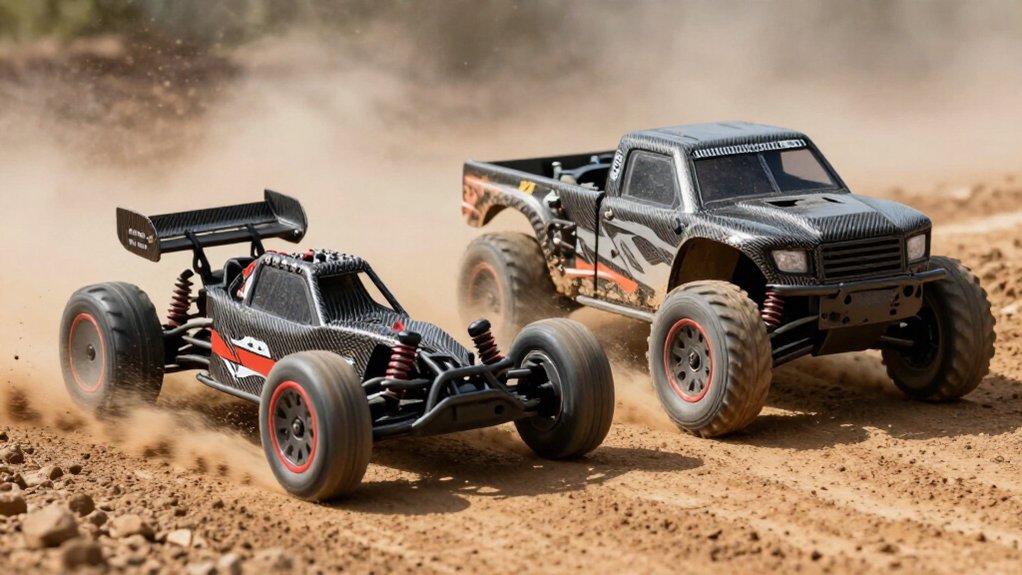
Choose a buggy for fastest response on smooth, technical hard-packed dirt: its low, light chassis turns sharply, holds tight apexes, and posts quicker laps through linked corners. Choose a short course truck (SCT) for gravel, grass, and uneven terrain; its wider stance, taller tyres, enclosed body, and longer travel improve control and impact tolerance.
Wheelbase, tyre choice, damping, gearing, battery capacity, and class rules determine which fits you. The sections below explain the key trade-offs.
Wheelbase, Ride Height, and Tyres
Wheelbase varies by model rather than vehicle class, so compare each buggy and short course truck’s published dimensions before drawing handling conclusions. For smooth tracks, you get precise buggy cornering from its lower ride height and low centre of gravity, yet obstacles can high-centre it. Choose pin tyres for hard-packed surfaces, mini-spikes for loose dirt, and step-pins when grip changes.
| Surface | Setup | Driver feeling |
|---|---|---|
| Hard-packed | Buggy pins | Sharp response |
| Loose dirt | Buggy mini-spikes | Calmer traction |
| Changing grip | Buggy step-pins | Reassured control |
| Gravel/light off-road | SCT | Planted stability |
On dirt and mixed surfaces, an SCT’s lower, wider stance than a monster truck helps you stay planted. Its lower clearance and shorter suspension travel restrict extreme-terrain use. Published dimensions and surface testing give you a defensible comparison.
Buggy Chassis and SCT Bodywork
A buggy uses a lightweight, narrow chassis and low centre of gravity to accelerate quickly, change direction sharply and hold tight lines on hard-packed dirt or purpose-built tracks. Its open, performance-focused layout lets you access chassis and suspension components easily, while geometry prioritises immediate steering response and controlled rotation.
Lap Times on Packed Dirt
Those chassis differences show up most clearly in lap times on packed dirt. You’ll usually gain time with a buggy on a smooth, technical layout: its lighter, lower-profile package changes direction rapidly and traces tight apexes with less correction. Your short course truck may give up some rotation, but its low center of gravity and planted stance keep high-speed cornering repeatable.
- Choose the buggy for rapid direction changes and compact corner sequences.
- Choose the truck when flowing turns reward stable, predictable line holding.
- Fit buggy pin tires designed for hard-packed surfaces.
- Select a compound that preserves grip without excessive wear.
Track geometry sets results: on smooth dirt, your buggy usually posts quicker laps; in open turns, your truck’s stable line can close gaps measurably.
Throttle Control on Loose Turns
On loose turns, throttle timing separates the buggy’s quick reactions from the short course truck’s more planted feel. Because a buggy is light and low-slung, its rear tires can spin immediately when you apply power. Ease into the throttle through the apex, then increase input progressively as steering unwinds. This sequence keeps the buggy on line and converts more motor output into forward drive.
A 2WD buggy demands the most discipline: rear-wheel drive and lower mass make traction breaks more abrupt than with a 4WD model. The truck’s wider stance and low center of gravity provide a platform, yet gravel still punishes abrupt acceleration. If either vehicle drifts wide, lift and use steering corrections. Don’t stab the throttle; wait until the front wheels straighten.
Track Width and Surface Match
Track width and surface condition should guide your vehicle choice before setup begins. On tight, technical lanes, a buggy’s narrow chassis reduces the space needed for direction changes, letting you place it precisely through linked corners. Its low profile works best on hard-packed dirt and smooth, purpose-built surfaces.
- Choose a buggy when lane width is limited and changes arrive quickly.
- Use its precise response to maintain clean apexes on compact, predictable dirt.
- Select a short course truck for wider dirt, gravel, and mixed-surface courses.
- Exploit its wider stance and lower center of gravity for controlled cornering stability.
On wider courses, you’ll benefit from its stability, but lower clearance limits rough, obstacle-filled terrain. Match track geometry and surface type before tuning grip for each platform.
Replacement Parts and Resale Value
Replacement-parts cost and local availability can shape the long-term value of either platform more than the initial purchase price. Before you choose, price the consumables and crash items you’re most likely to replace: tyres, suspension arms, hubs, shock parts, and body hardware. Short course trucks generally offer simpler, more affordable maintenance, which can reduce your cost per repair.
A buggy’s kit and common spares typically cost less than truggy-equivalent parts, but buggy tyres may wear rapidly, raising its recurring expense. Check whether your local hobby shop stocks each model’s parts, because online-only support can extend downtime and add shipping costs. For resale, don’t assume either class commands a premium: available evidence provides no comparative resale-price data. Document maintenance and retain spares to protect value.
Battery Run-Time and Heat Buildup
Beyond repair costs, battery setup and operating load determine how long either vehicle runs and how much heat it generates. You can’t predict runtime from buggy versus short course truck alone; capacity, gearing, terrain, and throttle input set current demand. A larger-capacity pack typically extends minutes, while a high-output brushless system can shorten them by drawing more amps.
- Use a 2S or 3S pack only when your electronics support that voltage.
- Confirm the pack fits securely in the battery compartment.
- Expect hard acceleration and rough terrain to raise motor and battery temperatures.
- Inspect both after each run, then let them cool before recharging or driving again.
Jumps increase workload, so monitor temperatures rather than assuming either chassis runs cooler. Driving pattern controls results overall.
Jump Landing Stability
When you land on uneven terrain, a buggy’s light, narrow chassis reacts quickly but demands precise throttle and suspension setup. A short course truck’s lower, wider stance and longer suspension travel typically absorb impacts better and reduce post-landing instability. For repeated large jumps on rough tracks, you’ll gain more landing margin from a monster-style truck than either platform.
Buggy Landing Behavior
A buggy’s low centre of gravity and light chassis let it react quickly in the air, but its narrower stance can make jump landings less stable on rutted or uneven dirt than those of a short course truck. On approach, you manage pitch with throttle and brake inputs, then aim for a level, straight touchdown.
The compact layout changes direction rapidly, yet rough surfaces can unload one side and amplify roll. Shorter suspension arms reduce leverage during impacts, which may limit crash loads, but they don’t eliminate driver error.
- Keep throttle neutral near touchdown to avoid pitching forward.
- Land with wheels aligned; steering angle can trigger rollovers.
- Expect less margin when ruts contact one wheel first.
- No test figures establish a precise stability gap here.
Short Course Stability
Short course trucks generally deliver more stable jump landings than buggies because their lower, wider stance keeps the chassis planted and makes pitch and roll responses more predictable. That geometry lowers your truck’s center of gravity, so it resists lateral upset and settles with less correction after touchdown. Compared with a buggy’s agile, performance-focused response, you get more repeatable results on dirt tracks and relatively smooth layouts.
The tradeoff is suspension capacity: shorter travel and lower ground clearance increase bottoming risk when jump faces, landing slopes, or impacts exceed available stroke. Match each jump’s height and distance to suspension travel, then use controlled throttle and braking to manage attitude. Don’t treat inherent stability as protection against a poorly timed, nose-down landing at any speed.
Backyard Bashing Versus Club Racing
For backyard bashing on grass, gravel, and uneven terrain, you’ll benefit from a short course truck’s wider stance, higher clearance, and enclosed electronics. On hard-packed club tracks, a buggy’s lighter, lower-profile chassis delivers faster acceleration, sharper steering, and more precise cornering. Choose a short course truck for mixed-surface durability and predictable stability, or choose a buggy if you prioritize lap-time-focused racing.
Backyard Bashing Priorities
Where you drive should determine the platform: a short course truck’s higher ride height, larger tires, and enclosed body handle grass, rocks, and uneven backyard obstacles with fewer high-centering incidents than a low-profile buggy. For bashing, prioritize clearance, impact tolerance, and controllability over outright lap-speed potential.
- Choose taller tires to roll across roots and loose stones.
- Use the enclosed body to shield chassis components from debris.
- Expect steadier landings when jumps aren’t consistently groomed.
- Accept slower direction changes in exchange for a wider stability margin.
A buggy’s lower center of gravity and sharper steering can feel quicker on hard-packed dirt, but rough terrain exposes its limited clearance. If runs include impacts, select the truck: its forgiving geometry reduces precision demands and keeps sessions productive.
Club Racing Demands
Club racing shifts the comparison from obstacle clearance to lap-time control: on hard-packed dirt and purpose-built tracks, a buggy’s low stance, light weight, and precise steering typically deliver faster direction changes and tighter cornering. You can exploit that agility through chicanes and tight infields, where reduced roll and yaw response help preserve entry speed.
A short course truck trades some rotational quickness for a lower center of gravity and a wider footprint, giving you predictable grip and stability through faster dirt-track sweepers. On rutted, bumpy sections, its longer suspension travel absorbs impacts. Compare lap consistency: the buggy often gains time on technical layouts, while the truck can maintain control when uneven surfaces disrupt lighter, lower vehicles. Tire choice, damping, and track conditions determine margins.
Choosing By Driving Style
Your driving style should determine the choice: pick a short course truck for backyard bashing across grass, loose dirt, and obstacles, since its wide, stable chassis and enclosed body make impacts and debris less disruptive. It remains more forgiving than a buggy on uneven terrain, although its clearance still trails a monster truck’s.
- Race short course on mixed dirt when you value predictable weight transfer and electronics protection.
- Pick a buggy for hard-packed layouts demanding rapid turn-in and tight apexes.
- Match wheelbase and class rules to your club’s surface and permitted category.
- Expect the buggy’s low chassis to high-centre when obstacles exceed its practical clearance.
That comparison lets you trade forgiveness for precision using track conditions, obstacle height, and rules as measurable decision inputs.
Match Your Local Track Class
Start by checking the classes your local track actually schedules, because its rules determine whether a buggy or short course truck can race. A faster vehicle is irrelevant if no heat exists. Ask racers or staff whether 2WD buggy, 4WD buggy, or short course is supported, then verify approved tire compounds and tread patterns. For tight, technical layouts, choose a buggy: its lighter, narrower chassis and lower centre of gravity deliver quicker rotation and more precise line changes.
On dirt or mixed surfaces, choose a short course truck: its wider, lower stance produces steadier, more predictable weight transfers. Before buying, confirm parts stock and setup rules. Buggy classes often reward suspension, differential, and tire tuning, so they can require more time and skill than truck racing.
Conclusion
Choose a buggy when your track is packed, smooth, and technical: its lower ride height, narrower body, and lighter rotating mass usually deliver quicker lap times, cleaner turn-in, and lower heat. Choose a short course truck when loose soil, ruts, and imperfect landings dominate: wider tyres, higher clearance, and protected wheels improve stability and durability.
For backyard bashing, SCTs absorb mistakes better. For club racing, match wheelbase, tyre rules, and the largest local class available.
RC Truck Scale Size Converter
Convert a real truck's length, width and height to any RC scale from 1/6 to 1/24, or find the scale implied by a model's length.
Tire Swap Speed & Gearing Compensator
Enter motor KV, cells, gearing and old vs new tire diameter to see the theoretical no-load speed change and rollout from a tire swap.
Basher Motor, ESC & LiPo S-Count Matcher
Compare your motor kV, ESC max S and LiPo cell count from your own spec sheets and see the theoretical no-load RPM (kV × S × 3.7).