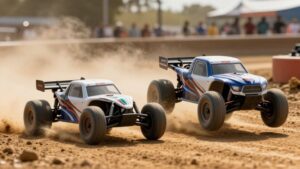
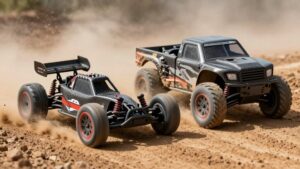
Types of RC Racing Classes: Buggy, Truck, Touring and Oval
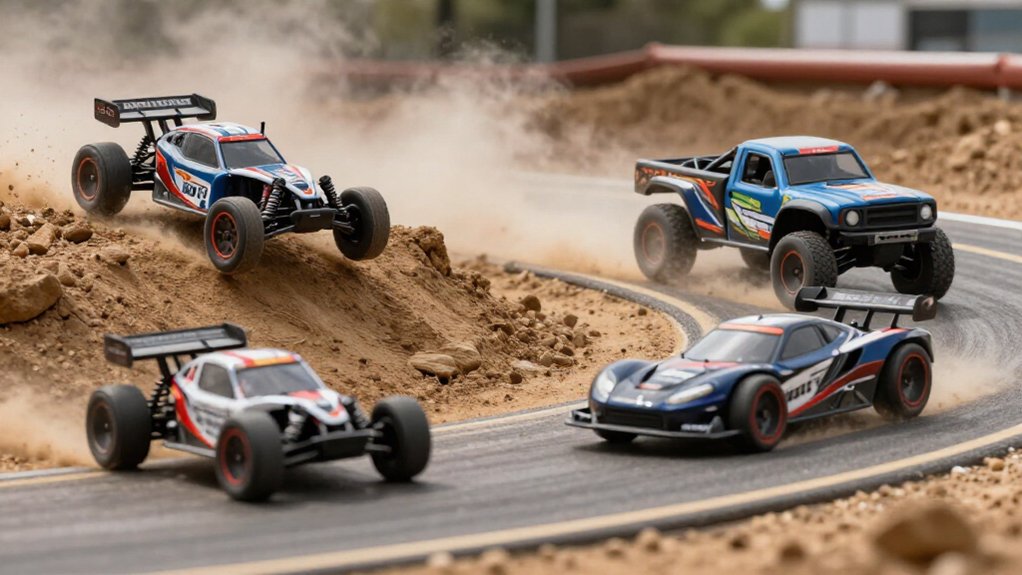
You’ll find RC racing classes for nearly every skill level and vehicle type. Choose 2WD buggy or stadium truck for a simpler start, or move to 4WD buggy, short-course truck, and 1/8-scale nitro classes for more demanding competition.
Touring offers 4WD electric sedans, while GT12 and F1 provide other on-road options. Oval racing includes classes such as Legends, MudBoss, and 17.5 Car. You’ll need to check local rules, since motors, batteries, and vehicle requirements vary by class.
Named Race-Class Categories
RC racing classes are organized by vehicle type, motor rules, and skill level. You can choose buggy classes from beginner-friendly 21.5T 2WD to modified 2WD and 4WD, with 1/8-scale electric or nitro options for advanced racing. Truck choices include Stadium Truck, Short Course Truck, Pro-2, Pro-4, and 1/8 Truggy; depending on the class, stock or open motor rules apply.
For touring, you can enter VTA, Stock Touring, or Modified Touring. VTA uses a fixed-timing 25.5T motor, while Stock Touring typically pairs a 17.5T motor with a blinky ESC. If you’re new, you may find Novice, Rookie, Vintage Buggy, Losi Mini, or Spec Short Course Truck classes accessible. Their eligibility and equipment rules vary by track, so check local requirements before selecting your vehicle.
Oval Weekly Classes
Oval racing offers several weekly classes, including RTT (13.5 rubber-tire truck), 17.5 Car, 21.5 Truck, Legends, MudBoss, Spec 10, and 1RC Wing Sprint 360. Your choice shapes chassis, power, battery, and setup rules you’ll follow.
| Class | Key requirements |
|---|---|
| RTT | 1/10 pan chassis; ROAR 13.5 motor, blinky ESC, 1S LiPo capped at 4.22 V, specified CRC Rubber GT tires. |
| 17.5 Car / 21.5 Truck | 1/10 pan chassis, blinky ESC, 1S LiPo capped at 4.22 V; 36 oz minimum. |
| Legends | RJSpeed kit, molded body; brushed or fixed-timing 21.5 brushless motor; 34 oz minimum. |
| MudBoss / Spec 10 | MudBoss: 17.5 spec, 2S LiPo capped at 5,200 mAh and 50C. Spec 10: 92-tooth spur, 46- or 47-tooth pinion, 4 mm minimum ride height. |
Stock Versus Open Classes
In Stock classes, you’ll use a specified motor and a ROAR-approved ESC in Blinky mode, while Open classes often allow a wider range of brushless motors. You’ll still need to follow class rules for batteries, chassis, minimum weight, and setup, since “Open” doesn’t mean every component is unrestricted. Compare local limits and your experience level when choosing a class, as motor rules and specifications vary by racing program.
Stock Class Limits
Although Stock and Open classes may use the same chassis and battery limits, their motor rules set them apart. In Stock, you typically need a specified ROAR-approved motor and an approved electronic speed controller (ESC) set to Blinky mode. That setting disables electronic timing and boost, keeping the motor within class rules.
For 1/10-scale 2WD buggy and stadium truck, the usual Stock choice is a 17.5T motor. Stock short-course truck (SCT) instead uses a ROAR-approved 13.5T motor with Blinky ESC. Check the class rules before racing, since vehicle types can differ too: Stock Stadium Truck is 2WD and excludes SCT. Battery limits often remain consistent between versions, commonly allowing six-cell NiMH or 2S hard-case LiPo packs. These limits define the equipment you may run.
Open Class Freedom
While Stock classes cap motor output and require a ROAR-approved ESC in Blinky mode, Open classes give you more brushless motor choices, generally 13.5T or faster in 2WD buggy and stadium truck, and 10.5T or faster in 4WD buggy. That flexibility can change how you build and tune your car, but “Open” doesn’t mean every rule disappears.
In 2WD short-course truck, Stock uses a 13.5T spec motor, while Open Pro 2 permits any brushless motor, generally 10.5T or faster. The 4WD 13.5T Buggy class pairs a spec motor with Blinky operation; Open 4WD Buggy removes that motor restriction. You may need to follow requirements for chassis type, tires, body, and minimum weight. Check the event rulebook, because rules can define setups differently.
Motor And Battery Rules
Stock and Open classes differ most in motor limits, ESC settings, and permitted batteries. In stock classes, you’ll need a specified ROAR-approved motor, such as 17.5T in stock 2WD buggy or 13.5T in stock SCT, plus a ROAR-approved ESC set to “Blinky,” with timing and boost disabled. In open 2WD buggy, you can run brushless motors of 13.5T or lower; open 4WD buggy often allows 10.5T or lower. Yet “open” doesn’t mean unlimited: open 4WD SCT may restrict you to 540- or 550-based brushless motors.
Many off-road classes let you choose 2S hard-case LiPo or six-cell NiMH; some require ROAR-approved packs. Oval rules can be tighter: RTT and 17.5 Car may cap 1S LiPo at 4.22 volts, while Traxxas Modified may limit 2S LiPo to 5,200 mAh and 50C. Check your class rules before selecting a motor or battery.
Chassis And Setup
Chassis freedom depends on the class, not just the motor rules. In Stock Buggy, you pair a ROAR-approved 17.5T motor with a ROAR-approved ESC in Blinky mode; Open 2WD Buggy permits brushless motors, 13.5T or lower. Open 4WD allows 1/10 4WD buggy chassis and motors, while 13.5 4WD requires a ROAR-approved 13.5T motor and Blinky ESC.
For Stadium Truck, both use 2WD chassis, but Stock specifies a 17.5T motor and Blinky ESC; Open allows modified brushless motors, 13.5T or lower.
Oval rules restrict chassis and setup. Spec 10 permits only RJ Speed Spec 10 or TK Racing Godfather chassis, with a fixed 92-tooth spur and 46- or 47-tooth pinion. MudBoss requires Traxxas 2WD plastic shocks and specified springs; it permits any pinion with listed spur gears and bans added weight.
Skill And Experience
Motor and ESC limits shape not only a car’s performance but also the kind of competition you can expect. In Stock Buggy, you’ll race with a ROAR-approved 17.5T motor and a Blinky-only ESC, keeping equipment specifications controlled. Open classes allow modified motors; Open 2WD Buggy generally permits brushless motors rated 13.5T or lower, which can raise performance demands.
These labels don’t measure your ability by themselves. Stock Stadium Truck, for example, may still be classified as intermediate or advanced, while 1/8 Electric Buggy targets advanced or expert racers. If you’re new, a Novice class can help you build skills before entering more competitive divisions. Race formats also depend on turnout: with fewer than five entries, organizers may combine Open 4WD Buggy with Mini Truggy.
Choosing Your Class
Which class fits your goals depends on how much equipment freedom you want. Stock limits power to specified motors, including 17.5T in Stock Buggy or 13.5T in Stock SCT. It typically requires a ROAR-approved ESC in “Blinky” mode, with timing disabled. Rules can also specify batteries, bodies, tires, and minimum weights; Stock Buggy requires 2S hard-case LiPo or 6-cell NiMH and weighs at least 1,500 g.
Open classes allow modified brushless motors; 2WD Buggy permits 13.5T and lower, while 4WD Buggy permits 10.5T and lower. Yet Open 2WD SCT requires 2S hard-case LiPo or 6-cell NiMH, an SCT body, and a 2,098 g minimum. Choose Stock for tighter, more uniform limits, or Open for broader motor choices if you can handle a faster modified setup.
Rookie and Novice Fit
Rookie classes give you an entry-level format, while Novice classes let you build skills under beginner-focused rules. Check each class’s vehicle and motor limits, since Rookie requirements can vary by track and indoor or outdoor format. Choose the class that matches your experience and equipment, and ask the Race Director whether you should move up as your control improves.
Beginner Class Differences
If you’re new to RC racing, Rookie and Novice classes offer different ways to learn before moving into more competitive racing.
Rookie sets entry-level vehicle rules. Indoors, you’ll use a 1/10-scale, 2WD electric off-road car; tracks discourage 4WD. Allowed power may include a 27T brushed motor, a 17.5T to 21.5T brushless motor, or your car’s RTR system, with 6-cell NiMH or 2S hard-case LiPo batteries.
Outdoor Rookie accommodates 1/8-scale nitro or electric off-road vehicles and 4WD short-course trucks. Trucks use 2S batteries, while eBuggies and eTruggies use 3S or 4S.
Novice can offer flexibility, but rules depend on the track. Some call it “run what you brung,” within vehicle and battery limits. For example, one track caps electric vehicles at 1/10 scale, with brushless motors 17.5T or slower or brushed motors 12T or slower. A race director may advance you as your skills improve.
Rookie Race Basics
For your first races, Rookie classes provide a structured entry point, while Novice classes let you build driving skills before moving into more competitive divisions.
For indoor 1/10 off-road Rookie racing, choose a 2WD electric vehicle; organizers strongly discourage 4WD. You can run a 27T brushed motor, a 17.5T to 21.5T brushless motor, or your vehicle’s original RTR power system. Use a 6-cell NiMH or 2S hard-case LiPo battery. These rules don’t set a minimum vehicle weight, so you needn’t add ballast solely to meet one.
Outdoor 1/8 Rookie races accept nitro or electric off-road vehicles and 4WD short-course trucks. Battery requirements depend on vehicle type, so check your event’s rules early before choosing a setup and confirm your vehicle meets class specifications for your entry.
Novice Skill Progression
Choose Rookie racing when you’re new to organized competition, then consider Novice as you gain control and confidence. Indoor 1/10 Rookie races suit 2WD cars with 17.5T to 21.5T brushless, 27T brushed, or original RTR power systems. Outdoor 1/8 Rookie may accept nitro or electric off-road vehicles and 4WD short-course trucks; rules vary by type.
Once you can steer consistently, manage speed, and complete heats safely, Novice can give you room to develop without pressure from competition. Electric off-road Novice covers vehicles up to 1/10 scale, with 17.5T-or-slower brushless or 12T-or-slower brushed motors; a race director may move you onward as your ability improves. Some programs cap Novice at 2S LiPo; dirt oval racers should have control and can ask the race-day contact for guidance.
Choosing Your Starting Class
Your starting class should match your experience and equipment: Rookie suits new racers, while Novice gives beginners room to build skills before moving into more competitive classes.
Indoor 1/10 Rookie permits 2WD electric off-road cars: use a 27T brushed motor, 17.5T to 21.5T brushless motor, or your RTR’s original system, with a 6-cell NiMH or 2S hard-case LiPo. Tracks strongly discourage 4WD in this class. Outdoor 1/8 Rookie accepts any 1/8 nitro or electric off-road vehicle and 4WD short-course trucks; nitro engines must use RTR pull-start or roto-start.
Novice allows electric vehicles up to 1/10 scale, with 17.5T-or-slower brushless or 12T-or-slower brushed motors and a 2S LiPo or 6- or 7-cell NiMH battery. A race director may advance you when appropriate, as your skills improve overall.
Choose 2WD or 4WD
Which drivetrain suits you depends on the class and how much complexity you want: 2WD buggies offer a simpler entry point and are generally aimed at beginner-to-intermediate racers, while 4WD buggies tend to suit intermediate or advanced racers.
In 1/10 off-road buggy racing, these are separate divisions, so check the rules before buying: Open 2WD Buggy generally permits modified motors of 13.5T and lower, while Open 4WD Buggy generally allows 10.5T and lower. Truck classes also define drivetrain. Stadium Truck and 2WD SCT use two-wheel drive, whereas Open 4WD SCT and Pro 4WD SCT require four-wheel drive. If you’re comparing SCT options, note the minimum weight: 2WD SCT is 2098 g, versus 2505 g for 4WD SCT. Check your chosen class’s rules before selecting a chassis.
Touring, GT12, and F1
Touring, GT12, and F1 offer distinct on-road racing options, but their specifications vary by class.
You can choose Touring for a 1/10-scale 4WD electric sedan class, with 190 mm bodies. In stock competition, you use a ROAR-approved spec motor and set the ESC to “Blinky” mode. Rules commonly separate motor limits, including 17.5T, 21.5T, or 25.5T. They also cap 2S LiPo batteries at 8.40 V and set minimum vehicle weights near 1,320 g.
GT12 uses a 1/12-scale, 2WD pan-car format and a fixed-timing 21.5T Gravity USGT motor. That gives you a setup from Touring with different scale and drivetrain.
F1 is another on-road option.
eBuggy Lite and GT12
eBuggy Lite and GT-12 cover very different formats: Lite is an expert 1/8-scale 4WD off-road class, while GT-12 is a 1/12-scale 2WD electric pan-car class. Choose Lite for an off-road buggy or converted 4WD short-course truck.
You must use a 540- or 550-based motor no longer than 73 mm and no wider than 36 mm; full-size 1/8-scale motors aren’t allowed. You can run a hard-case 2S, 3S, or 4S LiPo, subject to KV ceilings of 4,800, 2,700, or 2,000 respectively. Your car must weigh no more than 3,200 g. GT-12 specifies a Gravity USGT 21.5T fixed-timing motor, part GRC2.
Nitro Buggy and Truggy
Nitro buggy and truggy are 4WD, 1/8-scale off-road classes, but they differ in chassis, engine limits, and weight. Choose between them by matching your experience, preferred vehicle shape, and class rules.
- For buggy, you’ll use a buggy chassis, body, and intended 1/8 buggy rubber tires. This class suits advanced or expert racers; open engines can reach .21, while stock RTR engines must use pull-start or roto-start. Minimum weight is 3,200 g.
- For truggy, you’ll use intended 1/8 truggy rubber tires and a truggy body. It’s aimed at intermediate and advanced racers. Open engines can reach .28, and the truck must weigh at least 4,000 g but no more than 13 lb 6 oz.
- Check local class rules before entering, since limits define legal race-ready builds. These minimums keep specifications comparable while preserving handling and power characteristics.
Conclusion
Choose your RC racing class by matching its format, speed, and rules to your experience and interests. Oval, touring, GT12, and F1 offer distinct track styles, while buggy and truggy classes vary by drivetrain and power. Stock, open, rookie, and novice categories help you find a suitable level of competition. Check your local club’s class options and regulations before buying a vehicle, so you can race with equipment that fits.
RC Truck Scale Size Converter
Convert a real truck's length, width and height to any RC scale from 1/6 to 1/24, or find the scale implied by a model's length.
Basher Motor, ESC & LiPo S-Count Matcher
Compare your motor kV, ESC max S and LiPo cell count from your own spec sheets and see the theoretical no-load RPM (kV × S × 3.7).