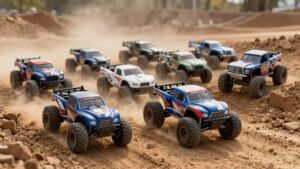
RC Monster Truck vs Truggy: Which Is Better for Backyard Bashing?
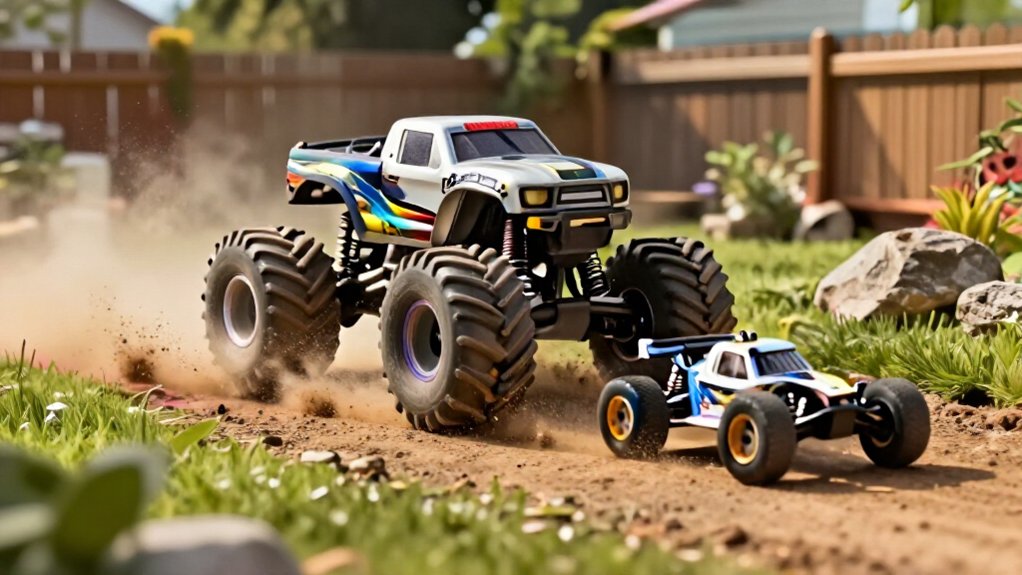
Choose a monster truck if your backyard has tall grass, roots, ruts, and rough landings: its larger tyres, greater clearance, and longer suspension travel keep it moving.
Choose a truggy for short grass, gravel, or compact dirt, where its lower, wider chassis gives you quicker, steadier turns and usually more speed. Neither class is rollover-proof, so compare actual dimensions, tyres, and steering.
The details below help you match the vehicle to your available backyard space.
Chassis Width and Rollover Resistance
A truggy generally resists rollovers better because its wider chassis and lower center of gravity keep it more planted during fast turns and off-camber backyard runs. You’ll notice that layout provides a broader support area across mixed terrain. A monster truck’s taller stance and greater ground clearance suit obstacles, but its higher center of gravity can tip it more readily in sharp direction changes. Still, neither design is rollover-proof: model-specific width, weight distribution, and setup determine the outcome.
| Vehicle | Chassis width | Cornering result |
|---|---|---|
| Truggy | Typically wider | More planted |
| Monster truck | Often narrower relative to height | More tip-prone |
| Either | Model dependent | Compare specifications |
For backyard use, compare width, overall height, and weight placement carefully. Balanced geometry helps you corner confidently, but abrupt steering can trigger rolls.
Suspension Travel and Tyre Size
Monster trucks usually provide longer suspension travel and much larger tyres, so they absorb hard impacts and maintain momentum across grass, rocks, roots, and uneven backyard ground. Their extra clearance lets you drive over obstacles that could snag a lower chassis, making them the more forgiving choice for rutted or unmown surfaces. Truggies improve on buggies: their larger tyres and increased clearance smooth out bumps and handle rough lawns well.
However, a truggy’s tyre size and suspension travel usually remain more limited than a monster truck’s. If you fit especially large tyres to a truggy, you can place added load on its driveshafts and differentials, and replacements may cost more. Compare stated tyre diameter, ground clearance, and suspension travel between models, since dimensions vary.
Top Speed and Acceleration
On smooth ground, truggies generally reach higher speeds than monster trucks because they combine lighter, lower-slung builds with more speed-oriented handling.
You’ll usually notice their quicker responses to throttle and steering, aided by lower weight and an agile chassis. Monster trucks instead emphasize torque: large motors and gearing help you climb hills, cross obstacles, and build speed for jumps.
Their heavier construction and oversized tyres commonly reduce speed, especially on open surfaces. Still, neither category guarantees a result. A truggy’s larger wheels add load to its drivetrain, affecting both launch acceleration and top speed. Motor choice, battery power, gearing, tyre diameter, and setup can reverse expectations between models. Before buying, compare each vehicle’s specifications and data rather than relying solely on category labels alone.
Jump Recovery and Throttle Control
For jump recovery, monster trucks use high ground clearance and long-travel suspension to absorb rough landings and continue over backyard bumps, while truggies rely on a wider, more planted stance that can feel steadier when they touch down on uneven ground. Neither design guarantees a cleaner recovery: your suspension setup, tyre choice, approach speed, and landing surface strongly affect the result. In the air, use smooth, gradual throttle changes to adjust pitch instead of making abrupt inputs.
As the vehicle lands, ease off the throttle so the chassis can settle without excessive bounce or a sudden loss of direction. Then feed power in progressively rather than flooring it. This particularly important on loose dirt, where instant torque can spin tyres and disrupt your line.
Grass Height and Surface Choice
Your backyard’s surface should guide the choice: a monster truck’s large tyres and high ground clearance cope best with tall grass, ruts, and uneven ground, while a truggy performs more effectively on short-cut grass, gravel, and firmer mixed surfaces.
If your lawn grows quickly or contains holes, tufts, and soft patches, the monster truck maintains momentum with less chassis contact. Its taller stance lets you cross rough sections that can drag beneath a truggy. A truggy still offers more clearance and larger wheels than a buggy, so it isn’t limited to smooth terrain. However, it works best where grass is closely mown and generally firm ground. On compact dirt, its planted balance gives you steadier cornering than a bouncier monster truck. Choose for your roughest surface.
Replacement Tyre Prices
Replacement tyres can shift the long-term cost difference between a monster truck and a truggy. Monster-truck tyres are usually larger, so their replacements may cost more. However, truggy tyres exceed buggy tyre dimensions in both width and size, which can also make them expensive.
- Check exact tyre size, fitment, and model before you budget.
- Compare individual tyre pricing with the cost of a complete set.
- Expect brand choice, compound, and availability to affect what you’ll pay.
If you bash frequently, replacement costs can matter more than the purchase price. A monster truck may carry a higher per-tyre bill, while a truggy’s wider tyres can narrow that gap in practice rather than assuming either platform is automatically cheaper to maintain through a season of regular use.
Battery Runtime Under Load
Battery runtime under load depends far more on pack capacity, voltage, condition, terrain, and driving style than on whether you choose a monster truck or truggy. Your actual run time changes most with how you use the vehicle. Repeated full-throttle launches, steep climbs, and heavy acceleration pull higher current than steady driving, shortening the pack’s useful runtime.
A monster truck’s large tyres, heavier build, and torque-focused setup can demand substantial power during hard bashing. A truggy’s larger wheels can likewise add drivetrain load. Frequent jumps and landings also consume more energy because you accelerate again after each impact. For a valid comparison, test both models with the same battery under similar terrain, speed, and driving habits; you can’t assign runtime figures from layout alone.
Turning Radius and Steering
For tight backyard turns, you’ll usually find a truggy easier to place because its wide stance delivers steadier, more precise steering. A monster truck may need wider arcs, as its tall chassis and large tyres can make turn-in feel bouncier over uneven terrain. Neither type guarantees a smaller turning circle, so you should compare each model’s steering geometry and setup.
Turning Circle Requirements
Turning circle matters more than outright speed when you’re maneuvering a confined backyard with furniture, trees, and other obstacles. A truggy’s lower stance and planted handling usually make its path more predictable, whereas a monster truck’s tall stance and large tyres can feel less precise in tight turns. Neither type automatically delivers a smaller circle; geometry, wheelbase, steering throw, and setup determine it.
- Check the published turning circle or test each model slowly before buying.
- Set steering trim and endpoints for straight tracking without binding.
- Confirm monster-truck tyre clearance at full lock; excess throw can cause rub or strain the servo.
Measure the space you actually have: a wide circle forces more reversing around obstacles, regardless of vehicle type, and substantially reduces usable space.
Steering Response on Terrain
Once you’re moving across uneven ground, steering response depends on how each chassis manages weight transfer and tyre contact. A truggy’s wider stance usually keeps it more planted, giving you predictable steering as it crosses ruts, loose soil, and small bumps. It typically changes direction with less body movement, so you can place it more confidently through corners.
A monster truck’s taller stance and oversized tyres create more bounce. Over bumps or in sharp turns, that movement can reduce precision and make inputs feel less direct. However, its high ground clearance and long-travel suspension help you maintain forward progress over obstacles that might unsettle a lower truggy. Don’t assume either class has a tighter turning radius: this depends on the model, geometry, and setup.
Body Protection Around Obstacles
You’ll find that a monster truck’s high body and clearance help its chassis and impact zones pass over rocks, roots, and ruts with less snagging. A truggy’s lower shell and underside sit closer to obstacles, so hard contact and bottom-outs become more likely on uneven ground. Neither uses the enclosed short-course body that offers added debris coverage, so you should consider exposed components around loose dirt and brush.
Body Shell Coverage
Monster trucks usually carry taller bodies that cover more of the chassis, but their high ride height can still leave lower components exposed while climbing logs, rocks, or uneven backyard obstacles. That coverage can help you keep dirt and small debris away from upper chassis areas, although it doesn’t seal the suspension or drivetrain. A tall monster-truck shell may also touch an obstacle during a large landing, so coverage doesn’t automatically mean less body damage. Compare shell fit before choosing carefully.
- Choose a securely mounted shell; loose mounts reduce coverage and can worsen cracking.
- Expect truggies’ lower, sleeker shells to leave wheel and suspension areas more open.
- Inspect your shell after obstacle runs; shape, material, and mounting determine damage more than vehicle category alone.
Impact Protection Zones
Around backyard obstacles, a monster truck’s large tyres and high clearance often let it roll over roots, rocks, and uneven ground without the chassis taking the hit. However, its tall body and exposed wheels can place panels and bumpers closer to direct contact when you pass beside objects. A truggy’s lower, wider stance may feel more planted alongside obstacles, yet its reduced clearance makes chassis scrapes more likely on raised edges or loose debris.
You shouldn’t assume either design protects impacts better overall. Bumper shape, body-mount flexibility, chassis layout, and model-specific build quality govern where loads travel and how effectively parts absorb them. Maintain clear space from people and property while bashing; even a well-protected RC vehicle can cause injury or damage in collision.
Obstacle Snag Resistance
Beyond absorbing impacts, each design’s shape affects how readily it catches on backyard obstacles. A monster truck usually resists chassis snags better because its high clearance and large tyres climb over roots, rocks, and uneven lawn. However, its tall, wide tyres can hook narrow gaps or sharp edges, while its body may brush branches and tight passages.
- Monster truck: prioritizes undercarriage clearance over low-profile access.
- Truggy: clears more than buggy, but its lower stance remains more exposed.
- Check clearance, tyre diameter, and body width before choosing.
You’ll find a truggy’s lower profile slips beneath branches that a monster truck contacts. For obstacle-heavy runs, compare dimensions rather than class labels: a wide body can catch where a layout passes, and clearance determines whether the chassis drags.
Choose for Your Backyard Size
Your backyard’s usable space should guide the choice: a truggy suits compact, smoother areas because its lower, planted stance supports quick turns and more predictable runs, while a monster truck needs more room for wide turns, big jumps, and its bouncier handling.
Measure the clear route rather than the property’s total footprint. If fences, trees, furniture, or garden beds shorten straightaways, choose the truggy; it changes direction faster and stays composed on firm ground. Pick the monster truck when you can create open lanes, dirt mounds, grassy sections, and landing room. Its large tyres and high clearance handle rough patches well, but they also demand recovery space after hops and slides.
For mixed yards, base your decision on the area you’ll drive, not corners.
Conclusion
For backyard bashing, choose a monster truck if you run on taller grass, loose dirt, rough ground, or around frequent obstacles. Its larger tyres, wider stance, and higher ground clearance improve rollover resistance and recovery. Choose a truggy if your yard has shorter grass, more open space, and room for higher speeds. It turns more precisely, accelerates harder, and feels more controlled on jumps. Match the vehicle’s width, battery load, and turning needs to your available space.