
What to Upgrade First on an RC Car for the Biggest Difference
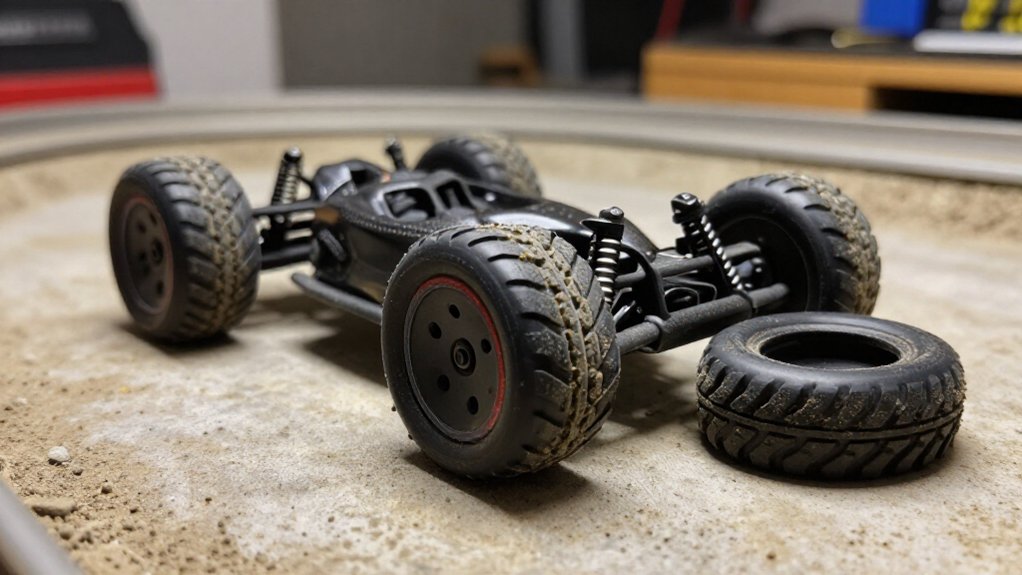
Start by finding the part that limits your car on its terrain. Upgrade tires first if it lacks grip; choose tread and rubber for dirt, grass, sand, or pavement.
If steering feels slow or inconsistent, check linkage and servo torque, gear material, fit, and endpoints. For longer sessions, add a compatible higher-capacity battery without raising voltage. If speed is the bottleneck, pair a compatible motor and ESC, then check gearing, fit, and temperatures. More guidance follows.
Tires for Better Grip
When your RC car struggles to accelerate, brake, or turn, tires are often the most noticeable first upgrade because they control traction across all three.
Match tread to your driving surface: deep or knobby tires suit dirt and gravel, taller treads grip grass, slicks suit pavement, and paddles work best in sand. Choose compounds for the surface: softer rubber generally grips hard-packed ground, while harder compounds suit carpet or heat.
For a 1/10-scale crawler, soft rubber and suitable foam inserts improve rock grip; beadlock wheels help keep tires seated under high torque. Before buying, check tire dimensions, wheel diameter, hex size, offset, and clearance. Confirm whether tires come mounted and include foam inserts, so you can select a compatible setup and get consistent traction and avoid fitment surprises.
Find Your Car’s Bottleneck
Once you’ve checked tire grip, run your RC car in stock form on the surfaces you usually drive and note its repeatable limitation: traction, steering, stability, speed, or reliability.
Identify one bottleneck before buying parts. More motor power won’t help if your tires can’t put it down or the chassis can’t control it. Match the fix to your driving: inspect tires and grip for bashing, assess steering and stability for crawling, and check handling or legal tire options for racing.
Look for component evidence, not guesses. Inconsistent steering centering, leaking shocks, or repeated drivetrain failures point to specific parts that may need attention. Confirm exact model compatibility and electronics limits before choosing a battery, servo, or motor upgrade. Retest under matching conditions to verify the fix.
Steering Response and Precision
If your RC car responds slowly, feels weak through the steering, won’t center consistently, or strips servo gears, upgrade the servo. A high-torque, metal-geared unit can sharpen steering precision and turn larger or stickier tires on rough terrain. Check dimensions, spline count, and horn fit before buying; match servo voltage to your ESC’s BEC and confirm it can supply the required current. After installation, set endpoints to stop binding, buzzing, overheating, and excess power draw.
| Check | Performance payoff |
|---|---|
| Servo torque | Turns larger tires with stronger steering force |
| Metal gears | Resist stripping under high steering loads |
| Fit | Match size, mounts, spline, and horn |
| BEC match | Confirm voltage and current capacity |
| Endpoints | Prevent binding, buzzing, heat, and excess draw |
You’ll feel cleaner, more predictable corner entry.
Prioritize Battery Runtime
Prioritize Battery Runtime
If short drive time limits your runs, add a second battery that matches your stock pack’s voltage, chemistry, connector, and dimensions. Choose higher capacity only if the pack fits the tray and stays within your ESC’s voltage and battery limits; a 2S pack isn’t automatically a safe 3S replacement. Before buying, check cell count and charger compatibility, and if you switch to LiPo, use compatible electronics, low-voltage protection, a balance charger, and storage mode for long breaks.
Assess Your Runtime Needs
How long do you need to drive between charges? Track your sessions and note when you stop. If interruptions are your main frustration, a second compatible pack can extend your drive time without changing the car’s power system.
Check that any pack matches your car and ESC for voltage, chemistry, connector, and fit; don’t assume a different voltage is a runtime-only change. Moving from 2S to 3S can raise speed and drivetrain stress, and your electronics must support it. If you use LiPo batteries, use an LiPo-compatible charger, follow safe charging practices, and confirm the ESC provides low-voltage protection. Also consider pack weight: extra mass can shift balance, reduce responsiveness, and alter handling. Choose runtime around your driving schedule, not just peak performance.
Choose Higher Capacity
When the stock battery runs out before you’re ready to stop, choose a compatible pack with higher capacity, measured in milliamp-hours (mAh), to extend runtime. Keep the original voltage and cell count to increase driving time without adding stress to the motor or drivetrain. Before you buy, check the connector, dimensions, weight, and compatibility with your car’s ESC and charger.
Higher-capacity packs can be larger or heavier, so confirm the battery fits securely and won’t shift weight balance or reduce handling. Secure the pack with the intended straps or tray supports, and leave enough clearance for the body and suspension movement. Compare capacity ratings rather than relying on size alone; a sensible upgrade should add runtime while preserving predictable performance. Monitor temperatures during runs and stop if the motor or electronics run unusually hot, for reliable comparison.
Match Battery Chemistry
For longer sessions, carry a second battery with the same compatible voltage and swap packs when one runs low. Choose chemistry around your electronics, not just runtime. A LiPo pack can deliver steady power and may provide more capacity than a stock NiMH pack, helping your car maintain punch as the run continues. But don’t install LiPo unless your ESC supports LiPo operation and has a suitable low-voltage cutoff; running cells too low can damage them.
Charge the pack with a balance charger designed for LiPo batteries and the pack’s cell count, so each cell stays within safe limits. When you won’t use it for a while, select storage mode rather than leaving it fully charged. Compare mAh ratings to estimate run time, then follow the car and battery makers’ limits. The right chemistry preserves performance safely without risking the pack or electronics.
Check Fit And Compatibility
To extend runtime with a second battery, match the original pack’s chemistry, cell count, voltage, connector, and dimensions. Verify the pack fits the chassis. Check its voltage and battery limits against your ESC’s specifications; exceeding either can damage electronics or trigger a cutoff.
Confirm your charger supports the pack’s chemistry and cell count. For LiPo batteries, use a LiPo-compatible balance charger and follow safe charging practices before charging. A higher-capacity pack can increase driving time, but choose one only if it fits and remains compatible.
Added size or weight can shift balance, slow acceleration, and change handling. Secure the battery firmly, then test steering, suspension travel, and body clearance before running. These checks help you gain runtime without sacrificing control or reliability.
Motor Upgrades for More Speed
For more speed, a brushless motor can boost acceleration, top speed, and efficiency over a brushed setup. Before upgrading, confirm your motor, ESC, and battery are compatible; never increase from 2S to 3S unless both motor and ESC support it.
Start with conservative gearing, monitor temperatures, and upgrade one component at a time to balance speed, heat, and reliability.
Brushless Versus Brushed
If you want more speed, a brushless motor usually delivers higher top speed, stronger acceleration, and better efficiency than a brushed motor.
A brushed setup costs less and delivers predictable power, so it’s a sensible choice when you’re learning or don’t need maximum performance. With brushless, you’ll typically need a compatible brushless ESC and suitable battery; check your car’s voltage limits before increasing power. A higher-voltage pack, such as moving from 2S to 3S LiPo, can raise speed only when both motor and ESC support it.
After upgrading, start with conservative gearing and monitor motor and ESC temperatures during runs. If temperatures climb, stop and let the system cool before continuing. This cautious approach helps reduce overheating risk and protects your drivetrain from damage.
Match Motor And ESC
A faster motor needs an ESC that can handle its power and your battery’s voltage.
Pair motor and ESC ratings before you install: an unmatched combination can overheat, cut out, or fail under load. A brushless motor-and-ESC combo gives you a matched route to stronger acceleration, higher speed, and better efficiency than many brushed setups. Confirm the system supports your battery’s voltage and cell count; don’t assume a 2S setup can safely run on 3S.
Then gear conservatively. Start with the manufacturer’s recommended pinion and spur combination, make short runs, and check motor and ESC temperatures before adding load or gearing. Higher voltage can raise speed, but it also stresses the power system and drivetrain, so reinforce weak supporting parts as needed. For crawling, choose a sensored brushless system for smoother low-speed throttle control rather than a speed-focused motor.
Check Battery Compatibility
Before fitting a faster motor or higher-voltage battery, verify that both the motor and ESC support the pack’s chemistry, cell count, and voltage. A 2S-compatible setup may not safely handle a 3S pack, so don’t assume a higher cell count will deliver a free speed gain.
Check the connector type and polarity before buying; a mismatched plug may require an adapter or soldering. Measure the battery bay and compare the pack’s dimensions and case style, since a secure fit matters for reliable driving. If you want longer sessions rather than more voltage, choose a compatible spare at stock voltage; it extends run time without increasing electrical demands.
LiPo packs can sharpen acceleration and power delivery, but use one only with a LiPo-compatible charger and ESC low-voltage protection. Confirm these details before your first run so the upgrade adds performance without risking damage to your electronics or pack.
Balance Speed And Heat
Once your battery and ESC can handle the load, a brushless motor can boost acceleration, top speed, and efficiency—but only when matched to a compatible brushless ESC. Before increasing power, confirm your ESC, battery voltage, gearing, and drivetrain can support the setup; a 2S system isn’t automatically safe on 3S. Start with conservative gearing, then make short runs and check motor and ESC temperatures.
More pinion teeth can raise top speed, but they also increase load and heat; fewer teeth reduce speed and favor acceleration. If temperatures climb, add an ESC fan or heatsink. Added torque may expose weak drivetrain parts, so upgrade components that fail rather than risk a breakdown. Tune one change at a time and recheck temperatures after each adjustment.
Match Motor Mount Dimensions
Choose a motor mount that matches your motor’s dimensions and your RC model’s exact version, since similar-looking motors can have different hole spacing or fit. Before ordering, measure hole spacing and compare it with the mount’s pattern; a mismatch can prevent installation. Check can diameter and length against mount and chassis to guarantee clearance from nearby components. Verify adjustment range positions the shaft correctly and allows pinion mesh.
Match shaft diameter to the pinion’s bore; the mount may fit even if the pinion won’t. Confirm the listing names your exact vehicle revision, since dimensions can vary between versions. Correct alignment keeps drivetrain engagement consistent and helps deliver power without binding or excess vibration. Recheck clearance after installation and rotate the drivetrain by hand before testing.
Budget for Gear Replacement
After confirming the motor mount fits, set a repair budget before changing motor power or gearing; repeated part swaps can add up quickly. Before increasing output, price replacement pinion, spur, transmission, and differential gears, then confirm you can actually source them. A brushless system or higher-voltage battery adds torque that can accelerate gear wear and raise failure risk, so include stronger drivetrain gears in the upgrade cost. Don’t spend the full budget on power; reserve funds for the parts that transfer it.
Change gearing one step at a time and evaluate the result. A larger pinion favors top speed, while a smaller pinion improves acceleration and can reduce drivetrain stress. Keep commonly broken gears and other likely replacements on hand if you bash regularly.
Check ESC Temperature Limits
Check your ESC’s rated temperature before pushing for more speed; limits vary by model, so use the manufacturer’s specifications rather than a universal cutoff. Use an infrared thermometer to check the ESC case after runs; internal components may be hotter than the surface. If the reading approaches the limit, stop and let it cool; repeated overheating can damage electronics. Recheck temperatures after changing gearing, motor, or battery, since load can push the ESC harder.
- Measure the case promptly after a run and compare it with your model’s limit.
- If temperature nears that limit, pause driving and allow the ESC to cool.
- If it still runs hot, reduce load or improve cooling; follow the maker’s fan-fitment and operating guidance.
Check Servo Gear Material
If your steering servo struggles under load, inspect its gear material: plastic gears can strip when larger, stickier tires or bound wheels put extra force on the steering, while metal gears generally handle demanding off-road use better.
Check specs or inspect it to confirm the gear type before upgrading. Match the replacement’s torque to your vehicle, and verify that its case fits the mount and its output arm works with the steering linkage. Use this quick check:
- Choose metal gears for rough terrain, but don’t treat material as a substitute for adequate torque.
- Check steering travel and linkage for obstruction before powering up.
- After installation, set endpoints so wheels reach full steering without binding; this limits heat and excess current draw.
Conclusion
Start with the upgrade that removes your car’s biggest limitation, not the part that promises the most speed. Fit tires to your surface, then improve steering precision and battery runtime if grip or control fades first. When you add motor power, verify mount fit, budget for gears, and keep the ESC within its temperature limits.
Check servo gear material before increasing steering load. Test one change at a time, measure results, and keep the setup.
